

Did he know, or did he not know? That was the question dominating Israel’s political debate this week. And if he did know, when did he know? Did Prime Minister Benjamin Netanyahu understand what was happening inside his own office, at the very center of government, which after a recent investigative television series now appears less like a seat of power and more like a place where norms collapsed entirely.
And if he did not know, why, once information became public, did he not clearly condemn what happened, distance himself from those involved, dismiss them, or demand an immediate investigation by Israel’s internal security agency? Why, even now, does the public not know Netanyahu’s position, when his advisers remain on the payroll, and when he and his closest aide share the same defense lawyer, as if this were a private misunderstanding rather than a matter of national concern.
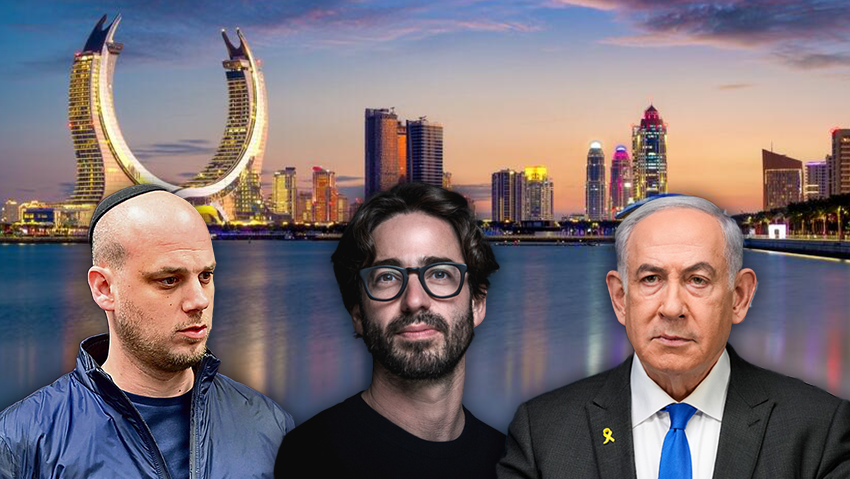
Qatargate
(Photo:Yair Sagie/ CGAT, Q world / Shutterstock, Ohad Zwingenbergl/ AP,Boaz Arad)
Much attention has focused on a televised interview given by one of the central figures in the affair, Eli Feldstein. Viewers debated whether he appeared credible. Were the tears genuine? Especially after Feldstein himself admitted that he once advised Netanyahu to display more emotion in public, even to cry. Crying, it seems, comes easily to him. But sincerity is harder to assess. The pauses, the stammering, the deliberate silences, the emotional stories about a difficult childhood, the pointed refusal to answer certain questions. All of it could signal discomfort, or calculated performance.
Should the public believe Feldstein now, knowing he previously lied to protect Netanyahu or his close associate Yonatan Urich, even during police questioning? Why assume this time was different?
Yet even if Feldstein is not credible, that changes little. What matters is what is already known. Feldstein acted under Urich’s direction. Both men, along with another associate, received payments from Qatar before the war in Gaza and during the war. That alone is deeply troubling. The communications among the three, which continue to be exposed, are disturbing regardless of whether they reached Netanyahu directly.
My own assessment is that Netanyahu likely did not know, or chose not to know. Not because of personal integrity, but because of personal weakness. It is difficult to believe Netanyahu would allow someone close to him to earn tens or even hundreds of thousands of dollars from a foreign state without being involved himself. Certainly not if doing so exposed him to serious risk. Taking such a risk for someone else’s enrichment does not fit his pattern.
This instinct was evident in past testimony describing how Netanyahu’s wife complained that a senior intelligence official might leave public service to earn millions in the private sector. The concern seemed less about losing a public servant and more about someone else making money. It is hard to imagine acceptance of an aide earning more than the prime minister himself.
My own assessment is that Netanyahu likely did not know, or chose not to know. Not because of personal integrity, but because of personal weakness. It is difficult to believe Netanyahu would allow someone close to him to earn tens or even hundreds of thousands of dollars from a foreign state without being involved himself.
Still, the central issue is not whether Netanyahu knew. That determination belongs to law enforcement. If investigators have no evidence he was aware, they should not question him. The real question is how this happened at all. How did media consultants with no meaningful security clearance gain extraordinary access and influence inside the most sensitive government office in the country? How did individuals whose primary expertise was shaping media narratives come to operate at the heart of national decision-making?
The answer likely lies in Netanyahu’s long-standing obsession with media coverage. Many of his legal and political troubles stem from that fixation. Previous corruption cases were rooted in efforts to influence news coverage. No other prime minister personally assumed responsibility for overseeing national media regulation, a role once considered marginal. No other prime minister surrounded himself so closely with advisers whose main qualification was mastery of communication platforms and public messaging.
 Sima KadmonPhoto: Avigail Uzi
In Netanyahu’s inner circle, influence flowed to those who understood media, not governance or security. That was the currency that mattered most.
Politically, the Qatargate affair could not have arrived at a more decisive moment. It appears to have reenergized Israel’s fractured opposition. The turning point came when former Prime Minister Naftali Bennett publicly labeled the affair an act of treason, arguing that advancing the interests of an enemy state for money from within the Prime Minister’s Office crossed a historic line.
Bennett has drawn a sharp distinction. Cooperation with Qatar before the October 7 Hamas attack is one thing. Accepting payment from Qatar afterward, he argues, is something else entirely. In his view, anyone who did so betrayed the country.
Other opposition leaders quickly followed, setting aside differences to focus on a single issue. For Bennett in particular, this scandal offers a direct challenge to Netanyahu’s long cultivated image as “Mr. Security.” He has narrowed his attack to one simple demand: What did Netanyahu know, when did he know it, and what did he do?
Everything else, Bennett argues, is distraction.
For him, Qatargate is not just another scandal. It may be the opening through which he hopes to reach the Prime Minister’s Office itself.