

The latest exchange of blows between the United States and Iran illustrated just how flawed the memorandum of understanding signed between the two countries last month really was. Although it was presented as an agreement meant to stabilize the arena after months of confrontation, in practice it remained a memorandum of misunderstandings, leaving almost every major issue open to interpretation.
The crisis over freedom of navigation in the Strait of Hormuz is only one prominent example. Iran claims that the passage of vessels through the Omani corridor violates the memorandum, which it says recognizes its right to formulate arrangements for traffic in the strait in coordination with Iran, and therefore also passage through the Iranian shipping lane rather than the Omani one. The United States, by contrast, completely rejects this interpretation and demands that vessels be allowed to pass through any shipping lanes of their choosing. But the dispute does not concern Hormuz alone. Almost every significant clause in the memorandum, from the nuclear issue to economic relief, is worded ambiguously.
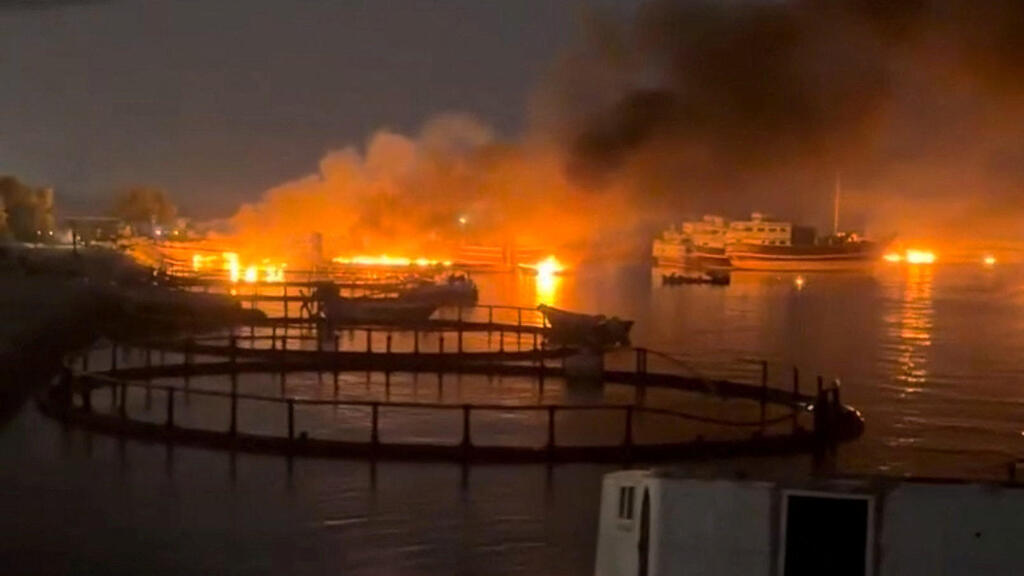
Aftermath of Israeli strikes in Iran
(Photo: Social Media/via REUTERS)
Such ambiguity does not necessarily have to lead to crisis. If there were basic trust between the sides, or an agreed mechanism for settling disputes, the interpretive gaps could be managed. But neither of those conditions exists. In Tehran, there is a conviction that Washington is merely playing for time until after the U.S. midterm elections in November, in order to resume the military campaign. In Washington, meanwhile, the assessment is growing that Iran is exploiting the negotiations to buy time to rebuild its military capabilities. The monitoring mechanism that was supposed to be established under the memorandum has also not yet been created, meaning there is effectively no body capable of resolving disputes or enforcing the understandings.
Behind the technical disputes lies a much deeper gap. From Iran’s perspective, the negotiations are meant to enshrine in an agreement the achievements of the war, foremost among them the change in the status of the Strait of Hormuz. For the Iranian leadership, this is not only an economic asset, which unlike the lifting of sanctions, for example, does not depend on the changing whims of the U.S. administration, but also a principled expression of the creation of a new regional order that recognizes Iran’s upgraded status. The United States, by contrast, seeks to obtain through diplomacy what it failed to obtain through military and economic pressure, including a return to the status quo in the Strait of Hormuz and the reduction of Iran’s nuclear capabilities.
Given these gaps, it is difficult to see how a permanent agreement between the countries can be reached in the near future. Even a detailed interim agreement currently seems an ambitious goal. Such an agreement would require decisions on highly complex issues, including how to handle the stockpile of enriched uranium, International Atomic Energy Agency inspection arrangements at nuclear facilities, the economic benefits Iran would receive, regulation of traffic in the Strait of Hormuz and even the issue of Lebanon. It is doubtful whether either side currently has the willingness or desire to move toward such an agreement.
A return to full-scale war also does not appear to be the preferred option. Both sides would prefer to avoid another war, which may not achieve its goals, although that does not mean war could not reignite, especially if confrontations between the sides continue and escalate.
In this reality, the most likely scenario at this stage appears to be a continuation of the current situation: not a full-scale war, but also not a long-term diplomatic arrangement. From Israel’s perspective, this reality seemingly has clear advantages. The military option remains on the table, and Iran does not enjoy a broad package of economic benefits that could strengthen the regime and allow it to invest significant resources in rebuilding its power.
But precisely because this situation appears relatively convenient, Israel must not fall in love with it. First, it is a highly fragile reality, which could deteriorate quickly under circumstances that are not necessarily convenient for Israel. Second, time is not standing still. Reports about the rebuilding of Iranian missile and air-defense systems indicate that Tehran is using the period of calm to reestablish its military capabilities. More importantly, there is no real freeze in the nuclear field either. Recent satellite images from the American research institute headed by expert David Albright, published in recent days, raise questions about continued covert activity at the secret nuclear facility at Pickaxe Mountain near Natanz, despite the memorandum of understanding requiring Iran to preserve the current status quo of its nuclear program.
 Dr. Raz Zimmt
In the absence of IAEA monitoring, Israel and the United States are forced to rely exclusively on intelligence to track these activities. Moreover, in the months after Operation Rising Lion, Iran has worked to restore its uranium-enrichment capability at two main sites: Fordow, which was not completely destroyed, and Pickaxe Mountain. It is doubtful whether continued rebuilding efforts at nuclear sites can be prevented without a diplomatic arrangement.
Ultimately, the current status quo may be preferable in the short term to a problematic agreement or another war. However, it does not provide a stable solution, but at most a temporary pause. The more time passes without an arrangement and without effective monitoring, the greater the danger of sudden deterioration, while Iran will be able to rebuild its military capabilities in the meantime. Precisely because the status quo provides a sense of relative comfort, it is important to remember that it may be not only temporary, but also misleading.
Dr. Raz Zimmt is head of the Iran and Shiite Axis Program at the Institute for National Security Studies (INSS).