


Like two sumo wrestlers locked in a clinch, neither able to move the other, the United States and Israel are at a stalemate with Iran and its proxies, with no way out in sight. It is a peculiar deadlock: Washington and Jerusalem enjoy almost complete freedom to operate in the skies over the Islamic Republic, along with a military advantage in every other domain.
Yet despite that imbalance and the crippling naval blockade enforced by U.S. Central Command, or CENTCOM, in the Persian Gulf, Trump cannot get the ayatollahs to raise a white flag. His negotiators cannot even secure agreement on his minimum demands: that Iran stop developing nuclear weapons and respect freedom of navigation through the Strait of Hormuz and Bab el-Mandeb. Worse still, Iran’s leadership is behaving like the victor, dictating humiliating terms to the United States despite the heavy blows it has suffered and an economy on the brink of bankruptcy.
Gallery
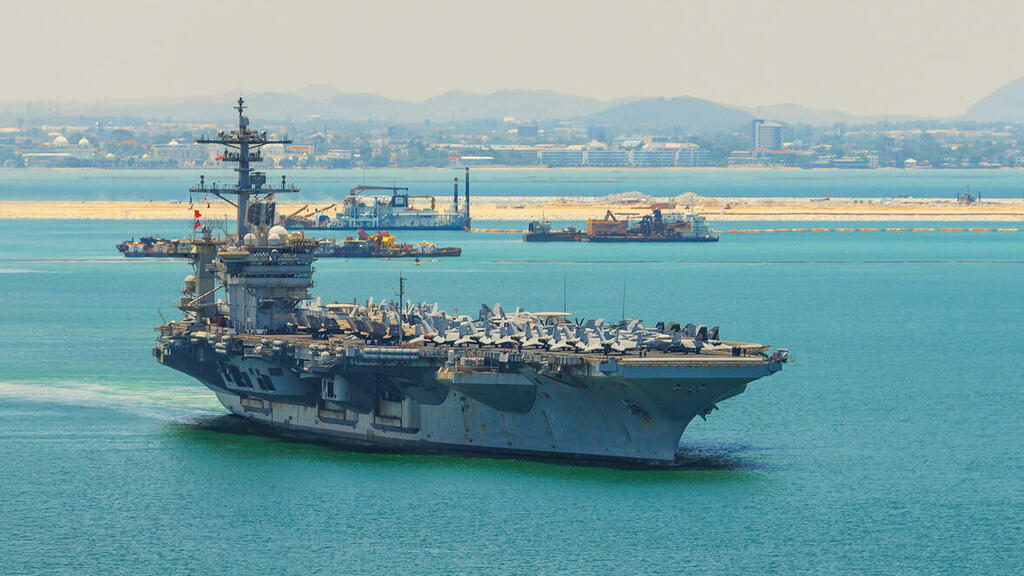
The aircraft carrier USS Theodore Roosevelt, a replacement for US bases in Gulf states targeted by Iran
(Photo: Ram the image creator, Shutterstock)
The explanation lies partly in the regime’s religious fanaticism: its survival in power and refusal to submit to American and Jewish “infidels” are its very reason for existing. It also lies in the absence of an organized force on the ground in Iran with the motivation, organization and resources to challenge the Revolutionary Guards and the Basij militia militarily, and offer an alternative government if the regime is defeated.
Underlying this assessment is a realization reached by Trump and the hawkish wing of his administration, including Secretary of State Marco Rubio and Defense Secretary Pete Hegseth, as well as Prime Minister Benjamin Netanyahu and Israel’s security chiefs: Under current conditions, the leadership in Tehran is a nut that cannot be cracked. Nor can a reasonable compromise be negotiated with it. Conversations with people familiar with developments in Iran indicate that Mojtaba Khamenei is a “fanatical type” who, despite his serious injuries, remains in control and dictates a hard line to other senior regime figures.
These include the heads of the Revolutionary Guards and Basij, most of whom support his hawkish, theologically driven position: no concessions on uranium enrichment, no restrictions on the development and production of ballistic missiles and drones, and continued Iranian control of the Strait of Hormuz, including the right to collect transit fees. To this group, the population’s suffering under the naval blockade, sanctions and the regime’s failures, which have caused severe water and electricity shortages, is a worthy sacrifice for religious and national goals.
Opposing this conservative, hawkish faction is a more moderate camp led by President Masoud Pezeshkian, alongside Parliament Speaker Mohammad Ghalibaf and Foreign Minister Abbas Araghchi. They are sensitive to the Iranian people’s social and economic suffering, but their influence over policy is limited. According to the experts, Mojtaba listens to them and allows them to negotiate with the Americans in an effort to return to the memorandum of understanding reached in June, negotiated with Vice President JD Vance in Islamabad under Pakistani mediation.
In Israel, and among Republicans in the United States, that agreement was viewed as appeasement, even capitulation to Iranian demands. But within days of its signing, the Revolutionary Guards violated it, launching missiles and drones that struck three merchant ships passing through Hormuz. That gave Trump a golden opportunity to withdraw from an agreement likened to the Munich Agreement on the eve of World War II, which had brought heavy criticism of the president and his deputy from conservative Republicans and some Democratic lawmakers. Trump resumed military action and the blockade, and Mojtaba sent Araghchi to obtain the same terms in slightly different wording.
By then, however, Trump had hardened his position. Unlike the June agreement, he demanded that negotiations begin with halting Iran’s military nuclear program. Only afterward would they address Tehran’s demands to lift the naval blockade and sanctions and release 12 billion dollars in frozen Iranian funds. The Iranians refused, and the negotiations on the sidelines of the U.N. General Assembly in New York collapsed.
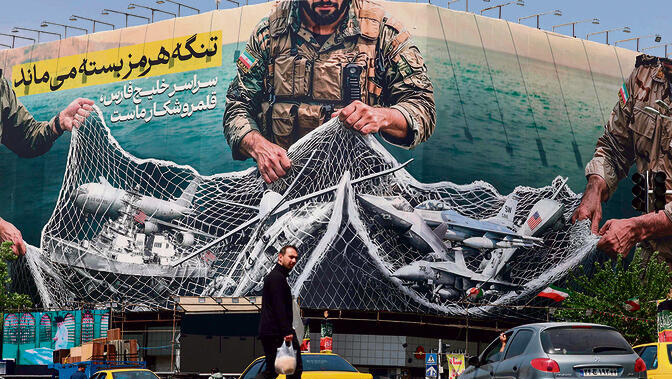
A billboard in Tehran: ‘The Strait of Hormuz will remain closed.’ Civilians are paying the price
(Photo: ATTA KENARE, AFP)
According to someone familiar with the administration’s deliberations, Iran’s violation of the conciliatory memorandum and the latest negotiations drove home a point for Trump: Not only is a diplomatic compromise with the current regime impossible, it is not even clear whether Iran’s representatives have the authority to agree to anything. That realization, the source says, is bringing Trump and Rubio closer to the Israeli position, shared by Netanyahu and all the security chiefs: Only overthrowing the regime will ensure that Iran does not rebuild its nuclear program and that passage through Hormuz again operates under international navigation rules.
Torture and executions
But overthrowing a repressive, murderous regime such as Iran’s is no simple matter. Military history teaches that bringing down or replacing a dictatorship in a hostile country has always required an organized force prepared in advance to operate on the ground. The Basij and Revolutionary Guards demonstrated again early this year that they can crush mass demonstrations that erupt spontaneously in the streets. Toppling the Iranian regime requires highly motivated people with military capabilities and the ability to govern, operating on Iranian soil.
Under present circumstances, such a force could come from two sources: U.S. troops, troops from the Israel Defense Forces, or both; and trained, equipped opposition organizations willing and able to operate even as the authorities fight them relentlessly, gather intelligence on them, hunt them down, torture and execute their members, disrupt their communications and cut them off from the internet and social media.
Several such organizations operate in Iran, mainly among ethnic minorities: Kurds, Baluch, Arabs, Azeris and Lurs. They receive support from the CIA, Israel’s Mossad intelligence agency, particularly in the case of the Kurds, and intelligence agencies in Arab countries such as the United Arab Emirates. But they lack the critical mass needed to confront the Revolutionary Guards and Basij. Iran’s political opposition organizations are also incapable of generating a genuine uprising against the regime.
The only organization with the potential, at least, to challenge the regime nationwide is the Mujahedeen-e Khalq, or MEK, with its thousands of members. Its ideology is Islamist-Marxist; it is led by a woman, Maryam Rajavi, and it has branches and fundraising operations abroad. Its members are fervent and motivated, well organized and, in some cases, armed. They could establish the foundations of local government. If someone managed to bring several ethnic opposition organizations together with the MEK, that could pose a significant threat to the regime.
Mojtaba and his supporters are determined to crush all opposition at any cost, including through the cruelest and most brutal measures. These include executions, taking place even now, of people who participated in January’s protests. Mojtaba has also reorganized the security and military apparatus to protect the regime more effectively, putting it under veterans of the Revolutionary Guards, intelligence services and Basij who proved not only their loyalty to his slain father but also their ability to suppress mass unrest.
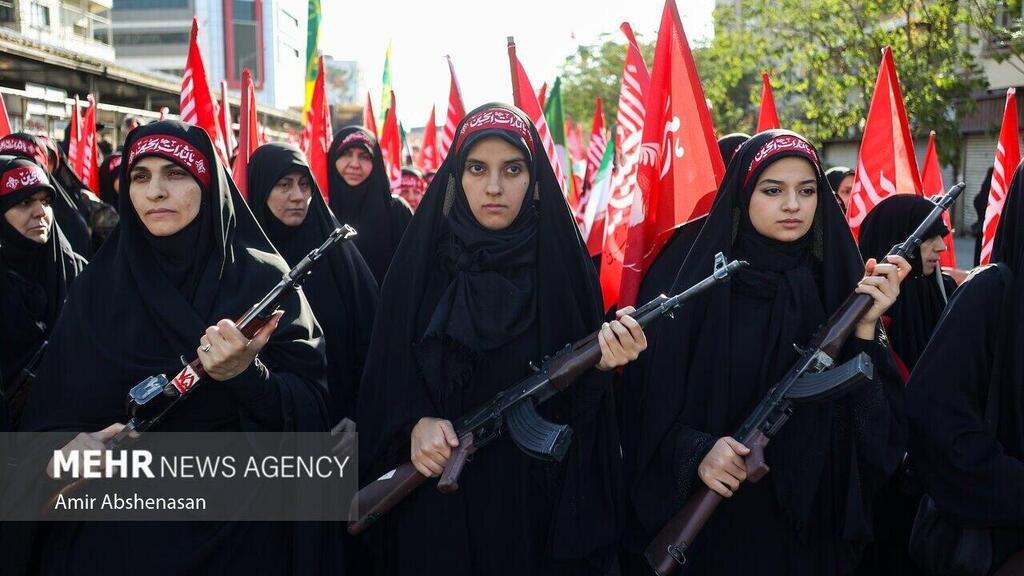
Women carrying weapons during an apparent drill in Tehran as part of a ‘Sacrifice of Life’ campaign encouraging Iranian regime supporters to volunteer to die for it
All of this presents the Trump administration and Israel’s leaders with a difficult dilemma. If two intensive joint air campaigns by Israel and the U.S. military have neither changed the regime’s positions nor shaken its stability, what would another joint campaign accomplish, even if it included the destruction of energy facilities and electricity and water infrastructure previously spared by both countries? On the one hand, striking that infrastructure would weaken the regime. On the other, it would deepen ordinary Iranians’ suffering, generate hostility toward the United States and Israel, and potentially play into the regime’s hands.
It is also clear that if the current regime remains in place, aerial bombardment cannot prevent Iran from eventually rebuilding its nuclear weapons project, perhaps within a year or two, or its programs to develop and produce thousands of ballistic missiles and tens of thousands of drones. Those programs can be delayed, but not prevented forever. The evidence is already there: Iran is producing new missiles, albeit not many, using the raw materials it still has. It is equally clear that decision-makers in Washington and Jerusalem do not intend to send in ground combat formations to overthrow the regime and seize its nuclear and missile facilities.
So what can be done? For now, the Pentagon and CENTCOM have no satisfactory answer. The New York Times reports that the Pentagon has presented Trump and his advisers with five plans in recent months for targeted air operations against Iran and the Houthis in Yemen. According to that report, the proposals envisage a short but intense, three-day operation alongside the Israeli Air Force, targeting ballistic missile and drone capabilities, energy facilities, and Revolutionary Guards headquarters and command-and-control centers.
Israel knows Trump considered the plans seriously because he discussed them with Netanyahu, and the IDF was ordered to be ready for another round with Iran within days, perhaps even hours. Ultimately, Trump decided not to act. According to informed sources, one of the main reasons was that the plans drawn up at CENTCOM headquarters in Florida and the Kirya, Israel’s military headquarters in Tel Aviv, did not promise a fundamentally different outcome from the earlier Roaring Lion campaign.
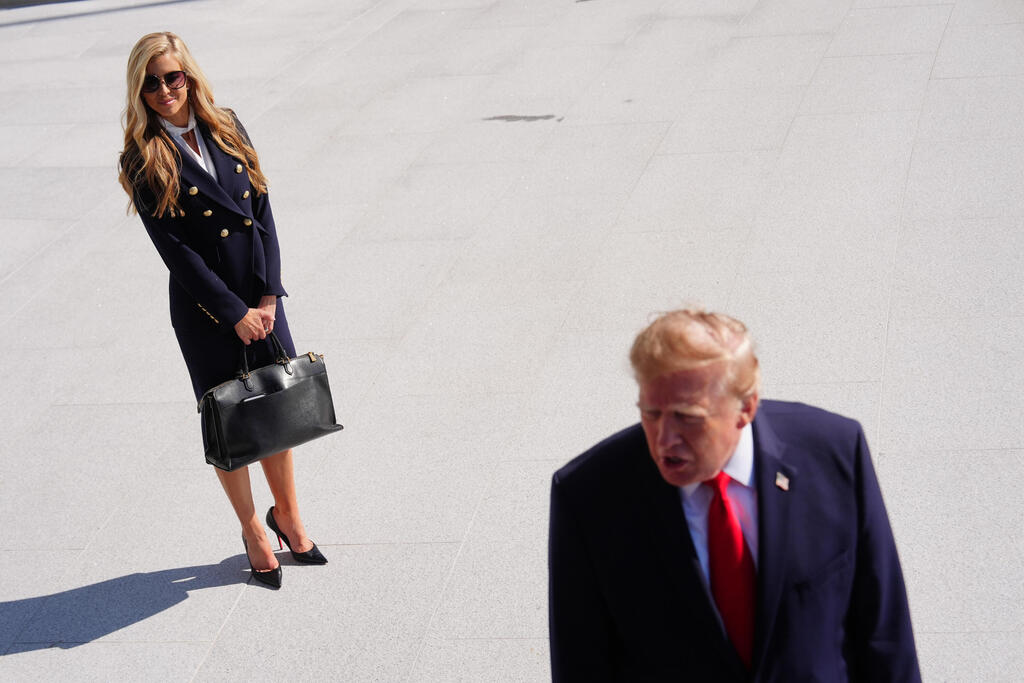
Trump has realized there is no one to negotiate with
(Photo: AP Photo/Julia Demaree Nikhinson)
In early October, senior White House officials led by Vance gathered at the presidential retreat at Camp David to reconsider those plans. According to U.S. media reports, they, too, were unenthusiastic about airstrikes, assessing that they would neither topple the regime nor change its positions. They presumably also drew on CENTCOM’s experience in its failed March 2025 air campaign to force the Houthis in Yemen into submission.
Vance and other senior officials also considered the retaliation the Revolutionary Guards are now threatening: setting oil and gas facilities in U.S.-allied countries ablaze, causing extensive destruction in Israel and Jordan, and dangerously depleting already strained stocks of interceptors and the U.S. military’s expensive precision-strike munitions. Alongside blocking Hormuz with their remaining drones and speedboats, the Iranians might also carry out threats to damage the undersea communications cables running through Hormuz and Bab el-Mandeb that provide communications and internet services to countries across the Middle East and Asia.
The IDF’s advice: do not rush
It is reasonable to assume that neither the IDF nor Mossad has a good operational answer yet to the question of what another round with Iran would achieve that previous rounds did not, and whether it would remove the need for yet another confrontation in a few months or years, perhaps followed by more and more. The Israeli Air Force remains ready to respond at almost immediate notice, placing considerable physical and psychological strain on pilots and ground crews.
But that is mainly because the unpredictable Trump could decide at short notice to launch an operation involving Israel, and because Israeli Military Intelligence assesses that Iran could launch a preemptive strike to inflict destruction on U.S. allies and American bases in the region. Iran could also fire missiles at Israel because of a “miscalculation,” mistakenly concluding that Israel is about to attack. In any event, Israel currently has no indication that Iran is planning a preemptive strike.
The IDF is advising Netanyahu not to rush. Every passing day allows Israel Aerospace Industries, Rafael and Elbit to produce more interceptors, long-range precision-strike weapons, drones and counter-drone systems, allowing Israel to better defend its home front and attack in the next confrontation with Iran. Moreover, reliable intelligence held by both Israel and the Americans indicates that Iran has so far neither tried to recover its uranium enriched to 60% nor moved to restore enrichment facilities and resume nuclear warhead development.
It is, however, trying to restart ballistic missile production and bring damaged missile development and manufacturing facilities back into operation. Despite claims that military action on the eve of the election would serve Netanyahu, the prime minister himself said in an interview with Israel’s Army Radio this week that he was not interested in initiating an attack on Iran at this time. Still, Israel continues to regard overthrowing the Iranian regime as an overarching goal.
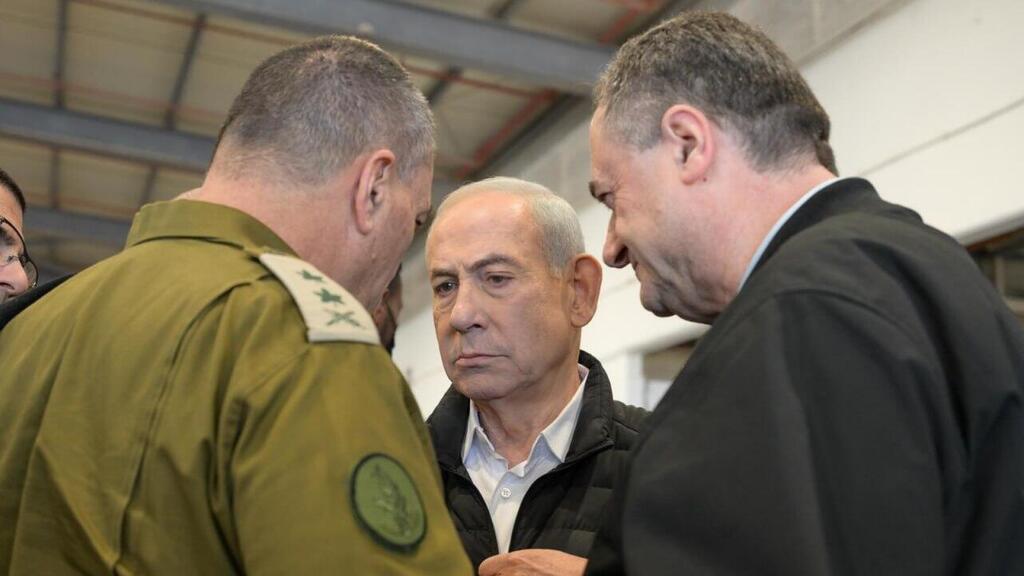
Still no operational solution. Netanyahu, Katz and Zamir
(Photo: GPO)
Despite the hesitation and doubts about what the United States would gain from continuing the war in Iran, it is increasingly clear that Trump will not abandon his demands that Iran have no nuclear weapons and that Hormuz remain open and safe for international shipping. These are his minimum demands, and he intends to achieve them through negotiations, military action or, more likely, a combination of the two.
Setting aside his contradictory statements and childish reactions, it is possible to discern the short- and long-term objectives the American president is pursuing. His foremost short-term objective is political: Trump fears losing the Republican majority in both houses of Congress in the November 3 midterms. The war in Iran is unpopular in the United States, including among many Republicans. He does not want television images of American soldiers coming home in coffins, but his greatest concern is the price of diesel and gasoline, which has soared since February.
Those increases hurt Americans both directly and indirectly, with agricultural prices rising because of fertilizer shortages, and erode the president’s political standing. They also damage the Republican candidates he is trying to get elected to the Senate and House of Representatives. Trump is therefore concentrating much of his effort on moderating the largely speculative rise in oil and gas prices whenever tensions with Iran increase and military escalation looms.
Aerial ambushes
That is why Trump repeatedly declares that he will not order an attack on Iran before the midterms. The announcement is primarily intended to calm trading and the jittery speculators driving up oil prices in global energy markets. On the advice of the CENTCOM commander and the U.S. treasury secretary, Trump also ordered a daring operation to move oil through Hormuz in defiance of Iran. Launched in mid-August, it worked as follows: Arab oil and gas producers, including Iraq, Kuwait, Qatar, the UAE, Bahrain and Saudi Arabia, chartered cargo ships and small tankers, which were fitted out and made ready within days to carry relatively modest quantities of oil and gas. Their advantage was their size: They were difficult for Iranian lookouts, radars, drones and coastal anti-ship missile fire-control systems around Hormuz to detect and track.
To let those vessels sail safely, the Americans conducted several precision nighttime operations to blind the Iranians, destroying radars around the port of Bandar Abbas and on the islands and shores of Larak and Qeshm. The U.S. Navy also cleared Iranian mines from the strait’s southern shipping lane, which runs close to Oman’s coast, about 30 kilometers from the Iranian shore. American fighter jets conducted patrols and aerial ambushes, allowing them to destroy most of the Revolutionary Guards’ coastal anti-ship missile launchers and fast attack boats as they emerged from hiding to strike vessels in the strait. At that stage, most of those vessels were actually American bait.
US Navy attacks a ship attempting to break the naval blockade on Iran off the coast of Oman
(Video: CENTCOM)


Once CENTCOM had cleared the shipping lane of mines and destroyed most Iranian surveillance, tracking and attack capabilities along the strait and Gulf coast, the operation began, largely at night. To avoid detection, the small vessels switched off their transponders, the radio devices used under international maritime practice to transmit their positions automatically. They moved alongside coastal storage facilities or large tankers anchored off the UAE or in concealed locations along the southern Persian Gulf coast. Oil was pumped from a large vessel into a small one.
Once full, the smaller vessel joined a group of similar ships, sailing under close U.S. warship escort through the “Omani” shipping lane, past Hormuz and into the Indian Ocean. There, near Oman’s coast, the process was repeated in reverse. The small vessel that had just passed safely through the strait drew alongside a giant tanker, which pumped the oil aboard. After several such transfers, the full tanker headed for customers in Europe and Asia.
The Iranians spent a long time trying to threaten and strike these feeder vessels, but failed because of the electronic defenses and military firepower provided by the Americans. For more than two months, the United States and its partners thus managed to move a daily volume of oil through the strait that nearly matched the prewar level of about 20 million barrels. Together with the oil flowing through Saudi and Emirati overland pipelines bypassing Hormuz, the quantity of oil and gas reaching customers from the Persian Gulf states nearly equaled prewar energy exports. Everyone was satisfied, especially crews handsomely compensated for the risks. Captains in this suicide fleet earned about 100,000 dollars a month, while sailors from Bangladesh, the Philippines and India each earned around 6,000 to 7,000 dollars.
Recently, however, Iran has developed new tracking methods that allow it to hit feeder vessels, mainly with drones, and disrupt the operation. The Revolutionary Guards employ spotters aboard small, seemingly innocuous fishing or cargo boats. When they report a feeder vessel, the Guards launch several attack drones toward it. Iran has also begun targeting tankers and container ships throughout the Persian Gulf, well beyond the shores of Hormuz. As a result, less oil has been passing through the strait in recent days, forcing producers to pay higher insurance costs. Captains’ pay has jumped to 100,000 dollars per voyage, and sailors’ to 10,000 dollars. Two days ago, a Singaporean ship carrying about 2,800 containers was sunk in Hormuz, although its entire crew was rescued safely.
The Hormuz blockade
Alongside his efforts to moderate energy price increases, Trump continues preparing for another round of fighting with Iran. As part of those preparations, the Pentagon dispatched another task force to the Middle East, led by the aircraft carrier Theodore Roosevelt. Together with the two task forces already in the region, centered on the carriers George Washington and George H.W. Bush, the force comprises more than 10 guided-missile destroyers, about 20,000 sailors and Marines, and hundreds of combat aircraft, intelligence aircraft and helicopters.
The thousands of Marines aboard dedicated ships are intended to give Trump the ability to conduct a limited ground operation, whether in Hormuz, to remove highly enriched uranium, or to capture Iran’s main oil export terminal on Kharg Island. It is the first time since the Iraq War that a force of this scale has sailed and operated in the Middle East.
The need for a third carrier probably reflects lessons the Pentagon learned from the latest Iran campaign. Using short-range ballistic missiles, the Revolutionary Guards managed to hit American bases in the region and destroy more than 10 U.S. aircraft at airfields in Kuwait, Saudi Arabia, Jordan and Qatar. CENTCOM consequently decided to reposition its forces both inside and outside the region. Several fighter squadrons were moved to Israel, which has strong air defenses jointly operated with the Americans. The additional carrier and its accompanying task force effectively replace more than one U.S. base in the region. The Roosevelt task force is expected to arrive and become operational in late October. The Pentagon is also sharply accelerating the production and procurement of Patriot and THAAD missile-defense interceptors and offensive munitions.
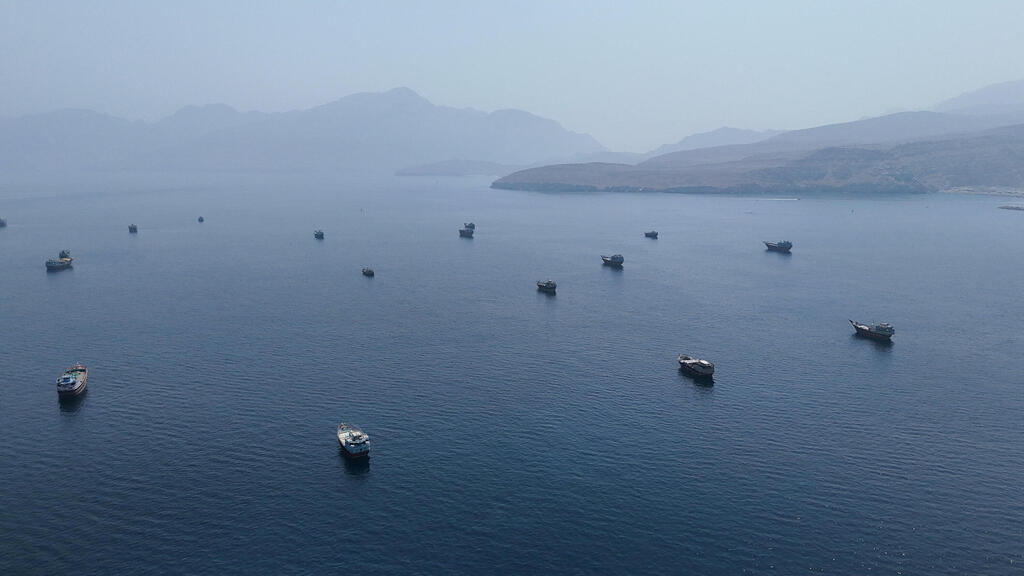
Strait of Hormuz
(Photo: REUTERS/Stringer/File Photo)
But the central military dilemma remains unresolved. Iran is playing for time. Its regime wants to survive and provide for the population’s most basic needs until Trump’s term ends. After that, God will provide.
The American president and all his advisers, including Vance, who opposes the war, believe the naval blockade is working well and is the main concern for a regime worried about its survival. Almost no oil is leaving Iran, and its foreign currency shortage is worsening. U.S. intelligence agencies and Israeli Military Intelligence believe the blockade is so far having a greater impact than military pressure, and could prompt Iran to escalate in an attempt to break it.
Either way, maintaining the naval blockade while holding the large naval force over Iran as a cudgel is the alternative to a short round of airstrikes. Another consideration is that if Trump loses his majority in both houses of Congress, he will be able to launch a military operation lasting no more than 60 days. He could, admittedly, sustain a longer war by using a presidential veto against Congress, but that would be politically very difficult for him.
A short American-Israeli air campaign against Iran could weaken it militarily and threaten the regime’s stability by hitting the Revolutionary Guards. But not much beyond that. It would not prevent the long-term restoration of the nuclear weapons and missile projects, nor would it bring down the regime. It is therefore reasonable to assess that even after the U.S. midterms, particularly if he loses the majority in both houses of Congress, Trump will not rush to attack Iran. Israel and the United States are searching for a different answer to the Iranian problem, one that breaks with the approaches of the past.