

A van rammed into the crowd. Then came the blade. One woman is dead. Twenty-nine people are injured. Berlin Pride — a celebration built on joy, dignity and the simple right to exist openly was turned into a crime scene by a 21-year-old German national of Lebanese descent whom authorities describe as tied to Berlin's Islamist scene. German Interior Minister Alexander Dobrindt called it plainly: an Islamist terrorist attack. The suspect, Abdul Ballout, was shot dead by police the following day after a manhunt through the city.
Before anything else, my heart is with the victims. My deepest condolences go to their families, their loved ones, and everyone whose life was changed forever in a matter of seconds near the Brandenburg Gate. What happened in Berlin was an act of terror, and it deserves to be named as one without hesitation or euphemism.
Gallery
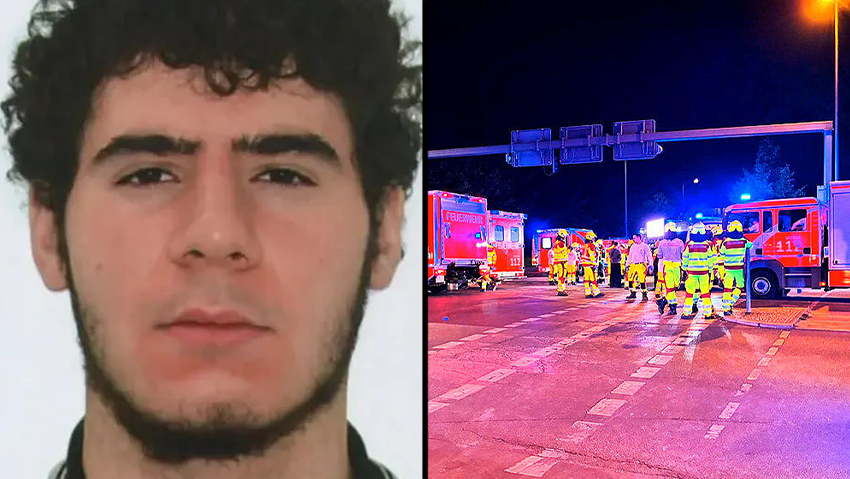
Suspected Islamist attacker Abdul Ballout and the scene of the attack at the Berlin Pride Parade
(Photo: Reuters, Berlin Police)
In the days since, thousands of Berliners have gathered at a memorial by the Brandenburg Gate, laying flowers and rainbow flags. Chancellor Friedrich Merz attended a vigil at St. Mary's Church. Berlin's LGBTQ affairs commissioner, Alfonso Pantisano, wrote movingly to his community about shared fear and grief. This grief is real, and it is right that it be honored.
But grief was not the only thing on offer from the community's own institutional leadership. It was, almost pointedly, the only thing on offer.
At an official press conference the day after the attack, the spokesperson for Christopher Street Day Berlin, the Berlin annual LGBT Pride Parade and organization, read a statement asking the public not to let the attack be “instrumentalized for political ends.” The statement added that: “People are trying to divide our society and set some people against others. As the CSD in Berlin, we will not allow this.”
Organizers added that they didn't want any group “placed under suspicion.” Andre Lehmann of LSVD+, Germany's largest LGBTQ+ advocacy organization, Lesben-und-Schwulenberband, said only that the community was “simply stunned.” Neither statement named Islamism. Neither acknowledged, even in passing, that the attacker's own stated hatred of gay people and Western freedoms was not incidental to the attack but its entire purpose.
It went further than omission. At the community vigil held the day after the attack, one speaker — an LGBTQ+ activist addressing the crowd — told the assembled mourners that when she first heard about the attack, her instinctive hope was that the attacker would turn out to be “not an Arab-Muslim, but a white Christian person.” She did not hope the attack hadn't happened. She hoped it had been carried out by someone else, someone who fit a more politically comfortable story. That is not solidarity. That is a community's own advocate publicly prioritizing ideological narrative over the truth of who is actually trying to kill us.
Notice what happened here. It was the German government — not the leadership of the community that was actually attacked — that called this what it was. Interior Minister Dobrindt said “Islamist terrorist attack” within a day. Chancellor Merz called it an assault on German society. Meanwhile the very organizers whose parade was turned into a killing field asked everyone to please not “politicize” the one detail that explains why it happened at all.
This is not new. It is not surprising. It is not the first time. In Dresden in 2021, a gay man was murdered by an Islamist. In Orlando in 2016, 49 people were massacred inside the Pulse gay nightclub. In Oslo in 2022, an Islamist terrorist killed two people and wounded many more outside Pride venues on the eve of the parade. Now Berlin joins that list — and once again, the loudest voices from within the community itself have chosen procedural language about “division” over the plain naming of the ideology that keeps coming for us.
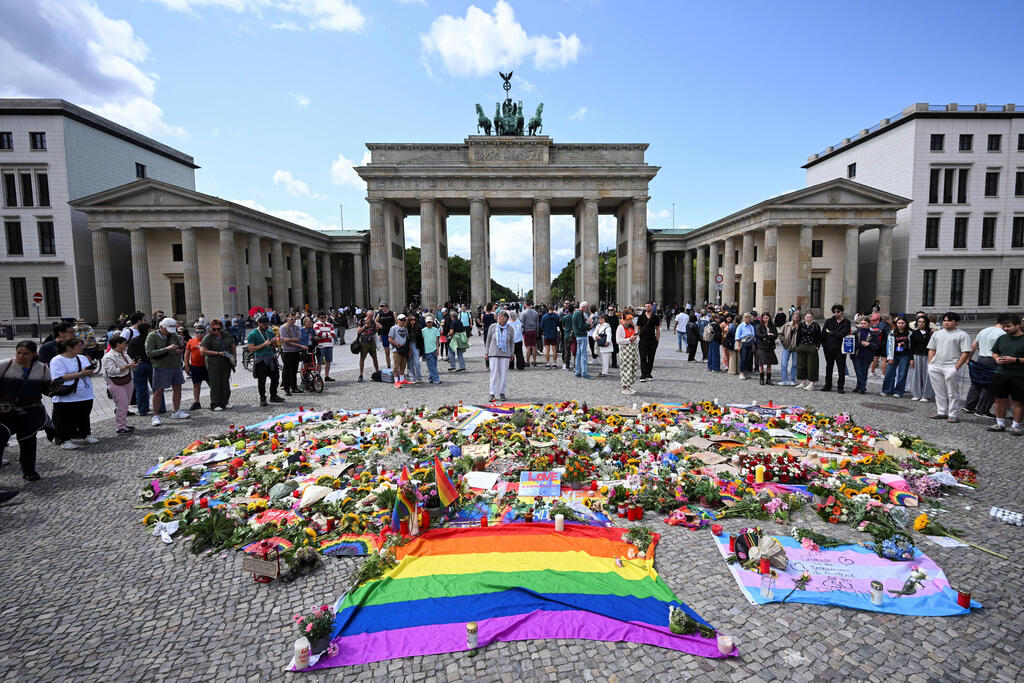
Makeshift memorial at Brandenburg gate after ramming attack on Berlin's annual Christopher Street Day Pride parade
(Photo: Annegret Hilse/Reuters)
And this is not only a story about attacks in the West. Right now, in dozens of countries governed by Islamist law, being gay is a criminal offense punishable by imprisonment — or death. LGBT people are hanged, imprisoned, tortured and thrown from buildings simply for existing. This is not the fringe fantasy of a handful of extremists. In parts of the world, it is official state policy today. A movement that cannot bring itself to name Islamist extremism when its own people are being murdered in a European park is not going to be the movement that stands up for the people being executed for it abroad.
The pattern extends further. The same Pride weekend, a separate, explicitly pro-Palestinian offshoot rally — the “Internationalist Queer Pride for Liberation” — clashed with Berlin police in the Kreuzberg district, injuring 17 officers amid what police described as antisemitic slogans. This is the same activist current that, in previous years, banned rainbow Star of David flags from its march while permitting Palestinian ones. This is “Queers for Palestine” in practice: a willingness to march in explicit solidarity with a political movement tied to an ideology that criminalizes homosexuality, while treating any direct criticism of Islamism — even after an Islamist has just murdered a member of their own community — as the real transgression.
So let me be precise about who I am addressing, because precision matters and bad-faith actors will look for any excuse to distort it. I am not speaking about Muslims as a people. The overwhelming majority of Muslims around the world want nothing to do with any of this, and many are themselves among Islamist extremism's most frequent victims. I am speaking about a specific ideology — Islamist extremism — and about the activists, organizations and community leaders on the progressive left who excuse it, minimize it, or actively give it political cover the moment naming it becomes inconvenient. That is who I mean when I say “you” in this piece. Not a religion. An ideology, and the people — including within our own community's leadership — who launder it.
So here is my question for that audience: how many more of us have to die before you stop calling this “divisive” to even discuss?
Supporting the human dignity and rights of civilians is compassion. Asking the public not to “politicize” the murder of a member of your own community by a man who hated everything that community represents is not compassion. It is cowardice dressed up as unity. It is a betrayal of the very values Pride was created to defend — the same values that brought hundreds of thousands of people into the Tiergarten to celebrate before their celebration was turned into a massacre.
As a proud gay man, I will never stand with an ideology that would criminalize my existence and celebrate my death. Neither should anyone who claims to lead in my community's name.
 Yuval David
For years, anyone who tried to name Islamist extremism as a distinct and serious threat to LGBT people was shouted down, smeared as a bigot, and exiled from “polite” progressive company. That silence did not protect anyone. It only left the threat unexamined and the warnings unheeded — in Dresden, in Orlando, in Oslo, and now in Berlin, where the community's own official statement asked us to look away from the one fact that mattered most.
History will not remember who had the trendiest slogans, the loudest chants, or the most carefully worded press statement asking everyone to stay calm. It will remember who had the moral courage to recognize evil, call it evil, and refuse to stand beside it — and who instead chose comfortable silence, or worse, alliance.
If your leadership gives political cover to an ideology that wants LGBT people dead — even, and especially, in the immediate aftermath of an attack that just proved it — you are not advancing equality. You are helping sanitize the very movement that would erase you. It is long past time for honest voices across the political spectrum, including within LGBT and progressive communities themselves, to say so clearly, and to mean it.
- Yuval David is an Emmy Award–winning journalist, news commentator, filmmaker and actor, and internationally recognized political advocate focused on combating antisemitism, Islamist extremism and disinformation while advancing democratic values, human rights and the U.S.-Israel relationship. He advises governmental leaders, diplomatic missions, NGOs, and policy organizations and appears regularly across major American, Israeli, and international news networks.