

A psychologist is a strange concept. A stranger sits across from you. Not a relative or anything. Someone who has set aside 50 minutes for your troubles. Your troubles need more than that. More than one person, actually. They need a whole team. But this stranger, who listens professionally and nods professionally, is what we have for now. And you find yourself moved. There is something beautiful about this solution humanity has come up with.
And yet you worry. Will the person asking how you felt, telling you, "I want you to breathe into that," really be able to handle it when I back the truck carrying my entire emotional life into the clinic, make that little beep-beep reversing sound, dump everything onto the parquet floor and, 50 minutes later, say thank you and disappear?
Gallery
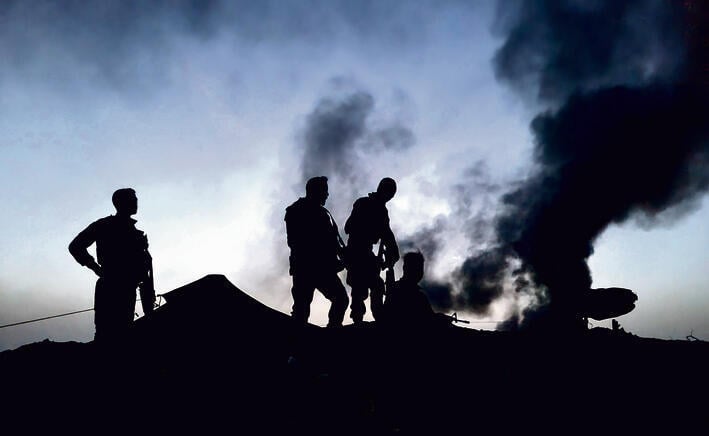
Soldiers in Gaza. ‘We have thousands of people who have lost friends and are living with unresolved grief’
(Photo: Yoav Keren)
The first time I went to therapy, I asked about my psychologist's training and how she would cope with stories that were simply too sad.
"You're worried about me?" she laughed, scribbling something on a piece of paper.
Probably her first diagnosis.
Over the past three years, I have met many people, mostly combat soldiers, who told me the same thing: The time will come to look inward. Right now, it's time to fight.
There was even a battalion commander in Gaza, with a military welfare officer beside him urging him not to ignore what he had experienced. She probably knew what she was talking about.
He changed the subject.
For a growing number of people, those brave enough to confront what they have been carrying, that moment has arrived. These days, though the war has not officially ended, feel like the beginning of its aftermath. The time has come for psychologists and therapists, for those tasked with picking up the pieces.
According to clinical psychologist Michal Newborn, the successive wars of recent years have fundamentally changed the therapist’s role. The profession must adapt to increasingly complex forms of psychological suffering. Sitting across from a patient in a consulting room is no longer enough. Therapists must step outside the clinic and accompany patients to the places where their trauma is most deeply rooted.
The wounds of moral identity
Newborn is a clinical psychologist who, together with Shlomi Oman, founded 7 Plus – Circles of Hope, a nonprofit organization that offers psychological treatment to people affected by war for a nominal fee.
She also heads the reserve clinical services of the IDF's LIBA unit, which provides psychological and clinical support to young male and female combat commanders.
I met her because of a new training program she is leading for therapists, focused on psychotherapy for moral and identity injury. This specialized approach to treatment is virtually nonexistent elsewhere in the world and was barely recognized in Israel until recently. But the prolonged war has created an urgent need for therapists equipped to address it.
Newborn defines moral and identity injury as a condition that leaves people disconnected from ordinary life, struggling with guilt, shame, a crisis of values and damage to their sense of identity, belonging and meaning.
She identifies four categories:
The first concerns the psychological impact of killing. Snipers, drone operators and combat soldiers who have killed return home and find themselves caught between the adrenaline of battle and the emptiness of civilian life.
Newborn describes one patient, a sniper who returned from combat to discover that everything seemed gray and lifeless. Even reading a bedtime story to his child felt devoid of meaning.
The experience fills such soldiers with shame. "What's wrong with me? Do I enjoy killing? How am I supposed to return to normal life?"
They need someone who can explain what they are experiencing, Newborn says. "This is adrenaline. It's okay. Adrenaline helped you protect us and do what you needed to do properly. It doesn't mean you enjoyed killing."
The second category, and the largest, is traumatic grief. It includes cases involving friendly fire, survivor's guilt and encounters with death that people believe they should have prevented.

Michal Newborn
(Photo: Anat Kazula)
Newborn describes a patient, a soldier in Gaza who was given an incorrect order to open fire, resulting in the deaths of fellow soldiers. The subsequent investigation established that he had acted correctly. He had followed an order without knowing what the consequences would be.
But that distinction offers little comfort. He is consumed by guilt over the families whose lives were shattered and feels he has no right to rest or enjoy himself. "This young man needs help learning to see himself once again as a good person whose life has value."
The third category involves agonizing decisions made under impossible circumstances. Doctors, rescue workers and military commanders have been forced to choose whom to save first or whom to send into danger.
"One of my patients is a combat doctor who goes over the names of every person she has pronounced dead, every single day," Newborn says. "In some cases, she arrived when there was already nothing she could do to save them, but that makes no difference to her."
"Every day, she looks through their names and photographs, determined to remember them and remind herself of what she believes she failed to do. In her current state of mind, returning to normal life, even something as simple as going on a date, is impossible."
The fourth category is what Newborn calls "fluorescent-light injuries." These involve people who were never in immediate physical danger and never served on the battlefield, intelligence personnel, for example, but who feel guilt over having watched traumatic footage or carried out their duties from a distance.
"Some of them don't even feel entitled to think they might be suffering from PTSD," Newborn says.
She describes a soldier serving in the military's prisoner-of-war and missing-personnel apparatus. His job required him to watch footage that most of us could never bear to see, searching for clues about the fate of missing people.
He now carries guilt over every minute he spent sleeping, looking at his phone or eating lunch. His feelings have reached the point where he believes he has no right to live.
How do we transfer that guilt to the politicians who are actually responsible, I ask.
"That's a question I can't answer as a clinician," Newborn replies. "But helping that soldier free himself from this guilt is a responsibility we all share."
The anger, the shame and the guilt
I return with Newborn to the changing role of the psychologist. Some of the cases she describes are situations therapists had never encountered before, or had seen only a handful of times.
They require a different kind of practice. Talking from an armchair is no longer enough. The trauma is out there, in the world.
Newborn describes a combat soldier consumed by survivor's guilt. Nothing that happened was actually his fault. But his friends from the unit were killed, and he survived. That alone is enough to make him want to stop living.
His therapist, Newborn explains, helped him find a way to say goodbye. Together, they worked through everything he wished he could tell his fallen friends: the anger, the shame, the guilt, the apologies and all the feelings he had never been able to express.
"She then accompanies him to the grave, where they hold a private funeral together. The next step is to meet with the fallen soldier's family."
I try to picture it. A soldier. A psychologist standing nearby. Both beside a grave, out in the open. A dramatic scene.
"It's not dramatic when you consider how common it is," Newborn says. "Thousands of people have lost friends and are struggling with unresolved grief. In moments like these, they confront conflicting emotions, sometimes for the first time: I love him, I miss him, but I can't bear to think about him because I feel guilty."
"There, beside the grave, perhaps with a photograph or a shirt I've brought along, I can begin to accept that he's gone, but that our bond still exists. I can still talk to him, even if he can't answer. I can imagine what he would say, what joke he might make."
"When someone dies, those left behind often feel terribly alone. They remember the moment they heard the news or watched their friend being killed. But they don't necessarily remember the love, the things they miss, the laughter or even the arguments they shared."
As I picture this painful moment of closure, my thoughts return to the therapist. The traditional boundaries of the profession have shifted. Standing beside the grave, the therapist is no longer merely an observer but part of the experience. And it is not just the soldier who sheds tears.
"Therapists cry far more than they ever did before," Newborn agrees. "These are moments of human connection in the face of the profound loneliness of war and death, moments that can also bring a sense of emotional release."