


"Time for compromises," Yashar chairman Gadi Eisenkot declared Sunday evening as he formally received the mandate to form a government from President Isaac Herzog, setting out to fulfill a promise he has repeated in recent days: to establish a new government at any cost, replace the outgoing coalition and remove Prime Minister Benjamin Netanyahu from power.
The 28 days ahead will be anything but easy for Eisenkot, not only because of the political deadlock between rival blocs, but also because of the tensions expected to emerge within his own camp in the coming days.
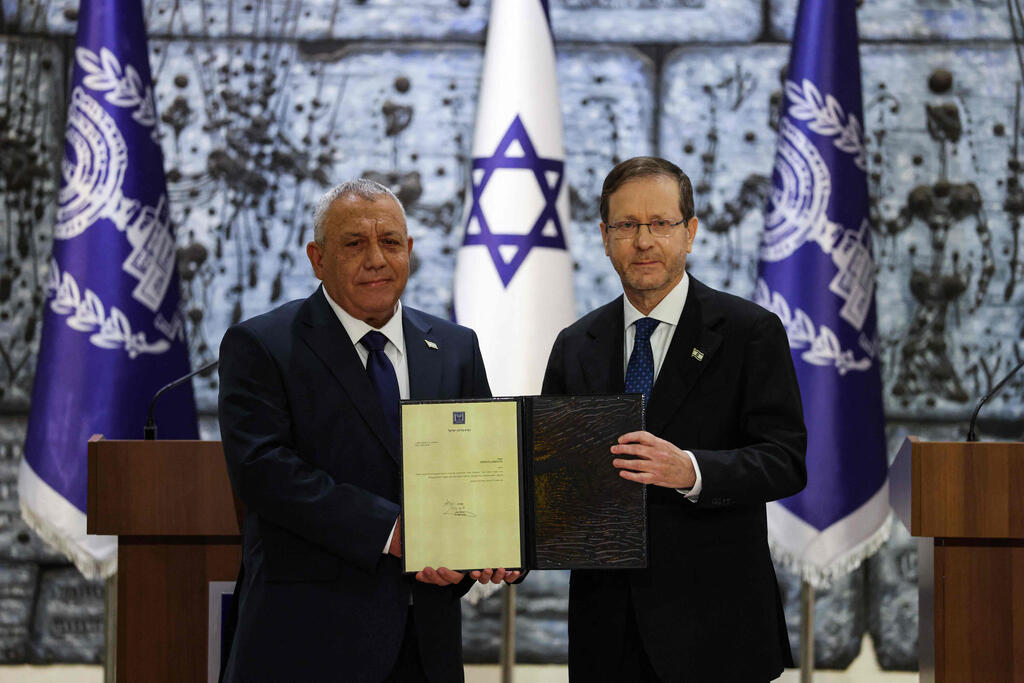
Yashar chairman Gadi Eisenkot formally receives the mandate to form a government from President Isaac Herzog
(Photo: Ilia YEFIMOVICH / AFP)
When Eisenkot speaks of compromise alongside Herzog, he is not referring to Netanyahu. He still views a unity government with the incumbent prime minister as a last resort, if he considers it an option at all. Instead, he envisions bringing a minority government to a parliamentary confidence vote without formal coalition negotiations and not necessarily with the explicit agreement of all his political partners.
"If they don't want it, we'll bring the government to a vote anyway and see who votes against it," people close to Eisenkot have been heard saying as they plan their next steps.
Publicly, Eisenkot is projecting business as usual in his dealings with fellow opposition leaders. He is meeting with them, holding extensive discussions and patiently assessing their intentions. Privately, however, he is angry that they have refused to accept his leadership and are exploring alternative coalition arrangements through separate channels. That frustration could resurface later in the negotiations.
An indication of the strained relationships came during Eisenkot's speech at the President's Residence, which made no reference to his political partners. Their conspicuous absence from his remarks was particularly striking, despite his plans to meet later Sunday with former prime minister Naftali Bennett, Yisrael Beytenu chairman Avigdor Liberman and subsequently Democrats leader Yair Golan.
For now, Eisenkot is trying to buy time.
A legal provision preventing the replacement of the Knesset speaker until a newly elected parliament is sworn in has created a particular timetable for his efforts. Only next week are 61 lawmakers expected to submit signatures demanding a vote to appoint a new speaker.
Until then, Eisenkot does not intend to make significant moves. As long as Likud's Amir Ohana remains Knesset speaker, Eisenkot does not plan to formally notify the president that he has succeeded in forming a government, advance legislation or repeal existing laws.
From his perspective, the main political and parliamentary developments will begin once the speakership passes to the bloc seeking to replace Netanyahu.
Replacing the speaker would be an important milestone, but it would resolve only part of Eisenkot's difficulties.
Eisenkot and the other leaders of the anti-Netanyahu bloc currently face a series of unappealing choices. Throughout the election campaign, the four leaders repeatedly made three core promises, with almost identical positions: no government with Arab parties, no government with ultra-Orthodox parties and no government with Netanyahu.
If a new government is formed, at least one of those promises will soon have to be broken. Which one depends on whom you ask.
Eisenkot is prepared to pursue a minority government that relies on support from Arab parties, despite his campaign pledge not to do so.
Liberman has chosen a different path, signaling a willingness to abandon his central promise not to govern with ultra-Orthodox parties and to overhaul military conscription arrangements and the government funding they receive.
Bennett, who also committed to all three conditions, has remained silent. However, the prevailing assessment is that he does not currently support a minority government dependent on Arab parties.
Golan initially favored a government based on Jewish-Arab political partnership. Since Saturday, however, he has adopted a more conciliatory tone toward the ultra-Orthodox parties, signaling his willingness to cooperate with them.
Eisenkot's team has been working intensively in recent days to bring the entire bloc to an agreement, but it is also preparing for a political game of chicken: presenting a proposed government to the Knesset and challenging reluctant partners to vote it down.
For Eisenkot, the crucial 28-day period has begun. Yet its outcome depends on so many competing political interests that his own ability to determine the result may prove limited.