

The second week of January 2026 saw a calculated diplomatic performance in Paris, where representatives of Syria’s interim government and the State of Israel announced the formation of a ‘joint fusion mechanism’ (JFM) to coordinate intelligence sharing and military de-escalation under United States supervision.
While some international observers have portrayed the move as a stabilizing breakthrough, a closer examination suggests a far more cynical reality. For Ahmad al-Sharaa, the former al-Qaeda-linked operative now serving as Syria’s interim president, the Paris summit represents not a pivot toward peace but a survival maneuver, aimed at securing sanctions relief and international legitimacy while consolidating a new, sectarian autocracy at home.
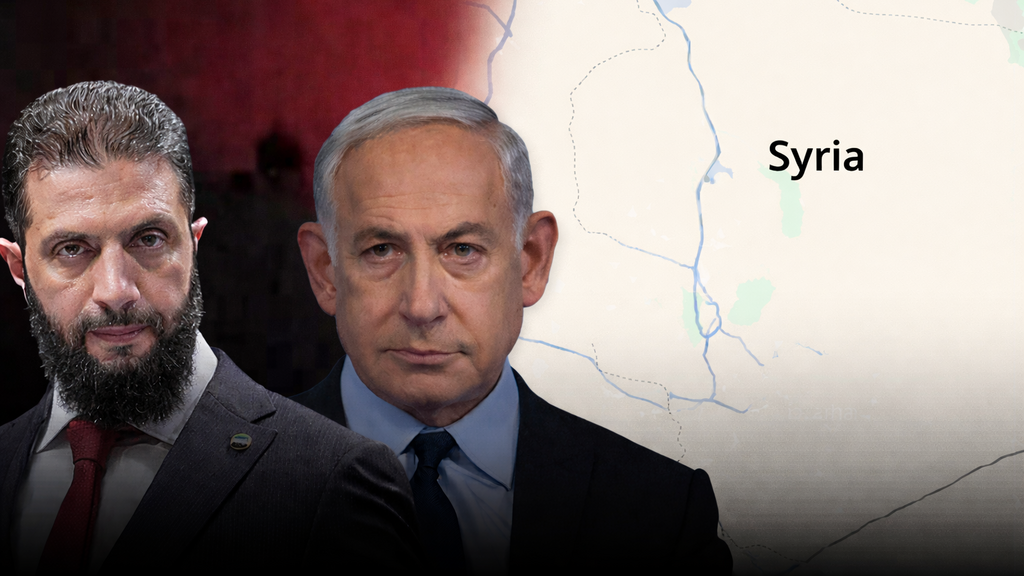
Ahmad al-Sharaa and Benjamin Netanyahu
(Photo: Alex Kolomoisky, Mehmet Ali Ozcan/ Anadolu via AFP, Menahem Kahana/ AFP)
The ‘joint fusion mechanism’ establishes a dedicated communication cell for intelligence coordination and limited commercial engagement, intended to prevent military friction along the Golan border. Yet this functional cooperation masks the ‘technocrats abroad, theocrats at home’ strategy that defines the Sharaa administration. While his envoys in Paris speak the language of regional stability, the reality in Damascus is the institutionalization of Sunni Muslim supremacy.
The interim constitution adopted in 2025 explicitly requires that Syria’s president be Muslim and establishes Islamic jurisprudence as the primary source of law, effectively stripping Alawite, Druze and Christian communities of equal standing in the national fabric.
Sharaa’s administration is increasingly viewed as a recycled form of authoritarianism, one that replaces Ba’athist secularism with Islamist centralism. This consolidation of power has been accompanied by a ‘shadow government’ crisis, as hardline Hayat Tahrir al-Sham officials from Idlib have moved into Damascus to enforce religious orthodoxy and ideological conformity.
Far from the inclusive transition promised a year ago, the Sharaa regime has presided over, and in some cases participated in, large-scale attacks against Alawite and Druze populations. Indeed, one of Israel’s primary demands during the Paris talks was the provision of specific security guarantees for the Syrian Druze, who have faced massacres and sustained sectarian violence since the fall of the previous regime.
The economic incentives discussed in Paris, including a plan to expand Syria’s power capacity by 800 megawatts and potentially boost GDP by 20 percent, are the true drivers of Sharaa’s newfound ‘pragmatism’. With Syria trapped in a subsistence economy and an estimated 87 percent GDP collapse since 2011, Sharaa understands that his HTS-led order will not survive without the removal of remaining Western sanctions.
By offering limited security cooperation and signaling an end to Iranian weapons transfers, he is attempting to purchase the political acceptance needed to access global markets and Gulf funding. Yet his legitimacy remains deeply fragile. Security forces continue to carry out arbitrary detentions and religious policing, while Sharaa himself has articulated an uncompromising governing philosophy: he who liberates will decide.
Strategic imperatives: what Israel should do
Given Sharaa’s background and the inherent instability of his regime, Israel must adopt a policy of strategic skepticism that prioritizes deterrence over diplomatic trust. The ‘joint fusion mechanism’ should be treated strictly as a tactical crisis-management tool, not a pathway to normalization or evidence of ideological transformation.
 Amine Ayoub
First, Israel must maintain its current military footprint in the buffer zone and at the summit of Mount Hermon, rejecting Sharaa’s demands for a return to the 1974 Disengagement Agreement lines. With the Sharaa government unable to exercise a monopoly on force in southern Syria, any Israeli withdrawal would create a vacuum quickly filled by global jihadist groups or remnants of the Iranian axis.
Second, Israel should institutionalize its role as a guardian of minorities as a core pillar of its regional strategy. This means extending direct protection to Druze, Christian and Kurdish communities whose survival is threatened by Sharaa’s Sunni supremacist vision. Rather than relying on hollow promises from Damascus, Israel should establish a dedicated mechanism for minority protection, providing intelligence coordination and humanitarian assistance to Sweida and other vulnerable enclaves.
This approach is not only a moral imperative, it also creates a network of natural partners who share Israel’s interest in resisting Islamist monocultures.
Finally, Israel must preserve its kinetic edge and preemption doctrine, refusing to allow terrorist armies to reconstitute under the cover of the JFM. Hamas, Palestinian Islamic Jihad and al-Jama’a al-Islamiyya are already seeking to establish footholds amid the post-Assad chaos. Israel must continue the war between the wars, targeting advanced weapons systems regardless of whether they are Iranian, Turkish or HTS-controlled.
Only sustained military pressure and a physical buffer can ensure that Sharaa’s Islamist experiment does not evolve into the next existential threat on Israel’s northern border.
- Amine Ayoub, a fellow at the Middle East Forum, is a policy analyst and writer based in Morocco