

At times it seems that in the international system the pace of change is especially rapid: what was once considered a red line becomes a matter for negotiation, and what once appeared unthinkable gradually gains legitimacy. This sense accompanies today’s debate over U.S. policy toward Iran and the Middle East.
The United States’ policy of containment toward Iran, alongside attempts at dialogue and avoidance of direct confrontation, is perceived by many regional rulers as a sign of strategic weakness. In the Middle East, not only actions matter but also how they are perceived. When the United States sends mixed signals or shows hesitation, its allies begin to question the reliability of its security guarantees in times of crisis.
Against this backdrop, claims are being made that American policy is encouraging, even if indirectly, a nuclear and missile arms race. It is still difficult to determine whether such a trend is indeed emerging, but it is clear that it is changing the security calculations of regional states. As the sense grows that the strategic environment is more dangerous and that the American security umbrella is less certain, the incentive to seek independent deterrent capabilities increases.
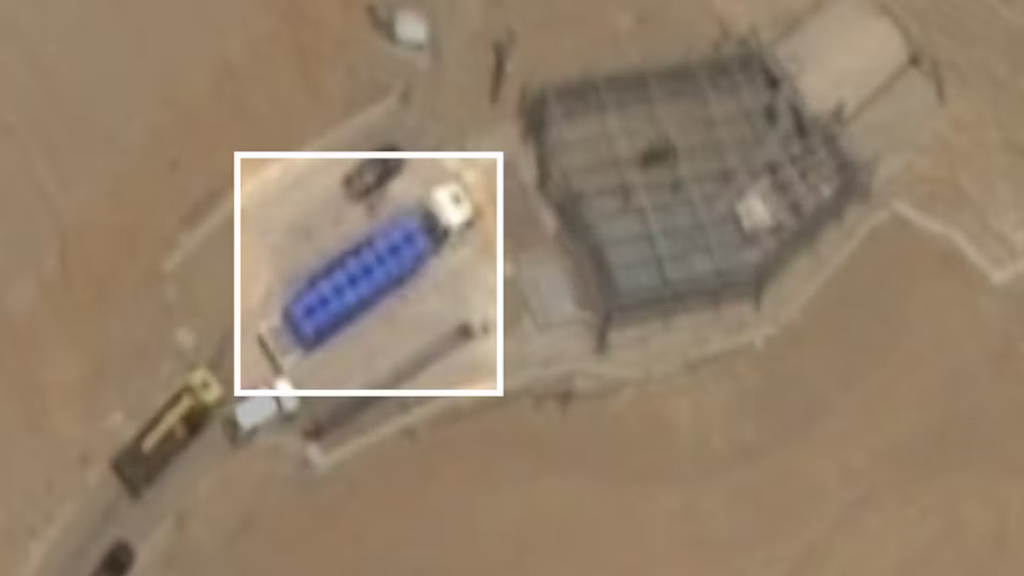
A convoy carrying mysterious supplies at the entrance to the facility in Isfahan
(Photo: Airbus DS (2026))
The global reality offers context for this concern. Today, nine states possess nuclear weapons, while threshold states such as Japan, Germany and South Korea have the technological capability that would allow them to move relatively quickly toward a military nuclear capability if they choose to do so. In the Middle East, countries such as Saudi Arabia, Egypt, the United Arab Emirates, Qatar and Bahrain are closely following developments between the United States and Iran and drawing their own conclusions. For them, the question is not only the strength of Iran, but also how determined the United States is to contain it over time.
Until recently, it was widely assumed that the risk of the transfer of nuclear weapons or nuclear technology to terrorist actors was relatively low. States feared exposure and severe international backlash, and intelligence capabilities and nuclear forensics made denial more difficult. However, this assumption rests on the belief that there is a firm international resolve to punish violators of the rules.
Herein lies the real concern. The danger is not necessarily the transfer of a complete nuclear bomb, but rather the dissemination of knowledge, engineering expertise, dual-use equipment and radiological materials. Knowledge is easier to transfer than operational weapons, and its spread is harder to prevent.
 Moshe Elad
The question is whether certain states may conclude that the cost of such activity is no longer the deterrent it once was. Why should state actors not in the future see the transfer of strategic knowledge as a tool for advancing political and economic interests, while relying on a broad space of plausible deniability?
The concern is not only about the current reality, but about the erosion of norms. For decades, there has been an international consensus that the proliferation of nuclear weapons is a red line. If regional states become convinced that the international system no longer enforces the rules consistently, they may seek security through means they previously did not even consider.
This scenario may not materialize. However, in the Middle East, perceptions create reality. If U.S. allies conclude that they can no longer fully rely on it, they may begin to seek independent alternatives. In such a situation, what was forbidden yesterday could become a legitimate option tomorrow — and perhaps even a new norm.
Dr. Lt. Col. (res.) Moshe Elad is an Orientalist and researcher.
First published: 05:39, 06.25.26