


As the Palestinian Authority accelerates preparations for legislative elections scheduled for November 28, 2026, a critical security dynamic is taking shape across Ramallah, Gaza and regional capitals. Two decades after the 2006 parliamentary vote provided the political springboard for Hamas to establish an armed stronghold in the Gaza Strip, the terror organization is executing an evolved version of the same tactical playbook. The upcoming vote is not an exercise in democratic renewal or institutional reform. It represents a calculated attempt by Hamas to achieve through political penetration what military force alone could not secure: formal standing within Palestinian Authority structures, access to West Bank civil mechanisms and the systematic expansion of its operational footprint directly adjacent to Israel's major urban centers.
The legal framework governing the November 28 election was formalized through presidential decrees issued in Ramallah. On July 9, 2026, Palestinian Authority President Mahmoud Abbas issued a presidential decree setting November 28, 2026, as the date for legislative elections, with presidential elections deferred to early 2027. Following a June 2026 decree that briefly expanded the Palestinian Legislative Council to two hundred seats, Abbas issued a corrective decree-law on August 11, 2026, officially restoring parliament to its baseline of 132 seats. Confirmed by the Central Elections Commission, this regulatory update retained key administrative reforms. The electoral system operates under nationwide proportional representation with a one percent electoral threshold. Statutory amendments lowered the minimum candidacy age from twenty-eight to twenty-three and instituted a mandatory thirty-three percent quota for female candidates across all participating slates.
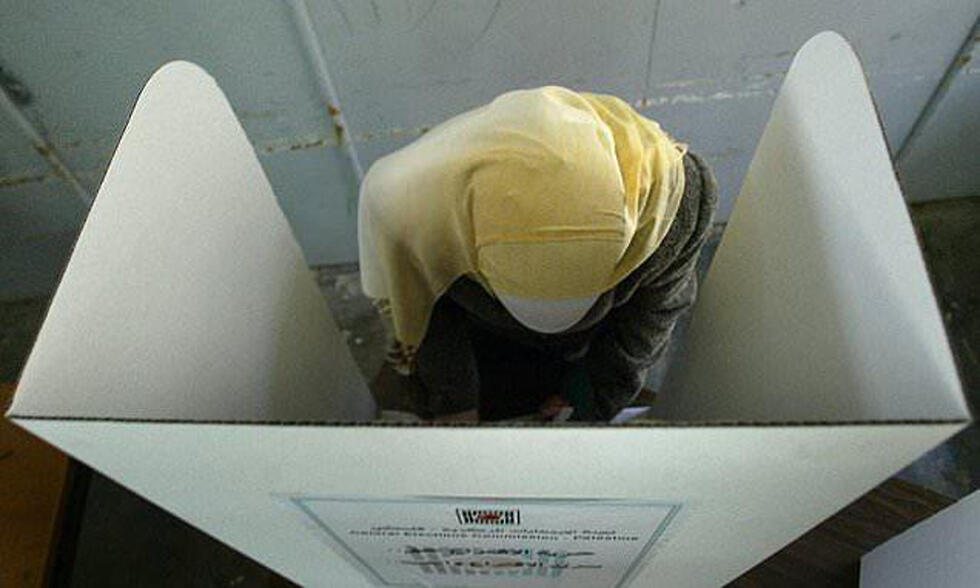
A voter casts her ballot in the 2006 Palestinian Authority election in the West Bank
(Photo: AFP)
Crucially, the election law establishes an explicit political precondition for all competing entities. Every candidate list is legally required to submit a signed pledge committing to the platform of the Palestine Liberation Organization as the sole legitimate representative of the Palestinian people, acknowledging international legitimacy resolutions and accepting past signed agreements. This requirement is widely recognized as mandating the formal recognition of the State of Israel and the explicit renunciation of violence. To Western diplomats and PA leadership, this statutory clause was envisioned as an insurmountable checkmate designed to force Hamas into a binary choice: either accept political moderation and renounce armed conflict, or face complete legal disqualification from the democratic process.
Hamas, however, operates with sophisticated cynicism regarding civil statecraft. In a public address broadcast on Al-Aqsa Television on August 12, senior Hamas political bureau member Hussam Badran explicitly rejected these legal preconditions. Badran dismissed the requirement to adopt the PLO program as an unacceptable attempt to impose political tutelage and restrict democratic competition. Yet documented statements confirm that Hamas has no intention of boycotting the ballot box. Instead, Badran affirmed that Hamas intends to participate under the broadest possible national coalition. By coordinating with secondary Palestinian factions, independent technocrats and regional slates, Hamas aims to field proxy lists capable of satisfying Central Elections Commission registration formalities without requiring ideological concessions or formal moderation from the movement's core leadership.
Hamas’s declared objective is not to assimilate into the PLO's existing peace framework, but rather to use parliamentary representation and national dialogue to alter and reform the PLO from within. By infiltrating the governing structures of the Palestinian Authority, Hamas seeks to dismantle historical commitments to peaceful settlement and realign the Palestinian national movement around its doctrine of perpetual conflict. August 2026 polling by the Palestinian Center for Policy and Survey Research indicates that overall public support for Hamas has declined from its wartime peaks, driven by widespread devastation, loss of life and severe displacement across the Gaza Strip. Recognizing that its direct political brand faces domestic strain, Hamas views broad coalitions and proxy slates as an essential survival mechanism to preserve structural power without exposing itself to direct public accountability or municipal liabilities.
This approach reflects a calculated evolution in Hamas’s long-term governance strategy. Having experienced the severe economic vulnerabilities, public discontent and administrative friction of managing daily municipal services, Hamas no longer prioritizes direct executive administration. The leadership does not wish to be burdened with collecting garbage, repairing municipal water lines or funding civil service payrolls in West Bank towns. Instead, Hamas seeks the ultimate political insurance policy: formal legislative standing, legal immunity for its operatives, access to Palestinian Authority financial mechanisms and unrestricted freedom of movement across West Bank municipalities. All of this is designed to occur while the organization preserves its underground military wing, the Izz ad-Din al-Qassam Brigades, maintains its weapons stockpiles and advances its core goal of destroying Israel. Hamas seeks the international legitimacy of a recognized political entity combined with the operational latitude of an unconstrained terror militia.
 Amine Ayoub
The cautionary historical parallel to this strategy was established two decades ago and remains a foundational lesson for Israeli defense doctrine. Following its victory in the January 2006 legislative elections, where it secured 74 of 132 parliamentary seats, Hamas systematically refused to accept international Quartet conditions requiring the recognition of Israel, the renunciation of violence and adherence to prior agreements. That electoral triumph provided the institutional cover that enabled the group, in June 2007, to execute a violent military coup throughout the Gaza Strip, overthrow Palestinian Authority security forces, establish an authoritarian enclave and transform the coastal territory into a forward launchpad for Iranian-backed terror. To assume that twenty years later Hamas will act as a disciplined participant in a secular democratic framework ignores both historical reality and the movement's immutable ideological commitments.
The primary danger posed by the November elections centers directly on the West Bank. If Hamas succeeds in embedding its operatives within proxy slates or broad national coalitions, political campaigning will immediately provide legitimate civilian cover for covert military operations. Campaign offices, public rallies and town hall meetings will serve as operational environments for terror financing networks, cell recruitment drives, weapons procurement and intelligence gathering regarding Israeli military deployments. Under civic cover, Hamas operatives will build command structures throughout key West Bank urban hubs, including Hebron, Nablus, Jenin and Ramallah.
An expanded Hamas political and operational footprint in the West Bank places Iranian-backed terror infrastructure directly adjacent to Israel’s critical strategic assets. Paper pledges signed by civilian proxy candidates exert zero legal or operational control over covert military cells or the Izz ad-Din al-Qassam Brigades. Physical proximity to West Bank urban hubs poses direct operational threats to the Ben Gurion Airport flight corridor, vital transportation arteries surrounding Jerusalem and the densely populated urban centers of the Gush Dan metropolis. Blending electoral legitimacy with an armed terror militia does not produce political moderation; it creates a dangerous platform for state-sponsored terrorism directly on Israel's borders.
Israel cannot remain passive while this threat materializes across the West Bank. To safeguard national security, the Israeli defense establishment must enforce three strict parameters. First, Israel must ban all terror-linked candidates, proxy slates and organizational activities in areas under its security jurisdiction. Second, Jerusalem must reject all electoral logistics in East Jerusalem for any process involving hostile proxy factions. Third, security forces must intensify counter-terrorism operations to dismantle covert cells. The scheduled November elections do not offer democratic progress. They represent a strategic maneuver by Hamas that Israel must dismantle.
- Amine Ayoub, a fellow at the Middle East Forum, is a policy analyst and writer based in Morocco. Follow him on X: @amineayoubx