


The old Israeli security doctrine is finished. For more than twenty years the prevailing assumption held that periodic airstrikes, intelligence monitoring, and international resolutions could keep hostile forces at a manageable distance.
October 7 shattered that assumption. Paper agreements and foreign peacekeepers failed to protect Israeli civilians. Quiet along the borders was never real stability. It was simply an invitation for the next attack. The period of hoping that external guarantees and limited kinetic pressure would suffice has closed. What replaces it is a more assertive approach grounded in the physical control of space and the early denial of enemy capabilities.
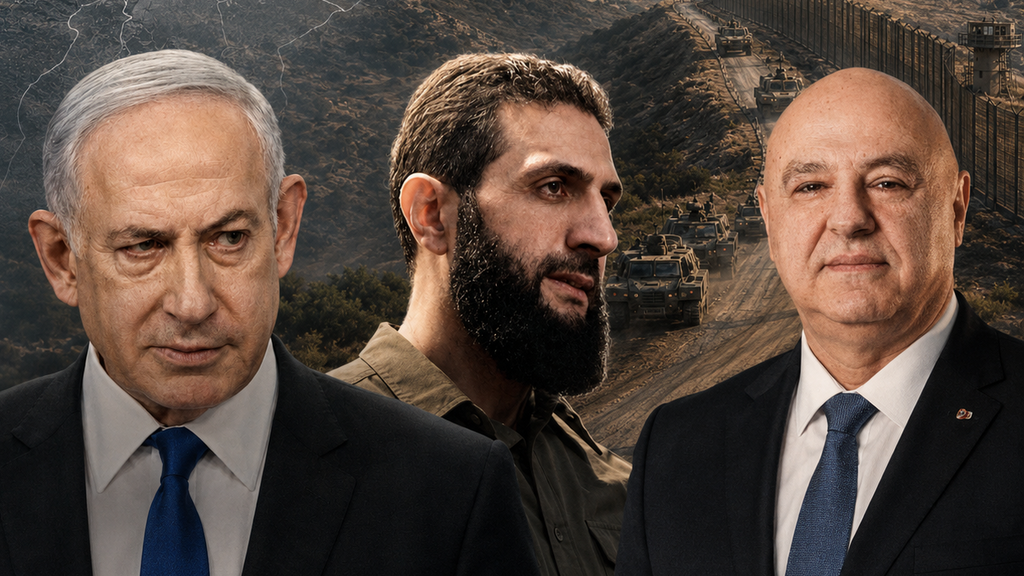
What is happening now in Syria and South Lebanon represents a decisive break. Israel is no longer content to manage threats on its perimeter. It is actively reshaping the operational map of the Levant under a doctrine that can be called Forward Deterrence. The objective is straightforward: deny adversaries the space and time to assemble forces, construct infrastructure, or gain any effective veto over Israeli freedom of action.
The precision strikes on Abu al-Duhur and the sustained campaign to establish a controlled buffer in South Lebanon are the clearest early expressions of this shift. Together they signal that Israel intends to dictate the conditions under which threats can even begin to form rather than wait for those threats to mature and then respond.
On August 18, 2026, Israeli aircrafts conducted eight precision strikes against the runway and storage facilities at the Abu al-Duhur military airbase in northwestern Syria. No casualties were reported. The base lies roughly seventy kilometers from the Turkish border along a strategic corridor between Hama and Aleppo. It had largely ceased functioning as an active airfield after 2013 and changed hands repeatedly during the civil war. Following the collapse of the Assad regime, the new Syrian authorities began rehabilitating it as a training site for their emerging army
Israeli officials explained the target selection by citing intelligence that pointed to growing Turkish military interest in the facility. A Turkish delegation had recently visited to evaluate runway rehabilitation. Israeli assessments concluded that Ankara was preparing to introduce radar, air-defense systems, and potentially troops under the stated purpose of helping stabilize the new Syrian government. An integrated Turkish radar and air-defense presence so close to the border would create an anti-access zone that restricted Israeli Air Force operations across northern Syria. Netanyahu’s office stated that Israel had issued clear warnings to both Damascus and Ankara. When those warnings went unheeded, the runway was cratered.
The strikes in Abu al-Duhur military airbase
(Video: X)


Syria’s foreign minister later confirmed that Turkish officers had visited for cooperation and training purposes but insisted there were no plans for a permanent Turkish base or troop deployment. Turkey denied that any military delegation was present at the time of the strike and rejected the characterization of the threat. A U.S. envoy described the action as an unnecessary escalation. The operational message was unambiguous. Israel will not allow any foreign actor, including a NATO member, to plant capabilities that constrain its air supremacy on the northern flank.
The following day, IDF Chief of Staff Eyal Zamir, speaking while visiting troops in the Israeli-held security zone in southern Syria, underlined the point. Israel tracks every development along the Syrian frontier and will strike exactly where and when national security demands it. Syria will not be permitted to become a platform for third-party military entrenchment.
The campaign underway in South Lebanon confronts a different but connected vulnerability. For eighteen years after the 2006 war, Israel depended on United Nations Security Council Resolution 1701 and the presence of UNIFIL to keep Hezbollah north of the Litani River. That arrangement collapsed in practice.
Hezbollah constructed tunnels, anti-tank positions, and weapons depots immediately adjacent to Israeli civilian communities. Observation posts and firing positions were embedded in civilian villages. The result was the prolonged displacement of tens of thousands of residents from Metula, Manara, Kiryat Shmona, and other northern towns. The international mechanism designed to prevent precisely this outcome proved unable or unwilling to enforce its own terms.
Israel’s current method is more direct. The IDF has established a Forward Defense Line, frequently shown on maps as a security or operations zone that extends several kilometers into Lebanese territory and in some sectors approaches the Litani.
Multiple divisions have conducted operations south of that line to dismantle Hezbollah infrastructure, destroy fortified positions, clear firing sites, and open clear lines of sight. Villages previously used as launch pads have been cleared or placed under restriction. The physical landscape of the border zone is being reshaped so that any approaching threat can be detected and stopped before it reaches Israeli communities. This is not a series of temporary raids. It is the deliberate creation of a controlled buffer under exclusive Israeli operational authority.
Critics label the effort overreach or occupation. Supporters view it as the necessary enforcement of sovereignty after diplomatic assurances proved worthless. The safe return of northern residents cannot depend on Lebanese government promises or another cycle of international mediation. It requires a zone under firm IDF control where threats are eliminated rather than merely monitored.
If reshaping the terrain of South Lebanon is what that demands, then the terrain will be reshaped. The buffer also provides continuous intelligence collection opportunities and shortens reaction times for any future rocket or ground assault.
Forward Deterrence along the northern frontier cannot hold if the internal rear is left unstable. Intelligence continues to warn of Iranian efforts to push weapons, cash, and operational direction into the west bank. As pressure increases on Iran’s other proxy routes, Tehran has every incentive to open a second front through cells in Jenin, Nablus, Tulkarm, and similar locations. Israeli security services treat these threats as inseparable from the larger regional campaign rather than as a separate internal policing matter. Preemptive action to break up cells, seize smuggled arms, and sever financing channels is essential if the main forces are to remain free for the primary strategic contest.
The Middle East has always rewarded clarity and proven capability more than restraint or appeals to legal formulas. Passive containment produced larger and more destructive attacks. Forward Deterrence aims to reverse that pattern by imposing costs early, denying sanctuary, and controlling the physical approaches to Israel’s borders.
The strikes at Abu al-Duhur drew a hard line against foreign military penetration of Syrian airspace. The buffer in South Lebanon is converting a chronic vulnerability into a managed security zone. Persistent pressure in the west bank works to keep the rear from becoming another active front. Each element reinforces the others.
None of these steps is free of risk. Potential escalation with Turkey, friction with the new Syrian authorities, and ongoing confrontation with Hezbollah all carry real costs. Diplomatic criticism is already audible from Washington. Sustaining a forward presence requires resources, political will, and the ability to absorb international pressure. Yet the alternative, a return to the pre-October 7 pattern of limited periodic operations and hope that international guarantees would somehow hold, has already been tried and found insufficient.
The period of managing the conflict through containment has ended. The period of setting the operational geography and determining the conditions of national survival has begun. The actions in Syria and Lebanon are the opening moves. They should not be the final ones.
Amine Ayoub, a fellow at the Middle East Forum, is a policy analyst and writer based in Morocco. Follow him on X: @amineayoubx