


Did he ask or didn’t he? That is the question. Did Netanyahu ask Trump during their most recent White House meeting to pressure President Isaac Herzog to grant him a pardon, or was it the U.S. president’s own initiative to publicly and rather aggressively call on Herzog to pardon Israel’s prime minister?
On the face of it, there is no clear reason to doubt the denial issued by the Prime Minister’s Office. It is plainly in Netanyahu’s interest for pressure to be applied on Herzog so that a pardon would be granted as soon as possible. The longer the process drags on and the more Herzog delays a decision, the greater the damage to Netanyahu. If a decision comes only after Netanyahu completes his court testimony, he will no longer be able to argue that a pardon and the suspension of the trial are necessary to spare the prime minister’s valuable time. Meanwhile, the legal proceedings continue and the testimony grows increasingly complicated for him.
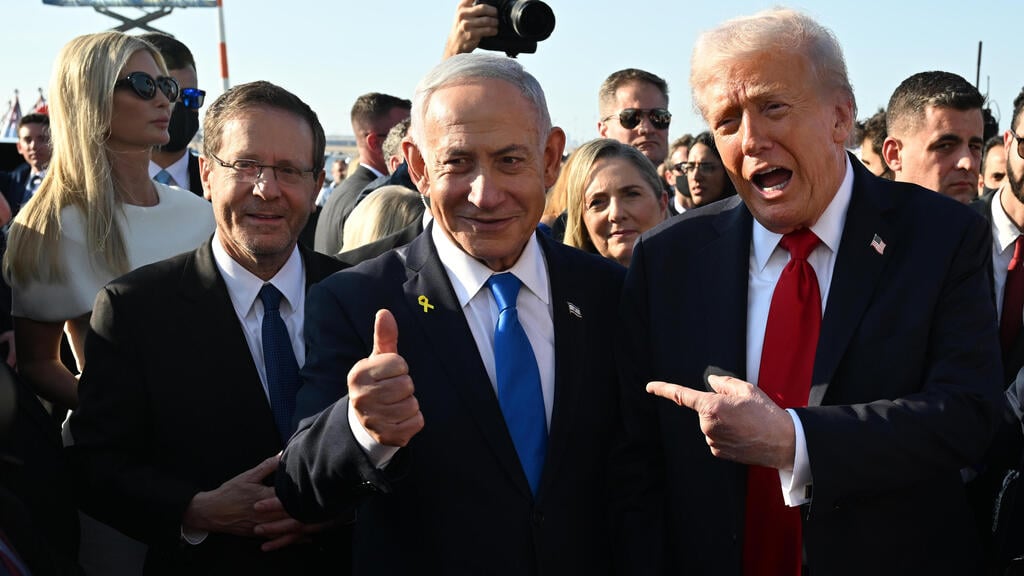
(Photo: Chip Somodevilla/Getty Images)
Knowing Donald Trump, it is entirely possible that he made such remarks spontaneously, on his own initiative and without Netanyahu asking him to do so. It should be remembered that both Netanyahu and Trump have shown themselves willing to bend the truth to serve their interests, and both have demonstrated that personal interests can outweigh those of their respective countries, the United States and Israel.
At this stage, the fact that both men are viewed with suspicion and that the broader public does not hesitate to cast doubt on their motives already says something about how many perceive their moral standing. In many respects, our lives are in their hands and they are the ones shaping our future.
Trump’s call for a pardon, made during remarks in Jerusalem, followed a private car ride from Ben-Gurion Airport with Netanyahu, along with Sara Netanyahu and Melania Trump. At the time, there was no clear denial over who initiated the mention of a pardon, only a partial one. There is no reason to assume the situation is different now. The same scenario appears to have unfolded: a private meeting followed by Trump publicly urging a pardon for Netanyahu in pointed terms directed at Herzog.
Will Herzog withstand the pressure?
Another question is whether Herzog will stand firm and whether the pressure affects him at all, or whether this is merely rhetoric designed to create a narrative Netanyahu can later use: that a pardon was demanded on his behalf but Herzog refused because he is beholden to the “deep state.” Netanyahu is in a win-win situation. If he receives a pardon, he benefits. If he does not, he can claim persecution by the “deep state” and argue that even Herzog ignored a request from Israel’s greatest friend in the White House.
There is also the question of the logic behind Trump’s attack on Herzog. Does it help Netanyahu, and does it suggest Netanyahu encouraged Trump beforehand?
One could argue there is little logic in Trump portraying Herzog as a hollow figure whose only authority is to grant a pardon, effectively inviting the Israeli public to shame him for failing to comply with the wishes of the world’s most powerful leader.
Perhaps Netanyahu and Trump assumed Herzog is a weak president who would buckle under such pressure and move quickly to grant a pardon. Or perhaps the very attack strengthens Herzog’s resolve to demonstrate that Israel is not a banana republic that yields to every whim of a U.S. president.
This leads to another possibility: the best outcome for Netanyahu might be for Herzog to approve a pardon only for the High Court of Justice to overturn it. Such a scenario could energize voters ahead of the next election and potentially help Likud recover several lost seats that may prove decisive. Internal Likud polling suggests that what most concerns its voters is the “deep state” narrative. A refusal by Herzog to grant a pardon or a court decision striking one down could serve as the ultimate political gift for Netanyahu, much like previous controversies that galvanized his base.
 Itamar Eichner
 Those close to Trump are well aware of Israel’s pardon process. In the past, associates of Jared Kushner reportedly inquired about the procedure and were told it typically takes three to six months and cannot be expedited. That makes the timing of Trump’s current intervention all the more striking and raises the questions outlined above.