

Two years have passed since the horrific morning of October 7, 2023, a day that revealed scenes few could have imagined: communities under attack, families slaughtered, hundreds taken hostage and a national shock that shook the foundations of security, society and the future.
October 7 was not just another “security incident”; it was a strategic, moral and cognitive earthquake. Two years later, the question is not only how to remember that day but how to translate its lessons into a sustainable vision for Israel’s security, society, diplomacy and identity.
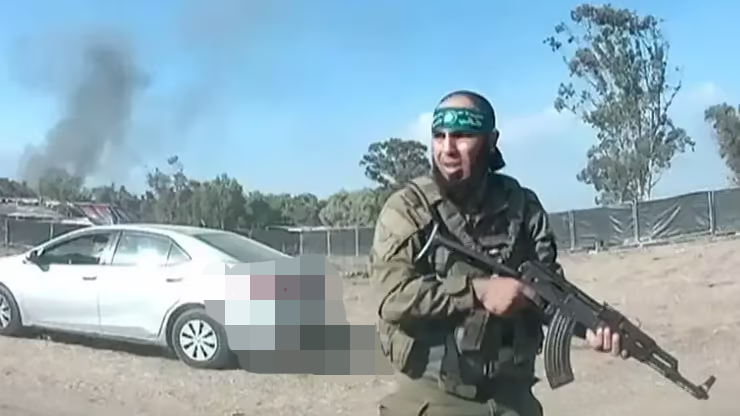
A Hamas terrorist at the site of the Nova music festival, October 7, 2023
The attack exposed a profound systemic failure: excessive reliance on technology and a “smart fence” rather than maintaining a constant threat perception and adaptive operational deployment. Years of relative calm in the south lulled the security establishment, the intelligence community and the public into complacency. The lesson is clear: Israel must shift from a static defense posture to smart defense with sustained offensive initiative.
This requires multi-layered borders integrating technology and human intelligence, persistent presence, rapid response capabilities and a culture of continually challenging outdated assumptions.
Strengthening the interface between the military and the civilian front is equally critical.
The crisis also revealed glaring civil gaps alongside security failures. Communities were left to fend for themselves for hours, while volunteers filled voids the state failed to address in time. Rebuilding trust requires empowering local authorities, closing center–periphery gaps in resilience infrastructure and renewing the social contract with clear responsibilities and transparency in emergencies. Civil preparedness is not a luxury; it is a strategic necessity that can determine the difference between paralysis and resilience in moments of crisis.
October 7 demonstrated that the Palestinian arena is deeply intertwined with the regional environment. Iran, Hezbollah, Hamas, Palestinian Islamic Jihad and Arab states all form part of the same strategic equation.
 Munir Dahir
Israel must adopt an integrated security-diplomatic approach that dismantles terrorist capabilities in Gaza while offering a measured civilian horizon, strengthens pragmatic elements within the Palestinian Authority and deepens security and civilian cooperation with Arab states through the Abraham Accords. At the same time, it must deliver a consistent message to Iran and its proxies regarding the cumulative strategic cost of destabilization.
The massacre was accompanied by a global cognitive offensive that included disinformation, distorted framing and rapid blame inversion. Israel’s response was often delayed and fragmented. To succeed, it must craft a national narrative strategy with unified messaging, interagency coordination and multi-platform engagement. The information domain is not a side campaign. It is a battlefield that requires constant, proactive presence and strategic clarity.
Beyond the military and political realms, the challenge is also moral. Can Israel fight barbarism without losing its moral compass? It must uphold the principles of ethical warfare, minimize harm to noncombatants and demonstrate unwavering commitment to the hostages and their families, not as symbols, but as a guiding national principle. Israel’s strength lies not only in its military power but also in the justice of its cause and its moral clarity, both of which are essential for maintaining legitimacy and resilience over time.
October 7, 2023, is a defining moment. The question is whether it will remain merely a memory of pain or become a practical turning point. The choice is ours: to settle for remembrance ceremonies and symbols, or to implement a renewed, comprehensive strategy across security, civil resilience, regional policy and the global narrative. Memory obligates us. The future depends on us.