

You don’t lose what you never had, but rather what you didn’t know how to defend. But there is a defeat worse than battle: capitulation, the renunciation of values in exchange for the ephemeral and illusory immediacy of the enemy's approval.
The kind that occurs when an almost invisible wound opens, through which a fever of disloyalty filters, now seeking its sounding board in social media and mass media. It is the same, amplified to the point of exhaustion, that which seeks to question the legitimacy of the world's only Jewish state. It is an old narrative, with new clothes, one that finds its perfect breeding ground in the digital echo, and which, for example, Osvaldo Bazán managed to encapsulate with such clarity in the story “For Paula,” published days ago in the Argentine Revista Seúl.
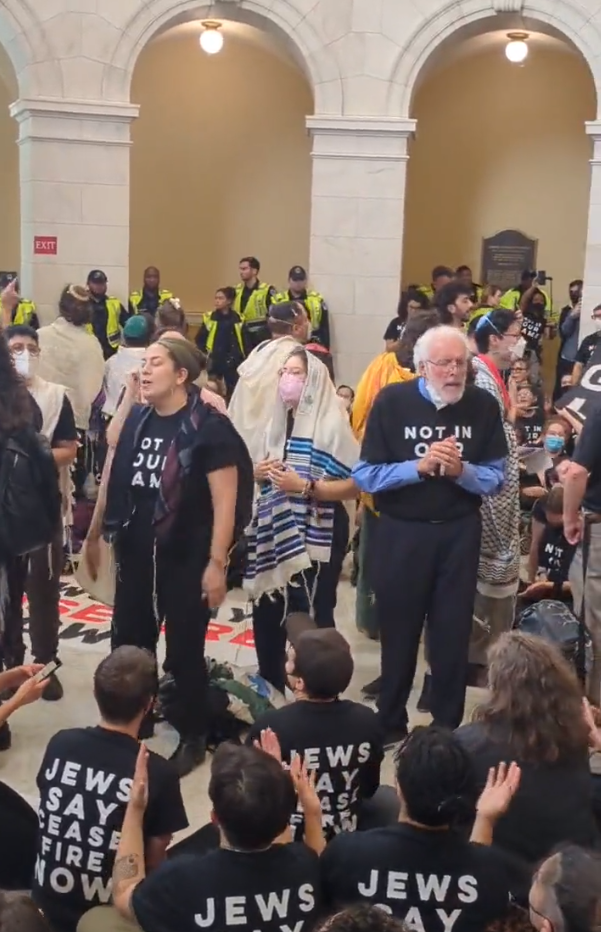
And so it is that there are those who want to turn social media into a showcase of denial, where a minuscule and noisy variety of wannabe individuals use the argument of the supposed "genocide" in Gaza - an abject falsehood in the face of legitimate self-defense against a genocidal organization - to justify their instrumental and preexisting hatred against the State of Israel.
To Paula's case, in recent days, South American X (formerly known as Twitter) lore was added that of Flor. They represent the deepest layer of betrayal: that which not only condemns Israel but also delegitimizes the most visceral operation of any nation: the search for its kidnapped citizens in defense of life.
For a Jew to question self-defense in order to recover the hostages (both the living and the ones who were tragically and painfully murdered) from the clutches of an organization that makes the permanent Intifada its genocidal modus operandi is not an act of conscience, but a moral capitulation. It is the point where the "critic" irrevocably becomes a "Token Jew" - as per defined by Adam Milstein on his brilliant op-ed published by the JPost on September 28 - or, in classic jargon, the "useful idiot," lending their identity to a cause that seeks the annihilation of their own people. I find it interesting to put some of these issues into perspective.
For the Jew, Zionism is not an option on the negotiating table of history. It is, unequivocally, the Tequma, the safeguard of a people who learned, at the price of blood and much sorrow, that Jewish life without sovereignty is an equation of infinite fragility.
Zionism, Herzl's dream in his call for the Basel Congress of 1897, is a resounding denial of that destiny of vulnerability that the Diaspora faced for millennia; it is the restoration of the Jewish home in its ancestral land, Eretz Israel. It is Contingency Theory materialized: the certainty, taken with the bitter pill that accompanies it, that to survive through time, the Jew must be its own guardian, maintaining vigilance, firmness and strength.
Against this existential and non-negotiable truth, the radical left has deployed its most insidious infantry: the "Token Jew." These individuals are not critics; they are deserters from the collective destiny, ideological ammunition that offers a "license to hate" to those who seek the dismantling of the world's only Jewish sanctuary.
What we are witnessing is a drama of betrayal, where belonging to the Jewish people becomes a human shield to whitewash an antisemitism that, unable to look itself in the mirror, disguises itself as anti-Zionism. Because saying you hate a group of human beings is a truth that not even morally bankrupt people can admit, but saying you hate the existence of a state immediately reconfigures the compass of their feeble emotions, at least in appearance.
In their pathological search for Conditional Acceptance (Kabala al Tenai), the Token sells their integrity and risks the survival of their people for the whisper of progressive approval. Their stance is not moral nobility, but a deep disloyalty to the blood covenant, repeating the blindness that in the past cost millions of lives.
The syndrome of historical self-annihilation
The phenomenon of the Token Jew is rooted in a pathology of assimilation that Zionist academia has diagnosed since its inception. Israeli historian and political scientist Shlomo Avineri dedicated himself to studying how Zionism arose from the catastrophic failure of Jewish emancipation in Europe.

Pro-Palestinian demonstratipn in New York
(Photo: Michael M. Santiago / Getty Images / AFP)
The Enlightenment (Haskalah) promised the Jew acceptance if they renounced their national identity and became a "German of Mosaic faith" or a "Frenchman of Jewish confession." The result was the Holocaust, where the distinction between the assimilated and the religious vanished under the Nazi yoke.
The contemporary Token revives this fallacy with suicidal arrogance. Their goal is not justice; it is the annihilation of Jewish sovereignty to ingratiate themselves with the progressive establishment. It is not for nothing that scholar Yoram Hazony emphasized in his work The Jewish State: The Struggle for Israel's Soul: these individuals confuse criticism of specific policies with the existential rejection of the nation-state of Israel. They desperately seek to be the "acceptable Jew," the one who is self-destructive enough to please the antisemite.
This behavior is a self-amputation of conscience. Prof. Ruth Wisse, in studying Jewish self-censorship, identifies the "strategy of the submissive victim," which I find interesting to bring into this discussion because the Token adopts the language and demands of those who pose as enemies, expecting benevolence and acceptance in return that will never come.
It is abundantly clear that, in the moment of truth, antisemitism never discriminates. The Token who today condemns Israel with more fury than a BDS supporter hanging a watermelon flag in their room, will tomorrow be as despised as the Jew who defends our people's right to exist in their ancestral land, their language, their collective memory or their faith.
By denying the Zionist Covenant and Ze'ev Jabotinsky's principle of the Iron Wall - the only guarantee that history will not repeat what happened with the Shoah or the Inquisition, for example - the Token becomes the advertising agency for the pursuit of a sentence to Jewish fragility among the nations. They want to surrender the only life insurance policy we have forged, in exchange for ephemeral applause, sentencing their own descendants to vulnerability.
Do-gooders and false neutrals
In this sense, the presence of figures like Ezra Klein and Peter Beinart in major Western media outlets (The New York Times and The Guardian, to name two examples) is purely instrumental. Their articles are not analyses, but rather attempts to be certificates of origin that seek to grant an ethical alibi to the anti-Zionist discourse. "Hey, look, if a Jew says it, it can't be hatred," is the argument that allows thousands of people to feel justified in desiring the dismantling of the Jewish state. These people seek to put a "kosher" stamp on the hatred they distill against their own people.
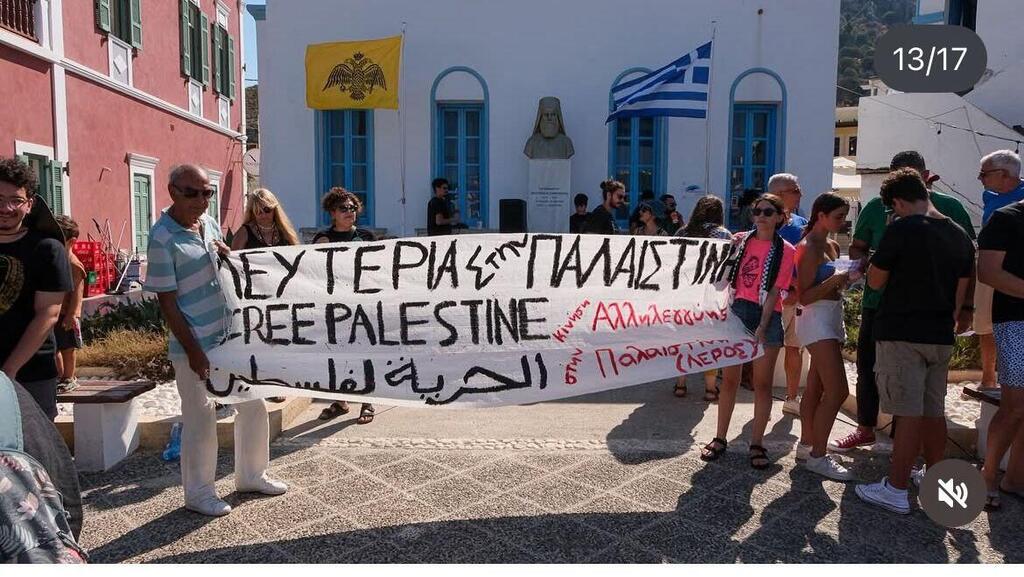
Pro-Palestinian 'Day of Rage' in Greece
(Photo: BDS Greece)
Beinart's rhetoric, which calls for the abolition of the Jewish state and its replacement by a binational entity, is an existential denial cloaked in progressive idealism. It is an act of supine ignorance or blatant disinformation, considering that the two-state solution was already agreed upon as far back as 1947, with a pact that even refers back to the Yalta Conference, and with offers that were reiterated 4 more times and always rejected because, until now, the Arab states have been more interested in trying to destroy Israel than in formalizing a Palestinian state.
Ultimately, this vision ignores the fundamental lesson of the history of minorities in the Middle East: those who lose their sovereignty are annihilated or forced into exile. The dismantling of Israel, under the euphemism of a binational state, would likely not generate coexistence, but a civil war of extermination that would result in the annihilation or mass exodus of the Jewish population.
The Token, by embracing this narrative, not only betrays Israel but also exhibits a double standard as ridiculous as it is crude: they seek to confuse the necessity of a Jewish state with the demand for its moral perfection. They forget that Zionism, like any national liberation movement, like the glorious Argentine liberation led by San Martín, promised survival, not the utopia of impossible perfection, and that the existence of Israel is, in itself, the greatest achievement of the Jewish people in the last century.
I highly doubt that the same people who defend these anti-Jewish positions from Argentina would dare to make the same proposal about Argentina in a speech at the Martín Fierro Awards (the media academy awards), for example. Ergo, their disloyalty is, at its core, a renunciation of the collective memory of Judaism, but also of 3,500 years of history of which their family is a part, sold for a pat on the back in the opinion section.
The case of Norman Briski in the Hispano-American sphere, whom we place in the showcase of (useless) idiots with Flor and Paula, is the epitome of cynical moral selectivity. His obsessive and monothematic criticism of Israel (which he reduces to a colonialist caricature) reveals the ideological transversality that guides him. For him, evil resides only in Jewish sovereignty; the rest of the world's atrocities are tolerable or, at least, irrelevant to his activism.
The contrast of his zeal against Israel with his indifference to tragic and painful global massacres is the most conclusive evidence of his imposture. One must admit that to overlook the things he chooses to ignore, one must be a serial dodger of the moral plexus. Something good had to be said for him, right?
Thus, while Briski rails against Israeli self-defense, his silence on the systematic slaughter of Christians in Africa and the Middle East, for example, finds no place in his moral compass. In Nigeria, attacks by Islamist groups have resulted in the deaths of tens of thousands of Christians in recent years, with entire villages burned and mass displacements that the Western press rarely highlights. In Pakistan, blasphemy laws are used to persecute and imprison Christian minorities. Briski has never dedicated the same vehemence to the victims of this ethnic and religious cleansing, which proves that his moral compass points to only one target: the demonization of the Jewish state.
His selective ignorance extends to the dictatorships he ideologically finds it convenient to tolerate. He does not raise his voice against the regime in Nicaragua (which persecutes priests and closes universities), Venezuela (responsible for the largest humanitarian crisis in South America) or the Cuban dictatorship. The Token demonstrates that his activism is not for freedom, but for the political propaganda that demands the annihilation of Israel.
The peak of his complicity is found in his tacit approval of the terrorism financed by the Palestinian Authority. The "pay-for-slay" scheme is not a budgetary trifle: it represents approximately 7% of the gross domestic product (GDP) of the Palestinian Authority (PA). Seven points of the GDP! A figure that exceeds the total health and education budget of many countries, dedicated exclusively to rewarding the murder of civilians with $3,500 per month for the family of each terrorist who murders a Jew. Briski's statements on the matter continue to be conspicuously absent.
By ignoring or minimizing this moral monstrosity, Briski endorses the ideology of death that makes peace impossible. His anti-Zionism is not an act of moral nobility; it is the crude alibi for barbarism.
The historical mirror
Jewish history is not a fairy tale, but a logic of survival. Zionism is the Tequma, the resurgence. When analyzing the history of the conflict, one must be clear that denying Israel's existence is not a political position, but an existential denial that must be confronted with force.

IDF armor in Gaza
(Photo: IDF)
Proof of this are the 16 wars the State of Israel, the Third Jewish State in history, has faced and won since its independence in 1948: The War of Independence (1948), the Suez Canal Crisis (1956), the Six-Day War (1967), the War of Attrition (1970), the Yom Kippur War (1973), the First Lebanon War (1978), the Second Lebanon War (1982), the First Intifada (1987), the Second Intifada (2000), the Third Lebanon War (2006), the First Gaza War (2008), the Second Gaza War (2014), Khan Younis (2018), the United Intifada (2021), Gaza and the Iranian Axis (2023) and Iran (2025).
The Token chooses to forget that history is full of Jews who believed they had negotiated their destiny. In 15th-century Spain, many converts believed that their conversion to Christianity would grant them immunity; the Inquisition proved otherwise. In Weimar Germany, Jewish assimilationists believed their loyalty to German culture was enough: Nazism proved their error at an incalculable cost.
Today's Token Jew, by seeking to dismantle the safeguard that protects Israel, attempts to condemn us to the same fragility. They believe that European acceptance or progressive or woke approval is a shield. But it is not. History has already shown that for the executioner, the "good Jew" is just as much a Jew to be condemned as the religious, the secular, the Zionist, the assimilated, the one who made aliyah, the one who goes to synagogue on holidays or the one who connects with Judaism only through pastrami or bobe's knishes.
The recent ignominy in Argentina, where students from a school on a class trip, along with their coordinators, engaged in antisemitic chants and gestures reviving Nazi symbolism, is not an isolated incident. It is the toxic product of the normalization of antisemitism in culture and education. The same applies to the very sad and painful murder of two Jews attending Yom Kippur services on October 2 in a Manchester synagogue.
"Anti-Zionism" functions as the Trojan horse or social pretext for antisemitism. When the Token Jew and their ideological allies reinforce the narrative that Israel is the embodiment of colonial evil, the message conveyed to society is simple: the Jew is the problem. This creates a gap of impunity that allows people without historical awareness, the malicious and the uninformed to resurrect the symbols of the Shoah under the guise of "political criticism," because, yes, above all, within that framework of historical ignorance, everyone wants to feel "good" and be an enemy of the "bad guys."
Zionism is the sine qua non condition of Jewish survival in the 21st century. It is the ethical mandate that requires us to never again depend on the goodwill of nations.
Fortunately, the voice of the Token Jew is a minority one, morally corrupt and artificially amplified. Polls released by the Jerusalem Post in the last weeks show that Jews in the Diaspora have an identification with the Land of Israel, a Zionism in their blood that does not waver, in the United States, Europe and Latin America alike.
The deserter's betrayal is not just an ideological error; it is an offense to the six million souls who died without the flag of Israel to defend them, to the memory of all those who fell in wars for the independence of the people who made their lives possible and to the collective memory of a people to whom their own ancestors belonged. They have traded their dignity for empty applause.
Our response, as Klal Yisrael, must be unbreakable unity. The repudiation of these deserters must be total because by selling their identity for the illusion of acceptance, they have attempted to disarm their own people. History tends to be implacable with those who, from within, lend their voice to the enemy. The Jewish future demands the firmness of Zionism, the only insurance against contingency.
Finally, to the hostages who returned home: the preservation and recovery of your lives and freedom is an immeasurable joy, just as immeasurable as the commitment we all feel to bring every last one of our fallen home. We will not rest. Am Israel Jai.
- The author is a political consultant in Argentina.