


When Saudi Arabia’s Grand Mufti, Sheikh Saleh bin Fawzan Al-Fawzan, told troops on 25 September 2026 that protecting the kingdom and punishing those who threaten its territory are among the greatest duties, “for which lives and souls may be sacrificed in seeking God’s pleasure,” he delivered a state-distributed religious message. The statement, carried by the Saudi Press Agency, shows how Mohammed bin Salman’s modernization has altered daily life without surrendering the state’s control over when and how religious authority is mobilized.
The address urged soldiers on the front lines and borders to remain constantly prepared, obey their commanders, and stand against the Houthis. It framed defense of the kingdom as a religious obligation. That framing is significant precisely because it is not independent clerical initiative. Under the current system, senior religious officeholders operate within boundaries set by the royal court. The message therefore demonstrates the continued utility of religious language to the state; it does not independently establish how closely the court dictated its wording or timing.
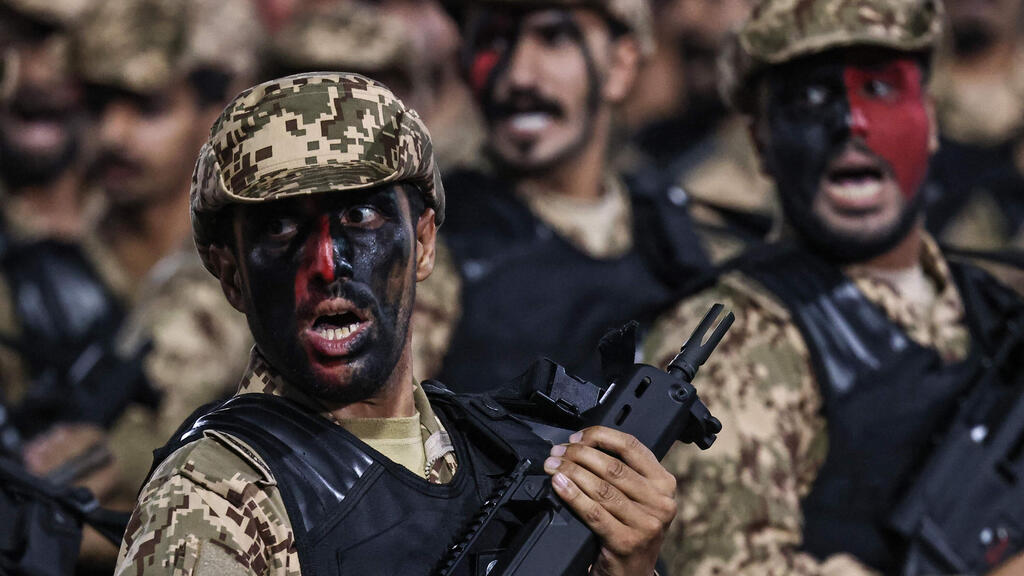
Saudi troops
(Photo: Zain JAAFAR / AFP)
For Israel the distinction matters. Riyadh and Jerusalem share concerns about Red Sea security, missile threats and regional instability. Parallel interests, however, do not equal coordination, still less a durable strategic partnership. The Grand Mufti’s words are evidence of how the Saudi state explains security policy to a domestic audience. They are not evidence of Saudi-Israeli cooperation.
Official clerics can reinforce state priorities without setting them. They can cast military service as duty, lend moral language to a government message, and encourage resolve. They do not control defense policy. Since Mohammed bin Salman consolidated power, the royal court has become the decisive center of decision-making. Religious institutions remain part of the state’s institutional landscape, but their public authority is exercised on terms the leadership defines.
The shift has deep roots. In April 2016 the government reduced the religious police’s enforcement powers, stripping them of the authority to pursue, arrest or detain and limiting them to advice and referral. That change markedly weakened an institution’s ability to enforce public morality independently and marked a broader transfer of control: the state has assumed greater control over the enforcement of public morality. The reform was presented as a modernization measure, yet it also concentrated residual moral authority more firmly inside the formal state apparatus.
Alongside this centralization, everyday life has changed in ways that are difficult to reverse. Cinemas reopened, public entertainment expanded, women entered the workforce in greater numbers, and many long-standing social restrictions eased. Vision 2030 presents economic diversification and social opening as a national project. These changes are real and visible. They are not political liberalization. Saudis have more choices in daily life and far less room to contest the leadership or shape major decisions. The contrast between expanded social freedom and narrowed political space is one of the defining features of the current order. What looks like rapid liberalization from outside is, inside the kingdom, a carefully managed expansion of social options under tight political control.
Al-Fawzan’s appointment on 22 October 2025 underscores the pattern. King Salman named him Grand Mufti, chairman of the Council of Senior Scholars and head of the General Presidency of Scholarly Research and Ifta on the recommendation of the crown prince. Al-Fawzan is a long-standing conservative figure whose earlier statements on Shiites and dissent are well documented. Elevating him does not revive independent clerical power; it keeps the senior religious hierarchy formally embedded while ensuring appointments and boundaries remain under royal control. The choice of a known hardliner for the kingdom’s highest religious office further illustrates that the leadership prefers continuity of conservative doctrine inside a tightly managed institutional framework.
The monarchy and the clerical establishment have never operated as separate spheres. Scholars legitimized the state; the ruling family controlled the institutions. The present arrangement adjusts the balance rather than abolishing the relationship. The state can curtail religious authority in one domain and still summon a senior scholar when religious language serves a national message. The decisive question is not whether religion remains influential, but who decides when and how it is used. That question has become more rather than less important as the kingdom projects an image of rapid social change to domestic and international audiences alike.
Social norms can shift rapidly while political power stays concentrated. Religious language need not govern every aspect of public life to remain useful when the state must explain sacrifice, reinforce duty or rally support in a security crisis. Modernization and selective religious legitimacy can both serve the same leadership. The outcome is neither secularization nor a return to the old equilibrium. It is a system in which tradition is retained as a mobilizable resource rather than as an independent source of authority. This arrangement gives the leadership flexibility: it can loosen social rules in one sphere while still drawing on religious language when the state needs to justify risk, sacrifice or national unity.
This model shapes foreign policy as well. Centralized decision-making can facilitate discreet, limited arrangements when interests align. An arrangement that is operationally useful can still be politically costly to acknowledge. Cooperation, public recognition and lasting strategic partnership are distinct thresholds. Evidence of one does not prove the others. The same concentration of power that allows rapid social reform also allows the leadership to calibrate external relationships with a high degree of discretion and without automatic translation into public commitments.
Israel therefore needs disciplined assessment, not cynicism or wishful thinking. Shared threat perceptions are a starting point, not a finished policy. Saudi Arabia has its own reasons to defend territory, shipping lanes and infrastructure against the Houthis, independent of its public stance toward Israel. Analysts must separate actions that serve Riyadh’s immediate interests from independently verified evidence of coordination with Jerusalem. The temptation to read every Saudi security decision through the prism of potential normalization remains strong, yet it regularly produces over-interpretation.
Three tests help determine whether any practical convergence is becoming durable. Continuity: does documented security coordination recur across multiple crises rather than appear once? Resilience: does it survive diplomatic friction, regional escalation or domestic pressure inside Saudi Arabia? Strategic commitment: do institutional practices—standing arrangements, joint mechanisms or statements that outlast a single leadership—show lasting alignment, or do they end where short-term interests end? These tests require evidence, not inference from religious statements or diplomatic atmospherics.
 Amine Ayoub
Public messaging remains relevant when read carefully. Religious addresses and state media show how leaders frame security policy for domestic consumption. They cannot, by themselves, prove private cooperation or define its limits. Official language must be measured against verifiable conduct; the evidence may still be insufficient to support a firm conclusion. The same restraint applies to conservative religious language: it can reinforce national solidarity, yet its effect on attitudes toward foreign partnerships cannot be assumed. Treating an official sermon as a window into private strategy is a recurring analytical error that continues to distort assessments of Saudi intentions.
Israel should judge Saudi Arabia by what it demonstrably does under pressure, not by hopes about where modernization will lead. A religious appeal to soldiers shows how the kingdom can draw on tradition while pursuing the priorities of a modernizing state. It reveals little, on its own, about an Israeli-Saudi alliance. Shared interests are real. Shared interests are not a partnership.
- Amine Ayoub, a fellow at the Middle East Forum, is a policy analyst and writer based in Morocco. Follow him on X: @amineayoubx