

In the portion of Tetzaveh, the priestly garments are described as “for honor and for glory.” The most striking of them is the breastplate: twelve stones, each different, set in a frame of gold. If the goal was splendor, why not choose twelve identical precious stones? Why diversity?
As Rabbi Yitzhak Arama, author of Akeidat Yitzhak, explains, some stones were more precious and some more simple. Was G-d lacking budget? Precisely here lies a deep insight: beauty is not in uniformity but in integration. Not only is the simple stone elevated when set among the precious ones — the precious stone, too, is intensified when surrounded by difference. Value is created through relationship.
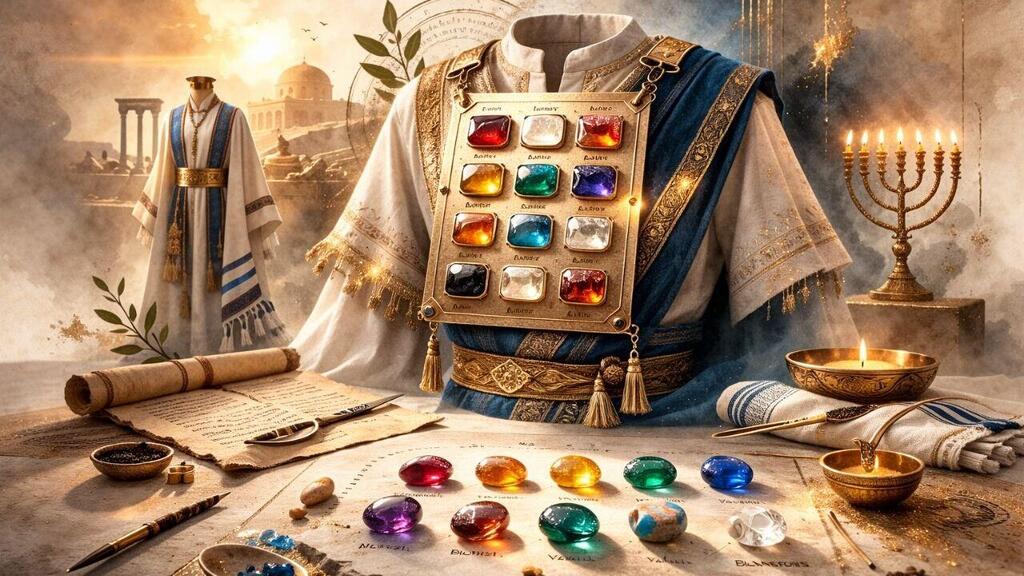
Choshen Torah portion
The managerial message is clear: an outstanding team is not a collection of brilliant individuals, but a system in which each element gains meaning within the whole.
Modern management has long wrestled with the tension between building organizations around standout talents and creating balanced systems. Social philosophers such as John Rawls emphasized that true fairness emerges from a structure that contains difference, while Peter Drucker repeatedly argued that leadership’s role is not to hunt for geniuses, but to create a whole that works.
A team made only of people from the same mold, same background, same way of thinking, same language — may look impressive, but it is one-dimensional. Such an organization is prone to groupthink and blind spots. It is precisely the diversity, between analytical and intuitive, fast and thorough, seasoned and fresh, that creates real organizational beauty.
Rabbi Arama connects the breastplate to the concept of ‘Choshen Mishpat’. the correction of distorted judgment. The managerial insight is sharp: when people are judged by a single metric, performance, charisma, or profitability - the picture becomes skewed. Mature leadership understands that value is contextual. What appears simple in isolation may prove essential within the whole.
In behavioral economics, this is a warning against the Superstar Effect — the tendency to magnify stars while forgetting the system that sustains them. In organizational psychology, it reflects the understanding that meaning emerges when a person knows they are part of a greater puzzle, not when everyone is identical.
The gold in which the stones are set is the framework, organizational culture, values, and shared purpose. Within a strong frame, diversity can exist without fragmentation. Without the gold, the stones scatter; without different stones, the gold is an empty frame.
As both a manager and a military commander, I learned how powerful difference can be, even when it demands more effort. It is easier to work with conformists who agree quickly, but fast decisions are not necessarily brave ones. Diverse perspectives create deeper dialogue and often lead to better decisions over time.
We have seen this in the business world as well. ironSource’s ability over the years to acquire companies and integrate entrepreneurs and leadership teams created a powerful multiplier. Likewise, the merger between Acro and Israel Canada shows the potential of synergy: combining aggressive marketing with professional depth can make the whole greater than the sum of its parts, not only economically, but culturally.
In every merger, acquisition, or leadership transition, one can focus on what might break, or choose to rebuild. That is a leadership decision: to see difference as a threat, or as an opportunity.
The new song I wrote, “Every morning is born,” reflects this very idea of renewal, the ability of a person and an organization to reset and build a new reality:
Every morning is born
Rising from dust, beginning again
Every morning is born
There is still strength in me, still faith within
Even if I fell along the way
I stand, unafraid
For life whispers to me
Begin again… everything is possible.
The breastplate reminds leaders that true glory is the creation of a mosaic. To avoid distorted judgment, toward people and toward decisions, one must embrace the complexity of the whole, not fear it.
Because great leadership does not only ask who shines brightest, but what combination creates the strongest whole.
And the question every leader must ask is simple: Are we searching for stars — or building a magnificent breastplate together?