

The signing ceremony held in Mecca on August 7, 2026, was not another routine diplomatic event. The trilateral security agreement signed by Saudi Arabia, Turkey and Pakistan, the “Mecca Agreement,” marked a significant moment in the reshaping of regional geopolitics.
Its core principle is sharp, clear and unprecedented in the Middle East: An armed attack against one member state will be considered an attack against them all. In effect, it is a Sunni Islamic version of NATO’s famous Article 5.
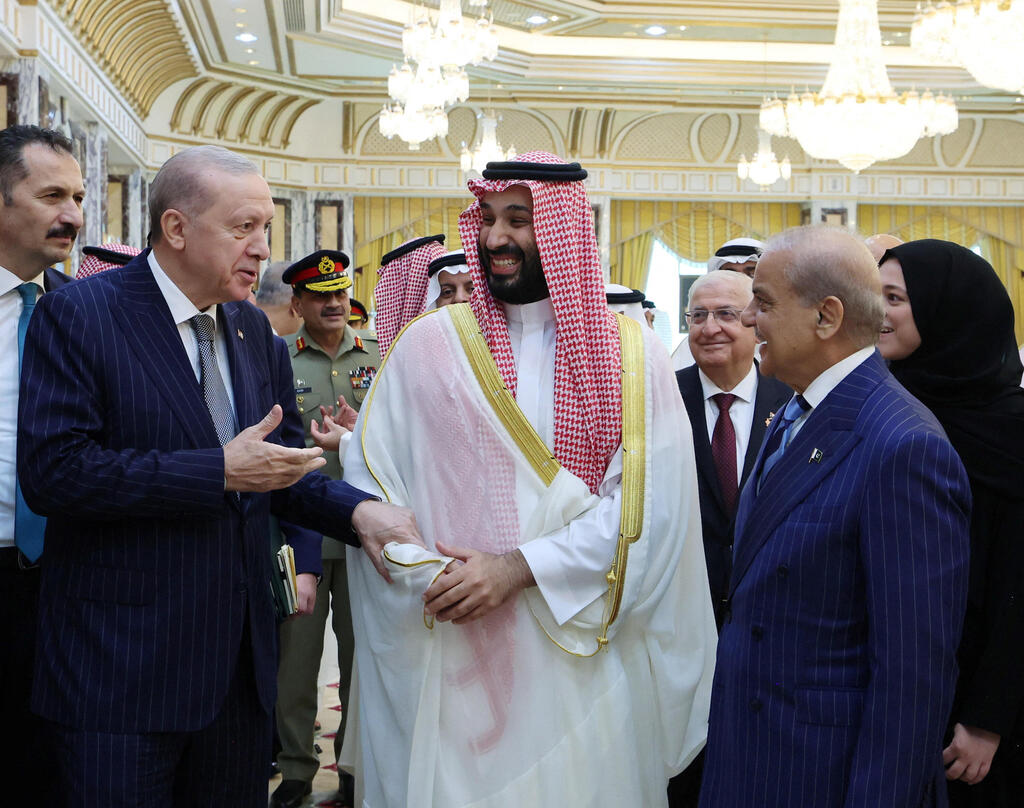
Signing of the agreement between Saudi Arabia, Pakistan and Turkey
(Photo: Murat Cetinmuhurdar/Turkish Presidential Press Office/Handout via REUTERS)
Structurally, the arrangement is remarkably sophisticated. Each capital brings a strategic asset the others lack: Riyadh contributes enormous financial power and extensive funding capacity; Ankara brings an advanced defense industry, leading drone technology and considerable military experience as a NATO member; and Islamabad contributes a vast ground force, operational experience and, most importantly, a nuclear deterrent.
At first glance, such a concentration of military and technological power could understandably alarm security officials in Jerusalem. But Persian strategic wisdom holds that “the observer manages the game better than the players on the board.”
A deeper analysis suggests that Israel’s exclusion from the Mecca Agreement is not a disadvantage but an excellent strategic vantage point. It allows Jerusalem to benefit from the new regional balance without being bound by the rules governing the players themselves.
A triangle of complexity that becomes an advantage
To understand why Israel’s place outside the agreement may be an asset rather than a liability, it is enough to examine Jerusalem’s unique relationship with each of the three members.
Turkey and the trap Israel avoids. Diplomatic and economic relations with Ankara have deteriorated to an unprecedented low, while President Recep Tayyip Erdogan has pursued an openly confrontational line against Israel. Joining a defense alliance that includes Turkey would create a serious strategic and political dilemma for Israel.
By remaining outside, Israel can see Turkish military and industrial power employed to restrain Tehran in the Gulf without Jerusalem having to limit its own freedom of action or compromise with a government acting against it internationally.
Saudi Arabia and quiet normalization. With Riyadh, where indirect security coordination and close intelligence ties operate under an American umbrella, the agreement demonstrates that a dramatic signing ceremony is not required for countries to benefit from a shared interest.
Israel’s absence from formal Islamic military frameworks also reduces the domestic political and religious price Crown Prince Mohammed bin Salman would have to pay. It allows Saudi Arabia to present itself as an independent Sunni leader while ties between Jerusalem and Riyadh continue to develop on the basis of discreet operational trust.
Pakistan and deterrence of a common adversary. Pakistan is a nuclear state that does not recognize Israel. The absence of formal relations spares Jerusalem the need to maneuver within an alliance involving a hostile country, while still allowing Israel to benefit from a situation in which Pakistani military and nuclear power serves as a counterweight to Tehran’s regional ambitions.
Cairo’s dilemma: Why is Egypt outside?
One of the most intriguing aspects of the new alliance is Egypt’s absence. The country with the largest Arab military remains outside the framework because of its historic competition for leadership of the Arab world and lingering tensions with Turkey.
Some may argue that Israel should want Egypt to join, allowing Cairo’s more secular leadership to pull the bloc in a more moderate and responsible direction. But from Israel’s perspective, the more prudent position may be to hope Egypt maintains its refusal
Egyptian membership would bind its military to distant defense commitments in the Gulf and divert resources from counterterrorism efforts in Sinai. More importantly for Jerusalem, Egypt currently serves as one of the region’s most important and effective mediators.
Joining an alliance alongside an increasingly confrontational Turkey could erode Cairo’s standing as a relatively neutral mediator during crises. An independent Egypt remains a major security asset for Israel.
The gain in Washington
Israel’s position could also strengthen its standing with the United States. For Washington, Israel’s determination to preserve operational independence once again demonstrates that it is a powerful ally that does not require American troops on the ground or cumbersome mutual-defense arrangements.
Israel allows the U.S. to benefit from greater stability in the Gulf without eroding the IDF’s qualitative military edge, or QME. The arrangement also gives Jerusalem another bargaining chip: Israel is not desperate for external security guarantees because, under this emerging balance, other U.S. partners are helping sustain deterrence against Tehran while the IDF preserves its own freedom of action.
The quiet containment of Iran
An old Persian saying holds that “the snake is struck with the hand of one’s rival.” In the strategic complexity of the Middle East, the main target of the Saudi-Turkish-Pakistani triangle is not Israel but Tehran.
Continued Iranian aggression and the direct threat to energy infrastructure in the Persian Gulf have created an urgent sense in Riyadh that Saudi Arabia can no longer rely exclusively on the American security umbrella. When Riyadh erects a fortified wall against Tehran backed by Turkish technology and Pakistani military power, the regional deterrence balance shifts in Israel’s favor.
Persian strategic thought also prizes the ability to “take the honey without suffering the bee’s sting.” Under the current arrangement, Israel gets precisely that: It benefits from the deterrence and stability the alliance creates against Iran without paying the heavy price of sacrificing operational freedom.
And, as another saying attributed to Turkish wisdom puts it, “A wise captain knows how to sail using the winds of others.” That captures Jerusalem’s geopolitical advantage at this moment. Israel does not need to maneuver inside the alliance or finance its mechanisms. It can instead use the regional winds generated by Saudi Arabia, Turkey and Pakistan to advance its central goal of deterring Tehran.
The obligation to monitor and remain cautious
For all the potential advantages, Israel’s political leadership and intelligence community must not fall into complacency. A defense agreement combining Saudi economic power, Turkish technology and Pakistani nuclear capability is an event requiring close scrutiny.
Regional history has taught Israel that alliances shift and regimes change. The central task for the security establishment will be to ensure that the military power accumulated under the Mecca Agreement remains directed solely toward containing Iran and is not, under changing political circumstances, redirected against Israel.
Ultimately, Jewish thought places great value on outcomes and long-term foresight: “Who is wise? One who foresees what will happen.” The Mecca Agreement offers Jerusalem a rare strategic opportunity: effective deterrence against Tehran without surrendering an inch of operational independence. Israel can welcome the outcome, but it must continue to keep its own hands firmly on the wheel.
- Prof. Mohammed Wattad is a full professor of law, president of Ramat Gan Academic College and a senior visiting researcher at the Institute for National Security Studies (INSS)