


For over five decades, the stretch of the Jordan River separating Israel from Jordan at Kasr al-Yahud has operated as a tightly controlled defensive perimeter. The narrow waterway and sparse desert terrain on the eastern bank provided the Israel Defense Forces with clear lines of sight, effective radar coverage, and an uncluttered environment to detect cross-border movements. Monitored continuously by optical systems, visual sensors, and thermal technology, low civilian density along the frontier has been a foundational element of Israel’s eastern security posture. This controlled environment exists alongside ongoing Israeli military efforts to interdict smuggling and unauthorized infiltration along the broader Jordan Valley frontier.
On the western bank, Israel has consistently invested in maintaining and modernizing its own facilities. Earlier in 2026, Israeli authorities completed and officially inaugurated a major NIS 25 million renovation at Kasr al-Yahud, upgrading civil infrastructure, security access, and pilgrim amenities. While both sides operate under separate sovereign administrations following the 1994 peace treaty, the physical proximity of the two sites means that major spatial changes on one bank directly impact the operational environment of the other.
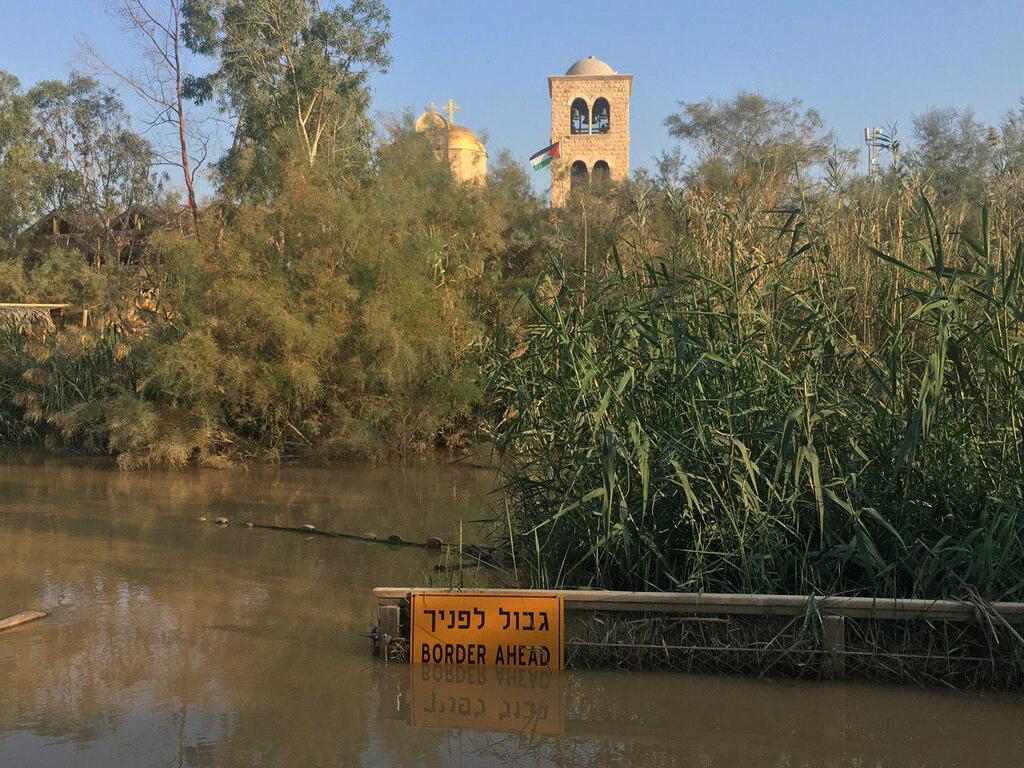
The baptismal area at Qasr al-Yahud on the Jordan River, along Israel’s border with Jordan
(Photo: Gilad Carmeli)
The physical context across the river is entering a period of significant structural development. On 12 August 2026, the Jordanian government, under the patronage of Prime Minister Jafar Hassan, officially signed agreements launching a specific 120-million-dollar development package covering 1,400 dunams adjacent to the traditional baptism site at Al-Maghtas. This contract represents the core, near-term phase of Jordan’s development vision for the zone, with preliminary ground preparation scheduled for the end of the first quarter of 2027, followed by main construction later that year and targeted completion in early 2029 to prepare for the 2,000th anniversary of Jesus’ baptism in 2030.
This 120-million-dollar agreement is precisely allocated across four primary components. The central architectural landmark is the Museum of Jesus’ Baptism, budgeted at 50 million dollars and designed by the British architectural practice Níall McLaughlin Architects. An integrated pilgrims and visitors village accounts for approximately 40 million dollars, incorporating hospitality facilities, hotels, dining complexes, retail centers, and public plazas. Civil infrastructure accounts for 27 million dollars, covering new access highways, electrical grids, and water systems built along the riverbank, while 3 million dollars is designated for a green ecological corridor. These contracts establish the firm, fully capital-backed core projects designed to establish the site's foundational visitor ecosystem over the next three years.
To evaluate the operational impact on border density, current actual visitor data from the Jordanian Ministry of Tourism provides an essential baseline. In recent full years, annual visitation to Al-Maghtas has ranged between approximately 70,000 and 95,000 individuals. While tourism has shown rapid recovery, as evidenced by official early 2026 figures recording roughly 25,500 visitors during January and February alone amid strong year-on-year growth, the overall human presence along the eastern bank has remained relatively modest and predictable.
This baseline contrasts sharply with the official projections established for the new development. Official projections for the Museum of Jesus’ Baptism alone anticipate between 400,000 and 450,000 visitors annually upon completion. When combined with the broader accommodation capacity of the pilgrim’s village, daily human density directly opposite Kasr al-Yahud will increase substantially.
For border monitoring units, this shift from sparse, periodic visitation to a continuous flow of hundreds of thousands of annual tourists represents a qualitative change in the border environment. A site that once experienced limited daily activity will soon host constant vehicular traffic, international tour groups, commercial deliveries, and permanent service personnel directly adjacent to the narrow river channel.
From an operational perspective transforming open, undeveloped land into an urbanized visitor complex presents specific technical challenges for existing surveillance systems. Thermal optics, radar installations, and visual monitoring equipment depend on environmental predictability. The introduction of commercial HVAC systems, high-intensity outdoor lighting, heavy vehicle exhaust, and extensive structural heat retention introduces thermal and visual clutter that can degrade the clarity of sensor networks calibrated for open terrain.
Furthermore, the dramatic increase in civilian density narrows the operational margin for military rules of engagement. When border zones are largely empty, identifying unauthorized movement near the water is straightforward, allowing rapid assessment and action. In a densely populated environment with international pilgrims standing meters from the water, military protocols must account for the immediate presence of non-combatants, increasing the complexity of responses to potential cross-border incidents.
The expected proliferation of commercial and recreational drones overhead introduces additional air surveillance complexities. With international media, content creators, and tourists operating in the area, low-altitude airspace over the narrow border river will experience frequent drone activity. Shortened detection and identification windows will make distinguishing between harmless civilian imagery capture and potential low-altitude security threats an exacting task for air defense controllers.
 Amine Ayoub
Additionally, a high-volume international tourist zone offers cover for visual intelligence collection. Foreign visitors, commercial personnel, or hostile actors blending into routine tourist groups could observe IDF post rotations, document physical camera positions, and map defensive routines without raising immediate suspicion.
The financial structure supporting the development introduces important international stakeholders. Funding for the pilgrim’s village is supplied by Abu Dhabi capital, bringing financial investment from a central Abraham Accords partner directly to the riverbank. Concurrently, the Church of Jesus Christ of Latter-day Saints has formally agreed to cover 50 percent of the construction cost for the baptism museum.
These external funding channels provide Jordan with increased financial autonomy on its sovereign territory, reducing its reliance on traditional multilateral development loans or direct bilateral channels. From an Israeli strategic perspective, the involvement of prominent international stakeholders does not prevent Israel from implementing necessary border defense measures, but it does raise the political cost of certain operational adjustments. Security steps or tactical deployments near the development must be managed with awareness of diplomatic relationships with both the United Arab Emirates and influential American religious organizations.
Ultimately, Israel retains complete sovereign authority over its side of the river and over the military measures required to protect its territory. Israel’s security establishment possesses both the technical expertise and the institutional capacity to adapt its posture to these evolving conditions. Logical steps include deploying advanced multi-spectral sensors capable of filtering urban noise, enhancing counter-drone defense systems around Kasr al-Yahud, and refining aerial surveillance protocols. Continued quiet coordination between Israeli and Jordanian security agencies regarding visitor screening and threat information exchange will remain a practical tool for maintaining stability. The geography of the Jordan River continues to serve as Israel’s functional eastern defensive line, and through targeted technological and tactical adaptation, Israel can maintain its operational advantages along the frontier.
- Amine Ayoub, a fellow at the Middle East Forum, is a policy analyst and writer based in Morocco. Follow him on X: @amineayoubx