


In the Middle East developments are judged not just the morning after, but the morning after that. Many once praised Ehud Barak’s withdrawal from Lebanon, which later turned against Israel in the form of the Hezbollah “monster” that entrenched itself along the border and proved to be a grave mistake.
Operation Guardian of the Walls, including the “Metro” operation to destroy Hamas tunnels, was marketed as a major success but later proved a failure. On Oct. 7, it became clear it had been one of the triggers for the surprise attack, contributing to Hamas’ sense of success.
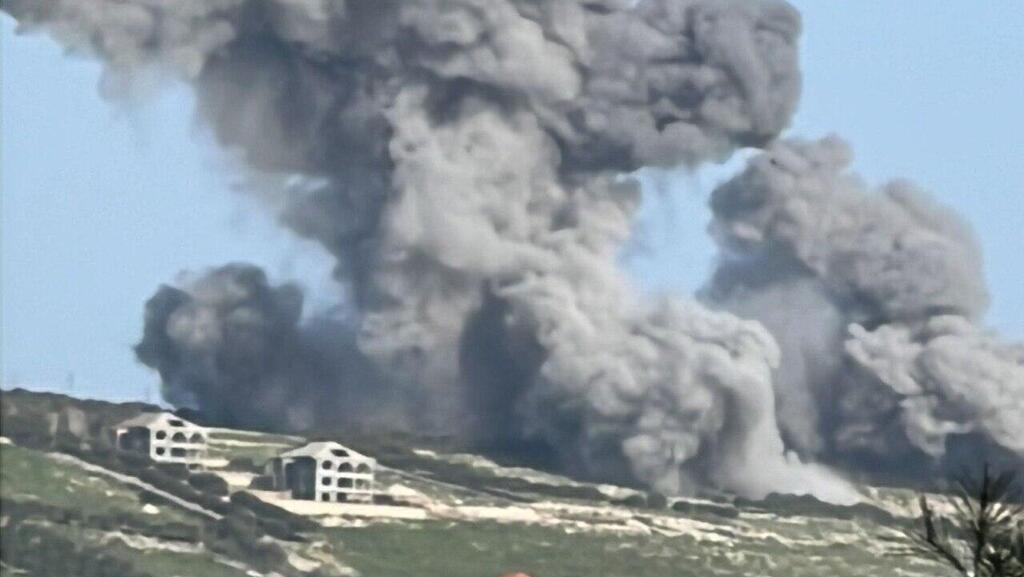
IDF strike in southern Lebanon
In practice, Trump’s announcement of a ceasefire in Lebanon enabled Iran to link the various fronts, and here Netanyahu failed to maintain the separation that had held until now. From an operational standpoint, two central questions must be asked regarding a ceasefire in Lebanon. The first: Has the security situation for residents of Metula and Nahariya improved, remained unchanged or deteriorated?
The second looks ahead: Will the security reality from now on be one in which conditions improve month by month or quarter by quarter, or the opposite? Is the pace at which Israel degrades Hezbollah greater than the pace at which the group rebuilds, or vice versa? Time will be needed to answer these questions, but the answers will eventually become clear.
Against the backdrop of ceasefire negotiations in Lebanon, the IDF set three conditions for an agreement: the creation of a buffer zone in southern Lebanon up to the Litani River, free of Hezbollah presence and infrastructure; the preservation of full military freedom of action to remove threats, including north of the Litani; and the launch of a long-term process to disarm the organization under a U.S.-supervised mechanism. At present, the IDF is restricted from striking north of the Litani up to Beirut. It controls fire along the Litani line and prevents civilians from moving south toward the border fence.
An immediate and full ceasefire under these conditions, including a partial withdrawal of forces, does not improve the security situation compared to the start of the war and should not be accepted. The IDF must remain inside the territory, deeper than the line of five outposts established in November 2024 at the end of Operation Northern Arrows, and must also preserve freedom of action against Hezbollah’s military buildup, including strikes in Beirut.
Hezbollah Secretary-General Naim Qassem has already made clear that he entered this campaign to break that status quo and reach a situation in which the IDF does not strike at all. Such a reality, if realized, would represent a significant deterioration in security and could not be presented as a victory.
It should be clarified that the pace at which Hezbollah’s capabilities and centers of gravity are degraded depends on three conditions that must be insisted upon. First, the ability to block the borders to prevent the entry of weapons, primarily from Iran. Second, preventing internal production capabilities: any new capacity by Hezbollah to produce precision, long-range missiles must be targeted and destroyed directly, and the ceasefire should not apply to it. Third, the continuation of the systematic destruction of Hezbollah’s capabilities, under close monitoring by Trump and the IDF.
There is one additional point that should not be open for debate: In the immediate contact zone, within a few kilometers of the border, there is no place for warning or deterrence, only for destruction.
When examining how these conditions can be achieved, the answer depends on military achievements, diplomatic action and above all the most important lesson from Oct. 7: to take our fate into our own hands, not to be defined by Hezbollah or Iran, not by the decisions of Mohammed Deif, Yahya Sinwar or Hassan Nasrallah, but to look ahead — how will we act next week? What will we initiate in a month?
It is necessary to insist on maintaining the ability to continue operating in order to constantly meet these three conditions. We must look residents of the north in the eye and tell them the truth: the threats have not disappeared and will not disappear. We must be worthy of the fallen and their families. The goal is to continue acting so that, like in a relay race, each shift hands off a better reality to the next. That is the definition of victory.
As for those next in line, the new commander of the Israeli Navy, Maj. Gen. Eyal Harel, assumed his post yesterday. His speech sounded exactly as expected from a commander tasked with shaking up the service and pushing it toward initiative and offensiveness. “There is no arena too distant for the navy,” he said, more than hinting at an anticipated shift in the force’s approach and suggesting it has not initiated enough offensive operations.
“The naval arm will operate in any arena required, without geographic limitations. The navy has unique capabilities that no other branch possesses. They must be employed with courage, with prudent risk management and without fear, to reach the enemy’s centers of gravity and strike them effectively.” The implementation now remains to be seen.