

We are all horrified — rightly so — when antisemitic incidents occur abroad. The hatred directed at Jews around the world since October 7 has continued to cross one boundary after another.
Last weekend gave us all good reason to be appalled. Central Synagogue, home to one of the world’s largest and most prominent Jewish congregations, was attacked. During a prayer service, a man burst into the sanctuary, shouted, spat, knocked over and broke candles and candlesticks and called worshippers “pigs,” according to a police officer interviewed by Reuters. He also cursed at a Black security guard and managed to assault two people, including a 63-year-old woman whose lips were cut, before security escorted him out.
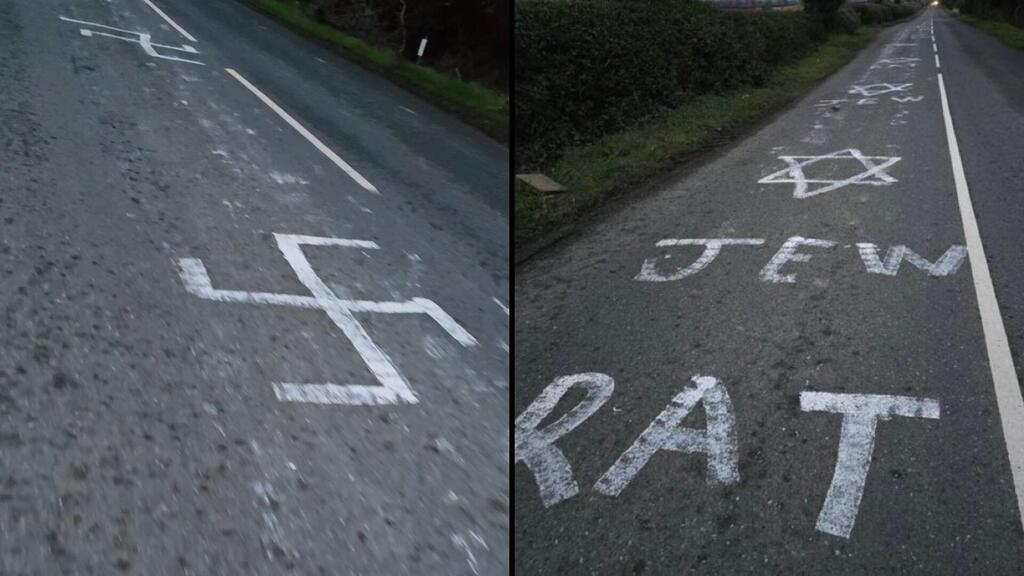
Swastikas and 'Jew rat' graffiti in Ireland
(Photo: from X)
And it is indeed horrifying. It is horrifying because Jews around the world feel unsafe in their own homes and communities.
It does not matter that, as the Forward later reported in an investigation, the man had previously expressed support for Israel and opposed the religious movement with which the synagogue is affiliated. A single antisemitic slur is enough to make clear what his views of Jews really are.
Nor does it matter that he was ultimately removed from the synagogue. Jews in the Diaspora feel unsafe, and that is something Israel, as a country that is supposed to care for the Jewish people as a whole, cannot simply ignore.
But that was not the only act of violence against a synagogue last weekend.
In another city — one whose name means “peace” and which is ostensibly meant to represent Jewish pluralism in all its glory — Kehilat Kol HaNeshama synagogue in Jerusalem was also attacked. The vibrant congregation was targeted over the weekend when teenagers broke one of its windows, climbed inside, tore down a Pride flag and damaged a work of art.
The question, then, is what connects these two incidents?
On the surface, there is one obvious connection: violent hatred directed at Jewish religious life, culminating in vandalism and harm to others. But there are other connections as well.
First is the motive. Alongside the clear antisemitism in the New York attack, footage from Manhattan shows the assailant — apparently an evangelical Christian, based on content he had posted — calling those inside the synagogue “fake Jews.”
 Ofer Chizik
In other words, the violence was also rooted in hostility toward Reform Jews. That, of course, also appears to have been the backdrop to the attack in Jerusalem. Yes, it seems that hatred of liberal Judaism can run so deep that it leads even Christians to violence.
And that brings us to another connection: The attack on Kehilat Kol HaNeshama in Jerusalem — which you probably did not hear about at all — and the attack on Central Synagogue in Manhattan — which, regrettably, you probably heard little about as well — are part of the same struggle.
It is a struggle over liberalism. A struggle over freedom of thought and belief. A struggle over the right to be Jews who believe in the commandment, “Love your neighbor as yourself.”
When someone enters a synagogue and attacks innocent worshippers because of their beliefs and Judaism, or breaks into a synagogue and smashes, damages and destroys liberal symbols inside, it is all part of the same picture.
It is also part of the same picture as those who seek to intimidate cafes in Jerusalem and Ramat Gan because they operate on Shabbat.
The bright spot is that the Jewish people truly are not afraid of a long road.
For roughly 200 years — perhaps more, perhaps less, depending on where one begins counting — Jews have chosen to express their Jewish identity outside the conservative path prescribed by a closed religious establishment. Some do so through the Reform movement. Others choose entirely secular lives.
What matters is that we constitute the majority of the Jewish world, an eternal flame that will not stop burning — and violence will not succeed in extinguishing our light.
Ofer Chizik is a journalist with Yedioth Ahronoth and a rabbinical student at Kehilat Halev, part of the Daniel Centers for Progressive Judaism in Tel Aviv.