

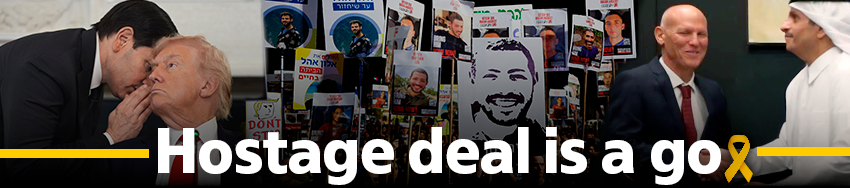
The agreement Israel signed yesterday with Hamas gives us breathing room — but breathing room is not a strategy. The question isn’t whether we need a deal (we do); it’s whether we have built an institutional architecture that prevents a pause from becoming an on-ramp to enemy rearmament.
Without verification and enforcement “teeth,” any short-term gain will be ground down into eroded deterrence, renewed smuggling, and micro-ratchets — small, incremental steps that accumulate and never fully reverse — leaving us back where we started, facing a stronger foe.
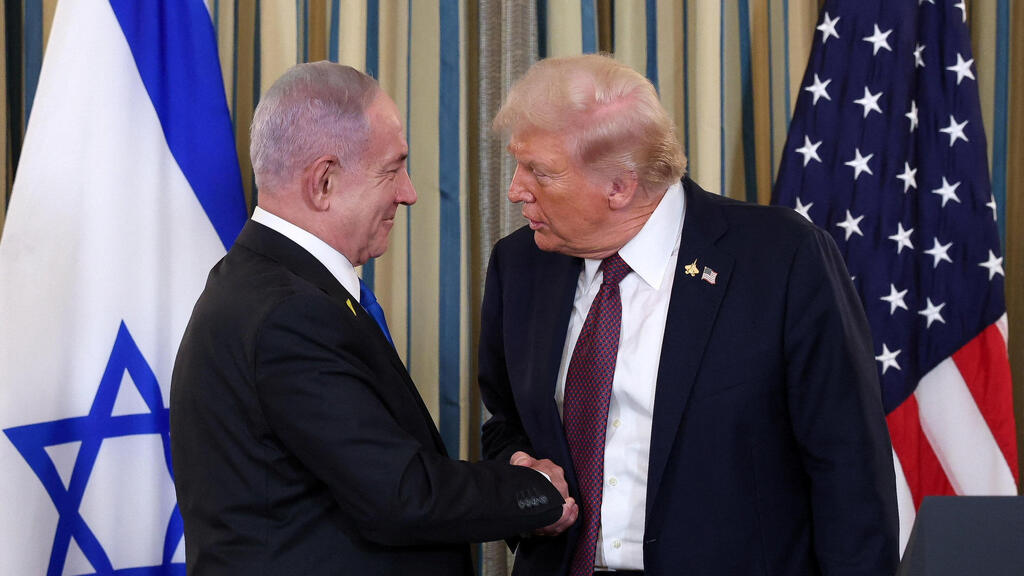
Benjamin Netanyahu and Donald Trump
(Photo: Reuters/Jonathan Ernst)
The clearest advantages are humanitarian and national: the return of hostages, a reduction in fire, and relief for Israel’s southern communities. There is also a regional opening — a pathway to Saudi normalization and tighter coordination with Washington. But these are conditional gains. If the Egyptian–Qatari–Turkish–international track lacks hard verification tools, the deal grants Hamas time, legitimacy, and resources to rebuild tunnels, rockets, and command networks.
Three forms of “teeth” must be written, funded, and staffed:
1. Real-time verification — sensors, drones, multi-layer cargo screening, and shared intelligence on land and at sea. Without a continuous intelligence picture, the mechanism remains a paper promise.
2. Automatic snapback — define “material violations” (rocket fire, smuggling, kidnappings). Once a violation occurs, benefits are immediately suspended and the IDF’s calibrated freedom of action resumes without protracted diplomatic haggling. Deterrence requires an automatic default, not joint committees without authority.
3. Sealing the Philadelphi Corridor — an engineering-technological shut-down of smuggling routes under Egyptian supervision and international auditing, with clear accountability metrics, a ring-fenced budget, and deadlines.
Enforcement must be paired with a reset of the reconstruction equation: conditional aid and reconstruction. Every dollar and project should be tied to demilitarization benchmarks — handover of weapons, destruction of tunnels, and external financial oversight. Without these, assistance becomes double fuel: for Hamas’s capabilities and for the narrative that rehabilitates its rule. An international escrow with an “stop-and-reimburse” clause can ensure funds serve civilians, not militias.
Any IDF “repositioning” must be benchmark-based: how many tunnels neutralized, which areas cleared, what screening rates achieved. Otherwise, Israel risks a dangerous lock-in — a premature withdrawal that hardens facts on the ground, narrows future freedom of action, and invites adversary “tests of outcome.”
Regionally, the deal can be a positive accelerant — Saudi normalization, investment frameworks, and security cooperation — only if a cross-theater linkage mechanism is defined. We must specify which incentives move between the southern and northern fronts, and when they exert real pressure on Hezbollah and its Iranian patron. Without linkage, each front becomes a separate zero-sum game at our expense.
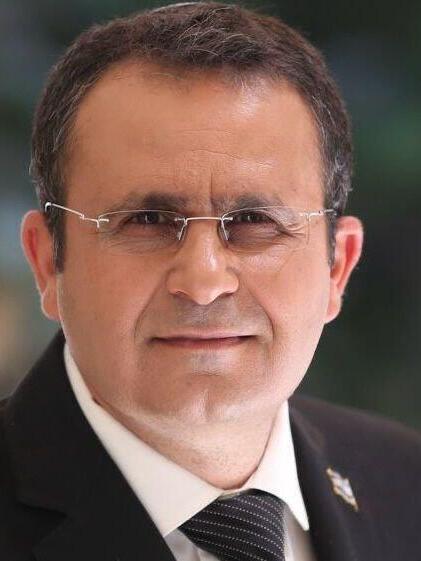 Dr. Ofer IsraeliPhoto: Shabi Kedem
Domestically, the test is managerial and cognitive: measured transparency with the public, clear red lines, and tight coordination with Washington and Europe to reduce legal exposure without surrendering essential security carve-outs. Israeli consensus rests on a sense of security, the return of hostages, and effective military freedom of action. If the deal looks like we were bitten and did not bite back, public trust — and international legitimacy — will erode.
Bottom line: A good deal for Israel is not one that delivers quiet alone, but one that creates the right dynamics: tough verification, automatic enforcement, conditional reconstruction, a civilian governance alternative in Gaza, and regional linkage across fronts. Without this architecture, the deal is a corridor to the next war; with it, we can change incentives and push that war farther away — not merely postpone it.
Dr. Ofer Israeli is a scholar of international relations specializing in complexity theory, foreign policy decision-making and Middle East geopolitics. He is a senior lecturer at Ashkelon Academic College. A recognized geostrategist and complexity theoretician, Dr. Israeli is the author of four books, including the forthcoming Complexity Effects in Middle East Conflicts.