

Imagine an 8-year-old girl typing a message to her grandmother on a tablet. She types quickly, autocorrect kicks in to fix the mistakes and the text looks perfect. But when she tries to write the same message by hand at school, she struggles — both with remembering the spelling and with organizing her thoughts and finding the words to express herself.
It’s 2025, and the changes are already clear: the way children think, learn and, above all, remember is shifting before our eyes.
(Illustration: Midjourney)
If you are a parent of kids aged 10 to 15, you may recognize this scenario: flawless WhatsApp messages, polished assignments on the computer — but in a handwritten test, the teacher marks down spelling errors.
And it’s not just a technical issue. A child who has relied on autocorrect since the age of 5 has already developed a dependence on it. They don’t experience the “pain” of mistakes, don’t practice motor memory and don’t pause to think about how a word is spelled — because they already know the machine will fix it.
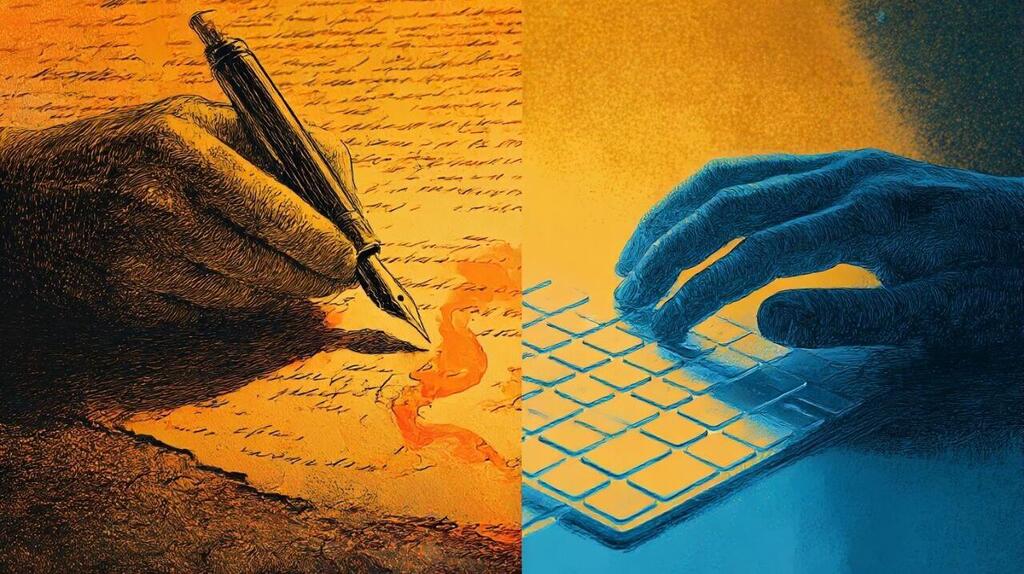
A groundbreaking study published in January 2024 revealed that handwriting activates more areas of the brain than typing. Writing engages movement, sensory processing and memory, while typing is a simpler, more automatic act.
That doesn’t mean handwriting is “good” and typing is “bad.” They simply encourage different kinds of thinking. Writing strengthens memory and learning; typing allows for managing long and complex tasks.
Think about us, the adults: who still remembers phone numbers by heart? Who can really navigate without Waze?
A troubling thought crosses my mind: are we the last generation to write correctly from memory — without relying on a machine?
Autocorrect: enemy or tool?
It started with autocorrect and has now reached artificial intelligence capable of producing entire texts. Tools like ChatGPT don’t just fix mistakes, they help generate whole ideas. That creates today’s dilemma: children can produce impressive text that doesn’t truly reflect who they are or how they think.
The question is: how do we ensure that technology becomes a tool to expand our children’s thinking, rather than a prison that limits it?
Practical recommendations
Early years (up to 3rd grade): Give full priority to handwriting. This is when the brain builds its foundations. Every message, every exercise, should be done with pen and paper.
Grades 4–6: Begin a gradual mix. Use handwriting for tasks that require memory and deeper thinking, and typing for longer or more technical assignments.
High school: The emphasis should shift to developing critical thinking skills. For example, how can students tell when artificial intelligence makes a mistake? How can they know whether the text truly reflects their own thoughts?
For all of us: Be role models. If we want our children to write by hand, we need to write by hand as parents. Research overwhelmingly shows the power of modeling behavior.
 Keren Shahar
Teachers’ roles are also undergoing a transformation. They can no longer focus only on correcting mistakes. A new and demanding task is at hand: becoming guides to innovation. They must learn how to prepare students for a technological world, when to lean on AI tools and when to set them aside, how to test the quality of what AI produces and when to put in the effort to think independently.
Between past and future
This is a historic turning point. For the first time since writing was invented, there are tools that can write for us. That raises a fundamental question: what does it mean today to “know how to write”?
I don’t believe we are the last generation that knows how to write. Rather, we are the first generation to fully experience the transition from handwriting to machine-assisted writing.
And one more note, before wrapping up — a touch of personal opinion. I love technology: everything it brings us, enables us to do, makes efficient and creates through imagination. I’m fascinated by its magic. At the same time, I also see how quickly some of us rush to install the newest apps for our children, enjoying their excitement but forgetting to give them the most important tool of all: confidence in their own minds.
We should guide them not only toward the “cool” tools, but also toward balance and mastery — understanding both the potential and the limits of technology. They should know how to invent a story from scratch, not just from a prompt. They should remember a birthday from the heart, not just from a phone alert.
- The author is a lecturer and trainer in the use of generative artificial intelligence.