

Over the past several hours, media outlets have reported on remarks by U.S. Secretary of State Marco Rubio about recent developments in Yemen. These statements deserve attention not only because they came from the top American diplomat, but because they brought back into the discussion some simple facts that often get lost when the fighting and media coverage begin, rather than when the events leading up to them actually began.
Secretary Rubio said that Saudi Arabia had been subjected to Houthi attacks and has the right to defend itself. He pointed out that Saudi Arabia and Yemeni government forces do not want the Houthis to continue controlling areas near the Bab al-Mandeb Strait. More importantly, he placed recent developments in their proper context: the Houthis advanced and took control of territory, and what is happening today is a counteroffensive, with Yemeni forces seeking to regain the areas from which they were expelled.
Gallery
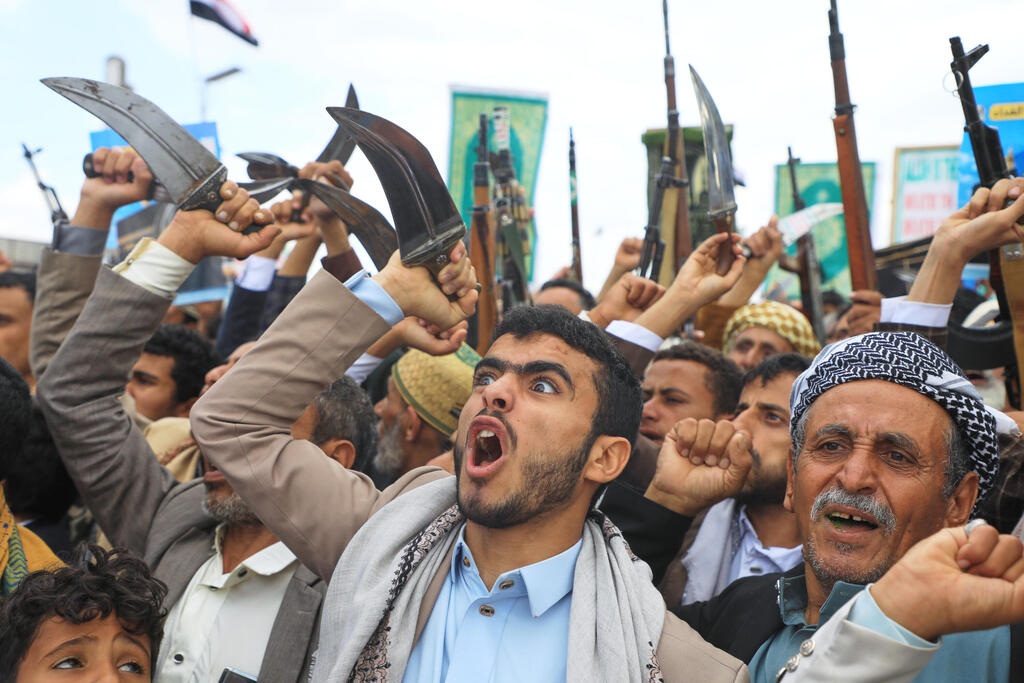
The conflict in Yemen has long ceased to be an internal matter
(Photo: AP Photo/Osamah Abdulrahman)
These are not marginal details; they are the essence of what is happening.
Years ago, I learned from someone dear to me a saying I never forgot: “The truths we ignore most are the simplest ones.”
In Yemen today, we need to return to those truths before they are lost in the noise of slogans, ambiguous terminology, and narratives that treat the scene as if it began yesterday.
The first truth: this war did not begin with Operation Dawn of Yemen.
Yemenis have been fighting for years to restore their state, institutions, and territory from an armed group that seized the capital, Sana’a, and state institutions by force, imposing its rule by force.
Even the latest round did not begin when government forces moved. It was preceded by Houthi military operations, advances on the ground, and the seizure of strategic areas, including territory overlooking Bab al-Mandeb. Presenting the current counteroffensive as the starting point reverses the sequence of events and makes the response appear to be the cause.
History does not begin when the cameras start recording.
The second truth: the conflict in Yemen has long ceased to be an internal matter.
Saudi Arabia has been subjected to missile and drone attacks launched by the Houthis, while commercial and military shipping in the Red Sea has faced repeated attacks.
That brings us to Bab al-Mandeb.
For Yemen, Bab al-Mandeb is part of our sovereignty and national security. For the world, it is one of the most important maritime passages linking Asia and Europe, carrying trade and energy supplies between them.
The question in Washington, then, must be bigger than who advanced a few kilometers or who lost a military position.
The real question is: Is it in the interest of the United States and the international community for one of the world’s most important maritime passages to remain subject to the decisions of an armed nonstate group—one that can decide when ships pass and when they become targets based on political and military calculations outside the authority of the Yemeni state?
The third truth: the Houthi threat cannot be understood in isolation from Iran, nor should Yemen be reduced entirely to Iran.
The Houthis are a Yemeni terrorist movement with their own leadership, calculations, and ties to the Islamic Revolutionary Guard Corps, but Iranian military and political support for them—and their relationship with Tehran—has become a fundamental part of the strategic environment of the war.

We are talking about restoring the Yemeni state itself
(Photo: AP Photo/Osamah Abdulrahman)
This relationship gives Iran something extremely important: the ability to influence one of the world’s most important maritime passages through an armed force that does not operate within Yemeni state institutions.
For Washington, this is not an ideological matter, nor should it be. It concerns maritime security, the stability of the Arabian Peninsula, the security of partners, and the need to prevent international maritime passages from becoming bargaining chips in broader regional conflicts.
This is why the developments at Bab al-Mandeb matter.
The issue is not merely about retaking a mountain, a road, or a port. It is about who holds decision-making power on the ground overlooking one of the most vital arteries of global trade: a recognized state with institutions the international community can engage with and hold accountable, or an armed group that retains the power to decide matters of war and peace outside the state?
There is a fourth truth that should not be lost: the words we use to describe this war matter.
Since the start of Operation Dawn of Yemen, media coverage has revived an old problem in how the Yemeni conflict is presented.
When Yemeni armed forces fighting exclusively under the internationally recognized government are described as “Saudi-backed forces,” while the Houthis are referred to by their preferred political name, “Ansar Allah,” without the same context, the issue becomes more than a matter of word choice.
Language creates the frame through which the reader understands the war.
When the narrative begins with airstrikes without mentioning the missiles that preceded them, or with the counteroffensive without mentioning the attack that prompted the response, the reader receives half the story. And half the story in wartime can lead to conclusions that distort the reality.
We do not ask the media to adopt the Yemeni government’s narrative. Nor should any government ask that.
Our request is simple: tell the full story. This leads us to the larger question raised again by Operation Dawn of Yemen: who should the Yemeni state serve?
Should it belong to all Yemenis, under a constitution, laws, and national institutions, with decisions of war and peace in the hands of the state? Or should millions of Yemenis—and with them a highly sensitive part of regional security and international navigation — remain trapped in a situation in which an armed group possesses an army, missiles, drones, and independent decision-making power outside state institutions?
That is the issue that should not be lost in the daily news of fronts, airstrikes, and missiles.
For Washington, perhaps the most important question is not whether the United States wants another war in Yemen. Yemenis themselves do not want an endless war. Our people have already paid a high enough price.
The question is what creates sustainable peace?
Can real peace be built if an armed group retains heavy weapons and the power to decide matters of war and peace outside the state? Can freedom of navigation in Bab al-Mandeb be guaranteed if the security of the strait remains subject to that group’s decisions? Can long-term stability in the Arabian Peninsula be achieved while an entire country remains divided between official institutions and a parallel armed force?
These questions go beyond Yemen.
For the United States, Yemen’s stability, the security of its partners, and freedom of navigation in the Red Sea are not separate issues. They are parts of a single strategic equation.
Helping Yemenis restore a state capable of enforcing the law on its territory, securing its borders and coasts, protecting its territorial waters, and living peacefully with its neighbors is not simply a matter of supporting one side in a civil war. It is an investment in a more stable regional system and a safer maritime passage.
Operation Dawn of Yemen will ultimately be measured by what it achieves on the ground and by the state’s ability to translate any military gains into security, institutions, and stability. What should not be lost in the discussion is why we reached this moment in the first place.
We are not talking only about retaking a city, a mountain, or a road.
Instead, we are talking about restoring the Yemeni state itself.
Yemenis deserve to have the world hear their full story, rather than having the narrative of the war begin at the moment their state and its forces decided to respond.
Peace is the goal Yemenis aspire to after long years of suffering. But sustainable peace cannot be built on the absence of the state or on accepting parallel armed forces as a permanent reality.
Restoring the Yemeni state is not an obstacle to peace. In the long run, no sustainable peace is possible without a state.
Moammar Al-Eryani is the minister of information of the Republic of Yemen.