

The buildup of U.S. military power in the Middle East is nearing its peak. The entire world is waiting for the answer to one fateful question: Is this a tactical move meant to force Iran into negotiations with the United States from a position of weakness, or a strategic move aimed at fundamentally reshaping the regional balance of power by toppling the rule of the ayatollahs?
If President Trump is indeed pursuing regime change in Iran, this would mark a complete reversal of the policy followed by his predecessors, Democrats and Republicans alike. True, last June, toward the end of Operation Rising Lion, Trump made a decision no previous American administration had dared to make, ordering the U.S. military to join Israel’s campaign against Iran’s nuclear sites. But a one-time, limited and focused strike is not the same as a comprehensive, systemic offensive intended to reshape the political landscape.
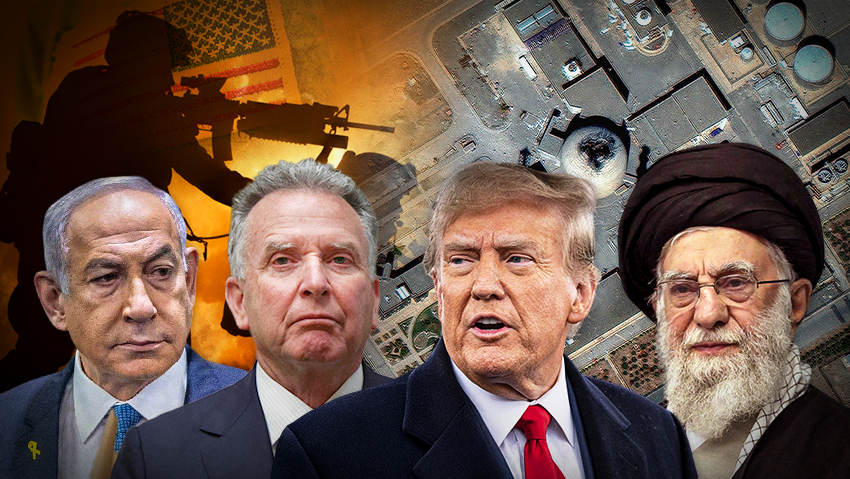
(Photo: lev radin/shutterstock, AP, Flash 90, SATELLITE IMAGE MAXAR TECHNOLOGIES / AFP, Getmilitaryphotos/shutterstock, REUTERS)
To understand the magnitude of the potential transformation in America’s traditional approach, one must return to earlier decision points, when Israel and the United States confronted the threat of an extremist Arab regime seeking nuclear weapons.
In 1979, Israel identified significant progress in the construction of a plutonium facility in Iraq, built with French and Italian assistance not far from Baghdad. Repeated Israeli appeals to U.S. presidents, first Jimmy Carter and later his successor Ronald Reagan, to stop the project came to nothing. The United States tried to persuade the European countries to halt their involvement in building the Iraqi reactor, but they ignored the request. The years passed, construction was nearly complete and a date for activating the reactor was set.
In June 1981, Prime Minister Menachem Begin ordered the destruction of the nuclear complex, known in Iraq as Tammuz. Israeli Air Force jets carried out a flawless strike. The threat was removed, but Reagan was furious and decided to delay the delivery of F-16 fighter jets whose transfer to Israel had already been agreed upon. In his memoirs, Reagan later wrote that the Israeli strike had raised grave fears of a slide into “Armageddon,” a world war that, in Christian belief, marks the end of days. He later reversed his decision, but the episode illustrated the deep differences between Israeli and U.S. approaches to the danger posed by nuclear weapons.
At the heart of this gap lies a fundamental difference in threat perception. During the Cold War after World War II, the United States learned to live under the shadow of a nuclear threat involving thousands of nonconventional warheads held by rivals Russia and China. America’s answer was the development of second-strike capability. Its enemies knew that even if they struck first, their own destruction would be assured. Thus emerged a balance of terror based on mutual assured destruction, a reality that for nearly 80 years has restrained the great powers from reckless use of nuclear weapons.
Israel, by contrast, sees nuclear weapons in the hands of hostile neighbors as an immediate and existential danger. Israel’s geographic and demographic realities do not allow for risk-taking. It has no alternative but to preempt any emerging nuclear threat. It cannot rely on the rationality of leaders whose fanatical religious beliefs are the primary source of their decisions.
The Israeli operation did not trigger a crisis of trust with Washington, but once again underscored the profound gap between the two on the nuclear issue
That is why the Begin government had no option to stand aside in the face of Iraq’s nuclear initiative. And that is why, in 2007, Israel again reached a similar decision point. Israeli intelligence obtained unequivocal information that a nuclear facility was being built with North Korean assistance in a remote area near the Euphrates River in Syria. Israel’s prime minister presented the facts to President George W. Bush and proposed that the United States strike the reactor. Bush consulted his advisers and chose, like Carter and Reagan before him, diplomacy over the use of force. The United States informed Israel it had no intention of taking military action.
Bush recommended exposing the suspicions to the International Atomic Energy Agency, hoping this would compel Syrian President Bashar Assad to abandon the project. The CIA director at the time, Gen. Michael Hayden, later said he was the one who advised Bush against a strike. Hayden acknowledged that he opposed American action because he mistakenly believed Syria would not be able to absorb the humiliation and that its response would lead to a severe war.
Once again, American reluctance to undertake preventive military action did not deter Israel. Then-Prime Minister Ehud Olmert ordered the reactor destroyed before it entered a “hot” operational phase that could have caused deadly environmental contamination. The strike was carried out successfully. As Israel had anticipated, the Syrians denied the very existence of an illicit secret facility and therefore had no pretext for retaliation. The Israeli operation did not lead to a crisis of trust with Washington, but once again underscored the yawning gap between the two countries on the nuclear issue.
The next round of tension between Israel and the United States over weapons of mass destruction came during Barack Obama’s second term. It was the sharpest confrontation between Israeli and American leaders since President Dwight Eisenhower, more than 50 years earlier, forced Prime Minister David Ben-Gurion to withdraw from the Sinai Peninsula. Obama made no secret of his opposition to Israel’s use of military force against Iran’s nuclear program. He believed in extending a hand to the Muslim world and became the first U.S. president to speak with an Iranian president, Hassan Rouhani, since the Islamic Revolution.
After years of grueling negotiations, most of them behind the scenes, the United States and Iran reached an agreement. Israel sharply criticized the deal. Many still recall the unprecedented invitation extended to Prime Minister Benjamin Netanyahu by the president’s Republican opponents, and his decision to address the U.S. Congress. I was in the chamber during the speech, and despite Netanyahu’s stark warnings about how misguided and dangerous Obama’s policy was, most members of Congress identified with the criticism.
The process was not halted, and in October 2015 the agreement went into effect. Under its terms, Iran significantly scaled back its nuclear program, retaining only a limited amount of enriched uranium and a restricted number of operating centrifuges. In return, the sanctions that had crippled its economy were lifted.
The central flaw of the agreement was its relatively short time frame by historical standards, so that upon its expiration Iran would be granted international legitimacy to resume uranium enrichment without restrictions. The deal did not address Iran’s ballistic missile array or its sponsorship of global terrorism. It provided further proof, in Israel’s view, that no actor in the international community, not even the United States, is capable over time of showing resolve in the face of the Iranian regime’s fanaticism, obstinacy, sophistication and patience. Israel’s conclusion was that even if it remained alone against the threat, it would have to neutralize it, whatever the cost.
During Trump’s first term, Israel’s sense of isolation eased somewhat when the American president withdrew from the nuclear agreement forged by his predecessor. Even so, the underlying U.S. policy remained unchanged
During Trump’s first term, Israel’s sense of isolation eased somewhat when the American president withdrew from the nuclear deal forged by his predecessor. Even so, the core U.S. policy remained unchanged: economic sanctions, yes; a military strike, no and no. Trump’s 2020 approval of the killing of Iranian mastermind Qassem Soleimani was a welcome deviation from the general line but limited in nature.
In the years since, including during President Joe Biden’s term, Iran advanced steadily and defiantly toward producing nuclear weapons, until Operation Rising Lion last June pushed Iran’s nuclear program back in a significant way. Six months later, the mass protests in Iran’s cities and their brutal suppression forced Trump to undertake a renewed, deep reassessment of U.S. goals in the region and of the implications of launching another military initiative. Has a decision already been made? And if so, what is it? Soon we will know.