


It is still too early to fully assess or analyze the details of the draft proposal the United States has presented to several members of the UN Security Council as part of initial negotiations over the final wording of a potential international “stabilization force” for the Gaza Strip.
The draft has not yet been formally submitted to the council, and not all 15 member states have seen it. It also remains unclear when a finalized version will be agreed upon or which countries will participate in the proposed force.
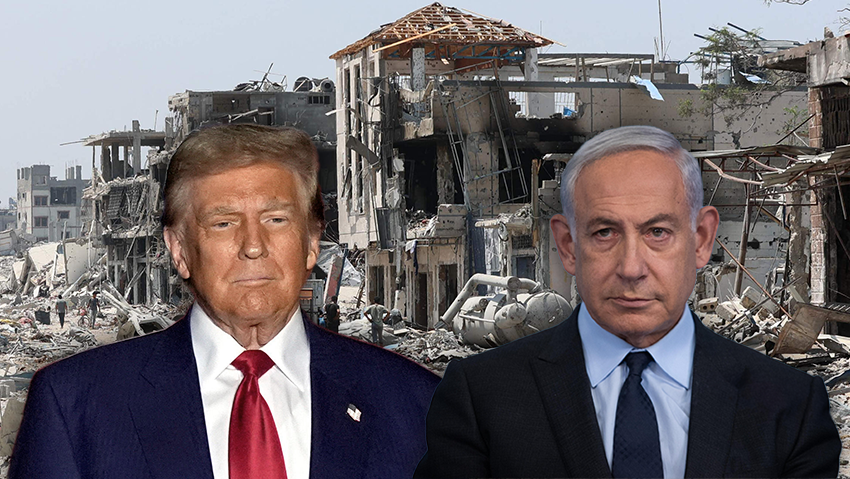
Donald Trump, Benjamin Netanyahu
(Photo: Omar AL-QATTAA / AFP, AP Carlos Osorio, Alex Kolomoisky)
Importantly, the United States is not seeking a Security Council resolution—certainly not under Chapter VII, which would authorize the use of force—but rather a vaguely worded document that would allow the council to give its backing and endorsement to the formation of a stabilization force. This force would be established by the U.S. in coordination with Arab and Muslim countries.
According to the plan, the force would operate under a “Board of Peace” expected to be headed by U.S. President Donald Trump and former British prime minister Tony Blair, and guided by a central coordination center in Kiryat Gat that would include representatives from 40 countries.
Based on reports in the American and international press about the draft text submitted to the Security Council, it appears there are, for now, no elements that are fundamentally problematic from Israel’s perspective—except for one: the clause concerning the disarmament of Hamas and other Gaza-based terrorist groups.
The original “20-point plan” presented by Trump used the term disarmament, while the draft proposal to the Security Council uses the term decommissioning—a softer and vaguer phrase that effectively means “taking out of use.” The practical meaning of this term is ambiguous and may allow Hamas to avoid surrendering its weapons—particularly small arms—to an external authority that would ensure the group no longer has access to them.
Another point of concern for Israel is the reliance on the United Nations as the source of authority for establishing the stabilization force and the Board of Peace. This could give the UN influence over the mandate language and the rules of engagement granted to the force.
Israeli officials fear a repeat of the UNIFIL experience in southern Lebanon, where international forces repeatedly failed to disarm Hezbollah. If this pattern repeats, the stabilization force could hinder Israel’s ability to achieve its key wartime objectives: ensuring that Hamas no longer poses a threat and preventing the group from rebuilding its military capabilities and infrastructure.
Lebanese front: Pressure on Beirut as Hezbollah rebuilds
On the Lebanese front, Israel appears focused on pressuring the Lebanese government and threatening Hezbollah in an attempt to revive the stalled process of disarmament. In southern Lebanon, the Lebanese army has occasionally acted to dismantle rocket sites, launchers and weapons stockpiles—based on intelligence provided by Israel to the UN monitoring committee—but its operations remain limited. Crucially, the Lebanese army is not acting to stop Hezbollah from rebuilding its military infrastructure in the area, including the construction of tunnels, concrete production sites and other entrenchment efforts.
IDF strikes Hezbollah operative in southern Lebanon
(Video: IDF)


The more serious concern lies in Lebanon’s eastern region, particularly the Bekaa Valley. There, small-scale weapons and technology smuggling operations are already underway via hidden overland routes stretching from Iran through Iraq and into Hezbollah bases and training camps.
A well-informed Israeli security source told Ynet that while the volume of smuggling is currently limited, Israel is striking every known attempt at smuggling or Hezbollah reconstruction, and is well aware of many such efforts.
According to the source, Hezbollah’s primary goal is not to prepare for renewed conflict with Israel, but rather to reassert itself as the dominant power within Lebanon. The organization seeks to intimidate the Lebanese government and military into avoiding confrontation, effectively paralyzing domestic opposition and deterring any state-led disarmament efforts, raising the specter of civil war.
Given this assessment, Israel is expected to exhaust its diplomatic leverage and military deterrence to compel the Lebanese government to act: dismantling Hezbollah’s military capabilities, halting weapons smuggling and disrupting the group’s reconstruction efforts. Should these measures fail within a reasonable timeframe, Israel may escalate its operations to carry out the task that Beirut and Hezbollah refuse to undertake themselves, albeit in coordination with the United States.