

President Donald Trump's endorsement of Prime Minister Benjamin Netanyahu managed to surprise even those who thought they had already seen every unpredictable move the American president could make. Those who insisted Trump would never strike Iran, that he despised Netanyahu and that the two were facing a crisis in their relationship have been proven wrong repeatedly. Now they have missed the significance of his latest move as well.
Trump's endorsement, issued despite objections from some of those close to him, was not simply an expression of affection for Netanyahu. He would not have issued such a statement unless he believed it served American interests beyond the military campaign against Iran. It was not merely an endorsement of Netanyahu as a leader, but a response to political and social developments unfolding simultaneously in Europe, the United States and Israel.
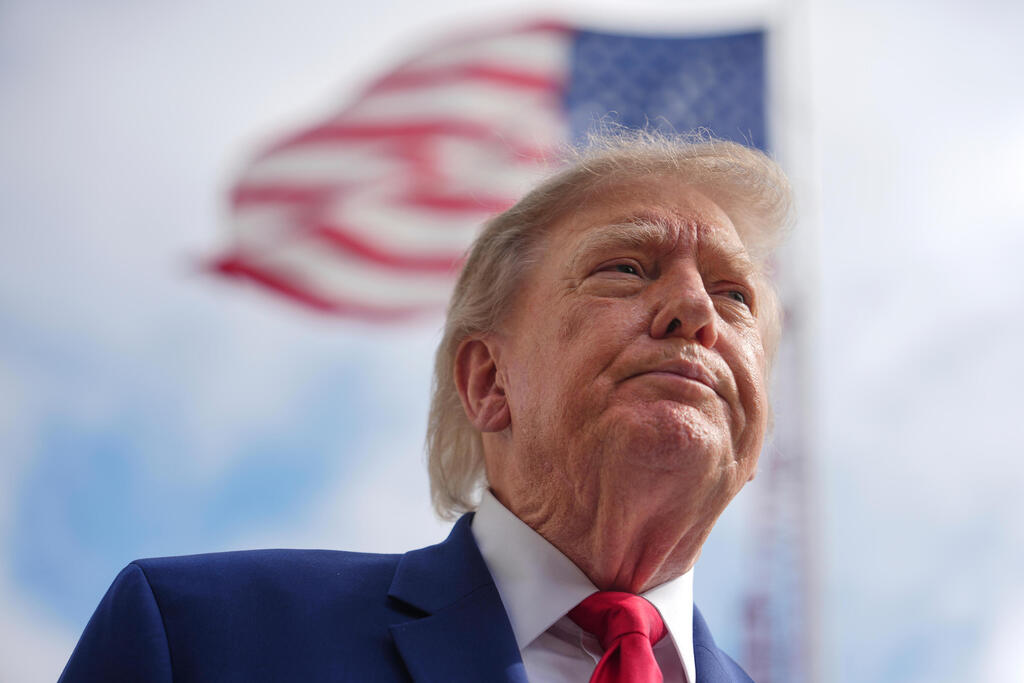
Donald Trump
(Photo: AP Photo/Julia Demaree Nikhinson)
Trump understands better than some of Israel's opposition leaders what this election is really about: the character of Israel as a Jewish and liberal state. He looks at the opposition candidates and sees Mansour Abbas and Ra'am, the United Arab List, a party rooted in Israel's Islamic Movement. In my view, he sees a parallel in Abdul El-Sayed, the Muslim Democratic candidate for the U.S. Senate in Michigan, whom conservatives have sought to associate with the Muslim Brotherhood.
El-Sayed came under criticism for his response to a terrorist attack on a synagogue in the United States, when he said that "hurt people hurt people," a remark critics viewed as an attempt to rationalize the violence, although he had explicitly condemned the attack. He later apologized for his wording. He has accused Israel of committing genocide in Gaza, described its government as evil and declined to give an unequivocal answer when asked whether the Jewish state has a right to exist.
If that reminds you of Ra'am, I believe the resemblance is no coincidence. There are similar political attitudes, in my view, among Abbas and members of his party who have refused to explicitly identify Hamas as a terrorist organization. One party lawmaker has even described part of Hamas as a charitable organization. There is also an unwillingness to speak clearly about Israel's Jewish character, alongside references to "50,000 murdered in Gaza" that portray the war as genocide.
Trump's endorsement of Netanyahu also represents a rejection of these political trends. In some respects, it is a counterweight to Barack Obama's support for El-Sayed and to what I regard as Emmanuel Macron's deeply misguided policies in France. Trump, like Netanyahu, understands that the struggle concerns the future of the Western world. He recognizes where the threat to that world is emerging in the United States and where it exists in Israel.
He also understands, in my view, that Ra'am's political influence could grow if Netanyahu and the Israeli right lose the election, particularly if the opposition becomes dependent on the party for parliamentary support.
The central threat facing both Israel and the United States, I would argue, is the Muslim Brotherhood and radical Islamism in its various forms. That is also what is at stake in Israel's election and the American midterm elections.
The same principle applies to Israel. There is hardly an Israeli, on the left or the right, who would not say they want Israel to remain a Jewish and liberal state. Everyone has things they would like to improve, according to their own political worldview, but most would agree that the current system is preferable to a state governed by religious law.
Yet many Israelis seem to fear a Jewish religious state above all else, even though such a system has never come close to becoming a reality since Israel's establishment. The possibility of an Islamic religious state, or the growing influence of political movements seeking to introduce elements of such a system, appears more remote to them and therefore less threatening.
That is a mistake. One need only look at Europe to see what can happen when societies turn a blind eye to developments of this kind. Trump and Netanyahu understand that.
Trump knows that most Americans want to preserve their country as a liberal superpower with Christian roots, a free society that maintains its identity and values. But he also sees political opponents whose determination to remove him from power, in my view, makes them willing to accept the growing influence of figures he regards as extreme, including El-Sayed.
He understands that something similar could happen in Israel, where hostility toward Netanyahu may lead some voters to support parties that could depend on Ra'am's parliamentary backing.
With his endorsement of Netanyahu, Trump was trying to draw our attention to precisely that danger.