

Every night, the Islamic Republic of Iran launches drones and missiles throughout the Middle East, threatening international shipping, destabilizing the region, and challenging the United States and its allies. These attacks are not random acts of aggression. They are part of a strategy Iran has perfected for nearly half a century.
Iran's most powerful weapon is not its drones, its missiles, or even its nuclear program. Iran's greatest weapon is blackmail.
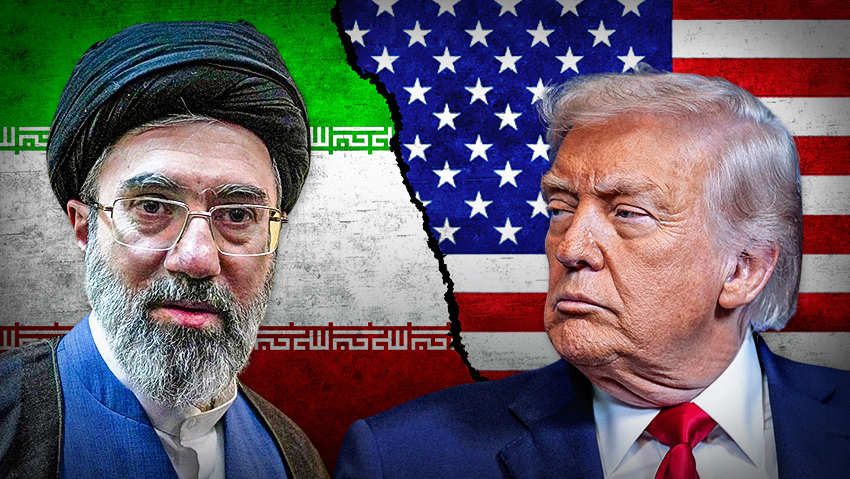
Iran's greatest weapon is blackmail
(Photo: Hamed Jafarnejad/ISNA/WANA (West Asia News Agency) via REUTERS, shutterstock, AP/Alex Brandon)
For forty-seven years, the ayatollahs have played a dangerous game. They create a crisis, raise the stakes, and then force everyone else to pay the price. The United States pays the price. Israel pays the price. The Gulf States pay the price. International shipping pays the price.
The only country that never seems to pay the price is Iran. That must change.
The first price tag: 52 hostages
The first major example came during the Iranian hostage crisis. On November 4, 1979, Iranian militants seized the American Embassy in Tehran and took 52 Americans hostage. For 444 days, those Americans were held captive while President Jimmy Carter struggled unsuccessfully to secure their freedom.
The crisis humiliated the United States and crippled Carter's presidency. Iran discovered that by holding innocent people hostage, it could force the world's most powerful nation into a defensive position. The hostages were finally released on January 20, 1981, the day Ronald Reagan took office.
Tehran learned a lesson that would shape its foreign policy for decades: blackmail works.
America paid the price. Iran collected the reward.
The Beirut lesson
A few years later, Iran repeated the strategy in Lebanon.
Through Hezbollah, its terrorist proxy, Tehran built an infrastructure designed to drive American influence out of the region. On October 23, 1983, that campaign culminated in the bombing of the U.S. Marine barracks in Beirut, killing 241 American servicemen.
I was with the Marines when they were killed. I slept on the beachhead that night. What happened afterward was just as important as the attack itself.
America eventually withdrew from Lebanon. From Tehran's perspective, terrorism had once again succeeded. The regime concluded that if it inflicted enough pain, enough casualties, and enough political pressure, America would retreat.
Once again, America paid the price. Once again, Iran walked away believing its strategy worked.
The price keeps going up
Today, the targets have changed, but the strategy remains the same.
Iran attacks commercial shipping. Iran arms the Houthis. Iran funds Hezbollah. Iran bankrolls Hamas. Iran threatens Israel. Iran destabilizes governments throughout the region.
Every drone launched into the Gulf carries the same message: "Pay us or suffer the consequences."
The ayatollahs understand that global energy markets react to instability. They understand that insurance rates rise when shipping lanes are threatened. They understand that uncertainty creates leverage.
The drone attacks we are witnessing today are simply the modern version of the hostage crisis and the Beirut bombing. The method has changed, but the objective remains the same: create fear, disrupt commerce, and force the world to bend to Tehran's demands.
This is organized extortion on a global scale.
What should the price be?
The question is simple: What price should Iran pay?
Every time Iran launches a drone at commercial shipping, there should be consequences. Every time Iran attacks American interests, there should be consequences. Every time Iran threatens regional stability, there should be consequences.
If Iran fires one drone, America should destroy a dozen strategic targets.
The regime must understand that every act of aggression comes with a price tag so severe that the attack is not worth making in the first place.
That is how peace is maintained.
Can you trust a terrorist's signature?
Some argue that another agreement can solve the problem. But can you trust the signature of a terrorist? Can you trust a regime that has spent forty-seven years lying about its intentions, concealing its nuclear activities, sponsoring terrorism, and violating its commitments?
Iran is reportedly claiming that President Trump would provide them with $24 billion upon signing a new agreement. However, there is virtually no possibility that Donald Trump would agree to such an arrangement. Likewise, there is little chance that he would simply take Iran’s word that it would neither pursue nuclear weapons nor continue enriching uranium.
As the saying goes, there is a great distance between the spoon and the mouth. There is often a significant gap between promises made at the negotiating table and actions taken afterward. It is also extremely unlikely that Iran would stop funding its terrorist proxies. The Islamic Revolutionary Guard Corps effectively runs the country, and support for terrorism remains deeply embedded in the regime’s strategy and operations.
The answer is obvious.
No.
Iran may sign an agreement. It may even comply for a season. But the regime's ideology has not changed. Its goals have not changed. Its hatred of America and Israel has not changed.
The ayatollahs are patient. Their strategy is to survive Donald Trump, wait for political winds to change in Washington, and hope the next administration contains a far-left liberal Democrat who will return to the policies of concession and appeasement.
For Tehran, agreements are often tactical pauses, not permanent commitments.
The real price tag: Kharg Island
If America wants leverage, it must focus on the regime's economic lifeline: Kharg Island.
If Iran's strategy is blackmail, America must identify what the regime values most and place that asset at risk. For decades, Iran has threatened what the world values, safe shipping lanes, stable energy markets, and regional security. It is time for the regime to understand that its most valuable asset is not immune from pressure.
That asset is Kharg Island.
Kharg Island has been the heart of Iran's oil-export economy for years. Roughly 90 percent of Iran's oil exports pass through this small island in the Persian Gulf. It is the financial engine that funds the regime's military operations, nuclear ambitions, and terrorist proxies.
Without Kharg Island, Iran's ability to finance terror begins to collapse. The ayatollahs understand leverage because leverage is their favorite weapon. Perhaps it is time to give them a taste of their own medicine.
Making the blackmailers pay
For forty-seven years, Iran has forced everyone else to pay the price for its aggression. It has built an entire foreign policy around the assumption that America will absorb the cost while Tehran reaps the benefits.
That assumption is the foundation of the regime's strategy. It is also its greatest vulnerability.
The ayatollahs have spent decades sending the bill to everyone else. It is time for the bill to be sent back.
It is time for the blackmailers to pay the price.
 Mike Evans, one of the most recognizable Christian Zionist figures in the world Photo: From the interview
For forty-seven years, Iran has forced America, Israel, and the civilized world to pay the price for its aggression. Peace will come only when the ayatollahs discover that they are the ones who must finally pay it.
Because when it comes to dealing with the Islamic Republic of Iran, peace will come only when the price is right.
Dr. Mike Evans has written 120 books and is a #1 New York Times bestselling author. He is the founder of the Friends of Zion Museum in Jerusalem, the ten Boom Museum in Holland, and Churches United with Israel, the largest Christian Zionist network in America, with more than thirty million followers.
First published: 10:51, 06.17.26