

I’m not sure how many of the commentators weighing in on the choice of Roman Gofman as Mossad chief actually know enough about him to declare the appointment unworthy. But one thing is clear: it is strange that after a successful year for the Mossad, and in a situation far from the turmoil that prompted Ariel Sharon to bring in Meir Dagan, Prime Minister Benjamin Netanyahu chose not to select any of the candidates put forward by outgoing Mossad director David Barnea. Instead, he opted for his own pick — another figure who reportedly underwent a personal interview with Sara Netanyahu and, by all indications, said all the right things to secure the role of military secretary.
Did he also undergo a similar interview now, as a candidate for Mossad chief, and have to pledge loyalty to the family? Don’t worry. We’ll find out.
(Photo: Alex Kolomoisky)
The appointment may turn out well; it has happened before. What is troubling is the message to Mossad personnel: you can excel, succeed and be the best — but to reach the top, as did the last three appointees, you need to be close to the family, and of course, express loyalty to it.
And that is disturbing. Many capable, dedicated people remain in the organization, enduring personal and family hardships, because they aspire to reach the top. The criterion should be who is most qualified, not who is most loyal or best connected.
In any case, the appointment of the new Mossad chief, in the same week marked by debates over Netanyahu’s pardon request and a blitz to pass the draft-exemption law, feels to me like spin layered on spin layered on spin. Who would have imagined that Netanyahu’s pardon saga would fade into history, be replaced by a vote on the draft law, and by the next day we would be seriously discussing replacing the Mossad director — someone who serves as the prime minister’s military secretary. A whirlwind of political spin only Netanyahu can generate.
A word of caution to the incoming Mossad chief: you may well be an excellent candidate, but given who appointed you, you begin with a significant question mark over your head. Unfortunately, you will have to work very hard to convince the public that, despite your personal loyalty, you can also be a capable Mossad director.
Just days earlier, Netanyahu pulled a pre-recorded video statement he intended to release on the draft law. Was it because Naftali Bennett and Yair Lapid announced they would speak after him? Is it possible that a man who sees himself as a media virtuoso fears that his words are less persuasive than theirs, and would prefer to wait until he hears what they say?
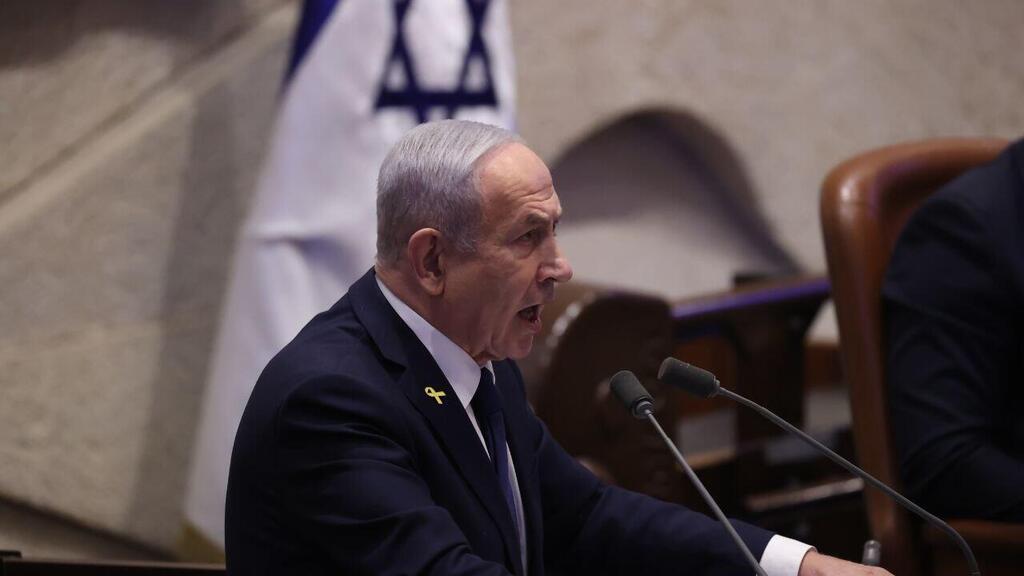
It seems to me his insecurity is less about his delivery and more about the substance. When someone must speak about something he himself is not convinced of, it is easy to back away. Talking about the draft-exemption law has been — and remains — his weak point. He knows what many Israelis, including members of his own party, think. More and more Likud MKs are voicing their opposition to the measure, dubbed the Bismuth Law but in essence the Deri-Bibi Law, and say they will vote against it. But Netanyahu, the brother of the late Yonatan Netanyahu, a Sayeret Matkal officer, a man who has long cultivated an image as “Mr. Security,” knows exactly what such a law means in wartime. Perhaps somewhere inside him there remains a thin thread of reason — of what is permissible and what is not — and before that inner voice reaches the public, it sounds different from how it sounds after being drowned out by the shouts of his family. Netanyahu does not want, under any scenario, to go down in history as the one who passed a draft-exemption law. He does not want to enter an election with such a law bearing his name, and he certainly does not want it to be known forever as “the Netanyahu Law.”
The prime minister is caught between a rock and a hard place. He must signal seriousness to the ultra-Orthodox parties to buy time for his government. On the other hand, he absolutely does not want to appear on camera as someone who supports this law. That is why everything we have heard so far on the issue has come only through background briefings.
Some believe that the entire pardon conversation that erupted this week is merely a diversion ahead of the real goal: ramming through the draft-exemption bill. Netanyahu knows that his pardon request — or more precisely the demand to resolve his criminal case without any consequence — is unrealistic. You can trust that all the alternatives have already been considered. What interests him now is passing the draft-exemption law, bringing the Haredi ministers back into the government and advancing toward the next term. And to divert attention from a bill that unites right and left in opposition like no other issue, he tossed the pardon request into the arena, like throwing a blood-soaked piece of meat into a pack of hungry animals.
According to journalist Barak Ravid, Netanyahu is indeed urging former president Donald Trump to escalate his support for the pardon request and pressure Israel’s judges. But let’s be clear: do not take your eyes off “the money.” The most important thing for Netanyahu is passing the draft-exemption bill. Look at Idit Silman and you understand the strategy. “Run, Shmulik” Silman is Sara Netanyahu’s poodle. Today there are deliberate crossbreeds of different dog types; I would call her a “Silman Pitdoodle,” a mix between a pit bull and a poodle. On one hand, she wants to be the perfect good girl, overflowing with flattery in her dealings with senior Likud figures. On the other hand, she says things few would dare say — such as her view that if President Isaac Herzog doesn’t grant Netanyahu a pardon, Trump may intervene, and that she even suggested to President Trump “additional steps,” possibly including sanctions against senior figures in the judiciary.
 Sima KadmonPhoto: Avigail Uzi
Let’s be real. This is not Silman’s idea. Not even Shmulik’s. Silman did not independently come up with the notion of Trump imposing sanctions on Israeli judges. This comes from somewhere. What does seem clear is that all the Netanyahu family’s fears are now converging into a single junction and reaching a boiling point: that the draft-exemption law won’t pass and the government could fall, that Case 1000 is far from collapsing and Netanyahu may very well be convicted — and that the consequence of that is prison.
Extreme situations produce extreme reactions. And that is what we are seeing now: spins layered upon spins, the appeal to Trump to amplify the pardon push, accompanied by the “Pitdoodle” from the film Operation Grandma: “You start at full speed and slowly build up.”