

This week, 25 years ago, a massive conference convened by the United Nations got underway to fight racism in Europe and North America in the wake of waves of immigration to those regions. About 16,000 participants came to Durban, South Africa, which was chosen as a symbolic location after the country’s liberation from apartheid rule.
Preparations for the conference lasted about two years, and four preparatory conferences were held beforehand. A preparatory conference in Tehran represented Asia — Israel was not allowed to participate, and the final document included extremely harsh language against it.
Even so, we came to Durban, a small Foreign Ministry delegation, hoping the conference would fulfill at least some of its goals and hold a serious discussion about the burning problem confronting many countries — racism. But within just a day or two, the conference had turned into a violent and blatant campaign of vilification against Israel and the Jewish people.
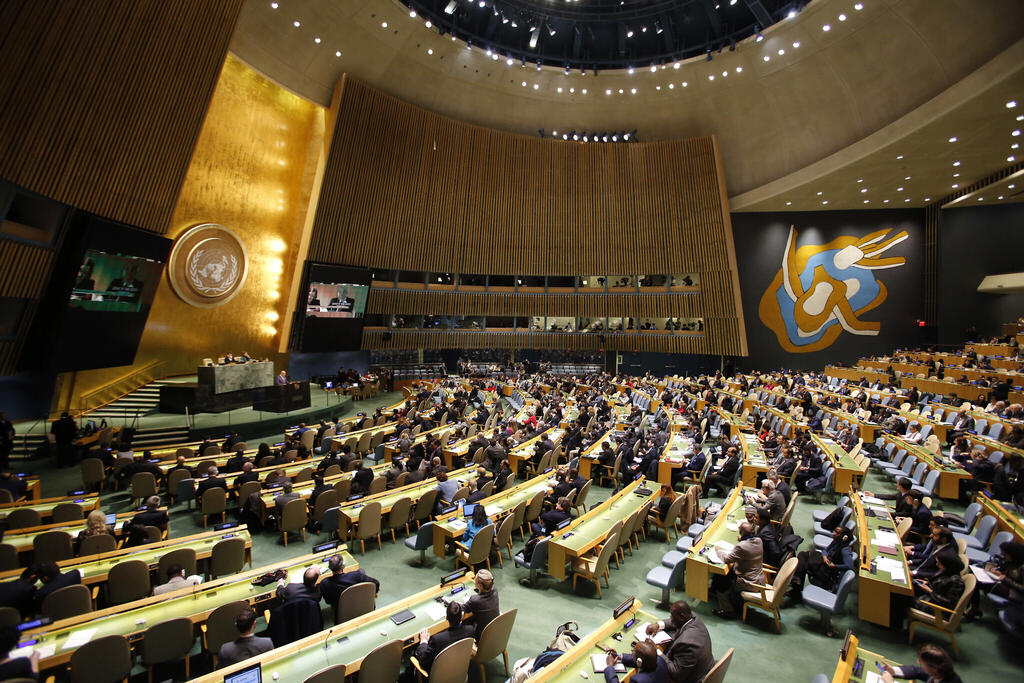
The UN General Assembly during a session in 2017
(Photo: AP)
As if out of nowhere, copies of “The Protocols of the Elders of Zion” appeared, along with shirts declaring that Hitler had failed to finish the job and that it was a shame, and demonstrations where signs called for the death of Jews wherever they were. The hatred was so overt that the security personnel protecting us forbade us even from approaching the marchers.
On the morning of the third day, I approached the senior Belgian official responsible for the diplomatic delegations and asked him how a conference into which such budgets and preparations had been invested could veer off course so quickly and turn into such a campaign of vilification, as though the 162 countries and thousands of representatives who had come from around the world had nothing more important to address.
He put a hand on my shoulder and said quietly and candidly: Representatives of countries that suffered under colonial rule want to discuss a different kind of racism, that of the past rather than the present — in their eyes, the white man is responsible for that suffering, and the role of the conference is to pay and compensate for it. Do you know, he asked, what Portugal would have to pay Brazil, Spain to most of the countries of Latin America, and — here he paused and took a breath — what Belgium would have to pay Congo? Belgium, as is known, plundered Congo’s treasures while imposing a brutal and violent occupation regime. We would all go bankrupt within a week, he said, and therefore the solution was to give in to the demand of the Arab countries — there were then 54 countries in the Muslim union — which had arrived prepared in advance, with budgets, propaganda material and crowds of demonstrators drawn from local Muslims, to divert the conference into an attack on Israel.
The discussions and battles at U.N. conferences revolve mainly around the draft — the document the conference agrees upon, which is later submitted for approval by the annual General Assembly. We therefore tried to continue resisting attempts to formulate the draft in a way that would harm Israel and the Jewish people, such as writing the word Holocaust — HOLOCAUST — with a lowercase h and an s at the end, meaning there had been many holocausts and there was nothing unique about the one that happened specifically to the Jews, or an attempt to establish in the draft that Palestinian refugees are entitled to refugee status for generations.
But the wave of hatred and attacks continued, and when representatives of Jewish nongovernmental organizations were expelled from the hall to screams of “Go, Jews, Go,” and veiled women burst into a press conference we were trying to hold, shrieking and throwing whatever objects came to hand, the U.S. and Israeli delegations got up and left the conference.
A conference like that had long-term consequences: It ushered in the era of the “new antisemitism,” characterized by more violence, more street activity, a greater presence of Islamists in antisemitic activity and a blurring of the line between antisemitism and anti-Zionism. The situation required a definition of antisemitism so that it could be fought, and one was formulated in 2005 and adopted for the first time by an international body.
The United Nations, as though to make amends for the Durban failure, declared an International Holocaust Remembrance Day. But that very same year, Iran formally decided to deny the Holocaust, and the boycott movement, BDS, was founded and began its activity.
Expressions of antisemitism continue to multiply. Anti-Zionism is expressed more and more in antisemitic tones and imagery. Muslim money, especially from Qatar, funds the activity. Social and cultural trends fan the flames in academia as well. Political alliances view antisemitism and anti-Zionism as an anti-American strategy. All of this began at the conference that opened 25 years ago. Two days later, on Sept. 11, 2021, came the attack on the Twin Towers and the Pentagon.