


Direct negotiations with Lebanon are both justified and hold positive potential. Lebanon is not a Shiite state and does not have a radical government. Israel and Lebanon share common interests. Direct talks, independent of Iran, could sever the link between Tehran and Beirut and weaken Hezbollah over time. Decisive military action alongside diplomacy from a position of strength is the right model in the Middle East.
In the long term, Lebanon could even become part of frameworks such as the Abraham Accords. Its ties with the United Arab Emirates and Saudi Arabia are more important to it than its relationship with Iran.
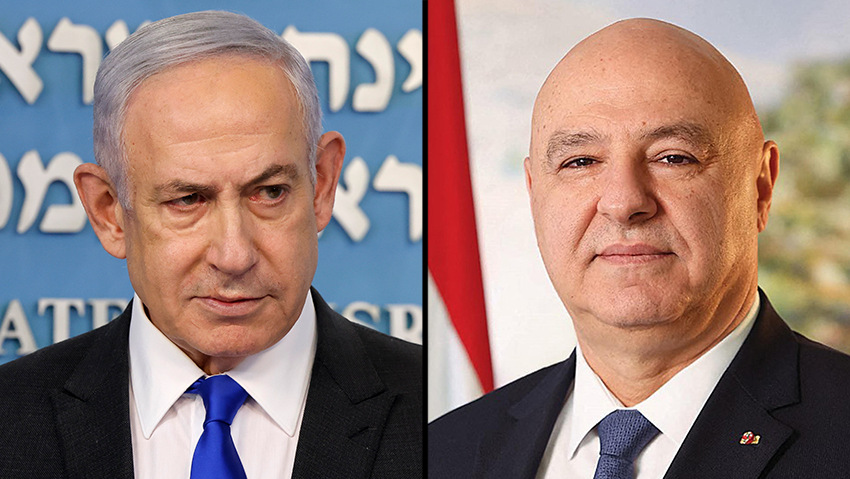
Lebanese President Aoun and Prime Minister Netanyahu
(Photo: AFP / Lebanese Presidency, Mark Israel Sellem)
After taking power in 1979, Ayatollah Ruhollah Khomeini’s guiding idea was to export the Islamic Revolution. It took more than a decade for Hezbollah to become a dominant military force in Lebanon in the 1990s.
In the 2000s, Qassem Soleimani, a close ally of Supreme Leader Ali Khamenei, was tasked with further strengthening Hezbollah to deter Israel and enable Iran to pursue a nuclear weapon under that deterrence. Hezbollah grew into a major force, with about 150,000 rockets and missiles of various types threatening Israel — more than 10 times its current launch capacity. Instead of 200 rockets a day, it could fire 3,000 or more.
Over the years, some in Israel’s defense establishment argued for a preemptive campaign against Hezbollah, after which Iran’s nuclear program could be addressed without the group’s deterrent threat. Those plans have since been reversed: instead of Hezbollah deterring Israel from striking Iran, Iran is now trying to protect Hezbollah in Lebanon. That reversal should also be changed.
Footage from a strike on one of the launchers used to fire toward northern Israel
(Video: IDF Spokesperson)


Operation Northern Arrows achieved significant gains, pushing Hezbollah back and reducing its arsenal to an estimated 10,000 to 15,000 rockets. The operation has markedly improved the security situation. As noted previously, terrorist organizations cannot be completely dismantled, but a better reality can be created.
The battlefield achievements against Hezbollah, combined with direct U.S.-Iran negotiations, create a timely opportunity to pursue direct and effective talks with Lebanon.
The goal is clear: after the fall of the Assad regime and the loss of a continuous land corridor between Tehran and Beirut, it is time to sever the diplomatic axis as well. Lebanon seeks a different path. Iran has used Hezbollah to entrench its influence there, and this connection must be cut. The combination of military and diplomatic action presents a real opportunity that should not be missed. It should proceed even under fire, albeit limited.
Hezbollah must not be allowed to restore its 'rules of engagement'
The IDF has reduced its airstrikes and, since yesterday, has not struck Beirut’s Dahieh district despite issuing an evacuation warning. Ground operations continue mainly in Bint Jbeil. At this stage, Hezbollah must not be allowed to reestablish its deterrence framework. Israel should continue pushing threats away from northern communities through limited but effective maneuvering, air operations targeting launchers and cells, and the elimination of operatives. Holding territory up to the Litani River, even partially through aerial control, is a strong bargaining chip in negotiations over Hezbollah’s disarmament.
Naim Qassem entered this war deliberately, not with symbolic fire but with a broader strategy. Beyond rocket launches, he deployed around 1,000 Radwan force operatives south of the Litani River for guerrilla warfare and potential incursions into Israeli communities.
He adopted from Hassan Nasrallah the logic of “equations” — a long-term approach aimed at building deterrence against Israel. His goal was to alter the rules established since November 2024, under which Israel strikes to prevent Hezbollah’s recovery while Hezbollah refrains from responding. Israel must not allow a return to that framework.
If it does, then in terms of long-term victory, it will not be possible to say that the security situation in the north has improved.