


On September 22, Tehran said it could reopen the strategic waterway within seven days if Washington eased military pressure and lifted its blockade of Iranian ports. Yet shipping remained severely disrupted. Reuters reported that only two commodity vessels crossed the strait on Monday, compared with an estimated pre-conflict average of 125 large commercial ships a day. That gap reveals the strategic value of ambiguity. Hormuz can become a lever even when it is neither fully closed nor reliably open.
For Iran, this creates a cheaper form of pressure than a permanent blockade. Every reopening announcement can move expectations, while every threat of renewed disruption can reverse them. The waterway may change little while its political meaning changes dramatically.
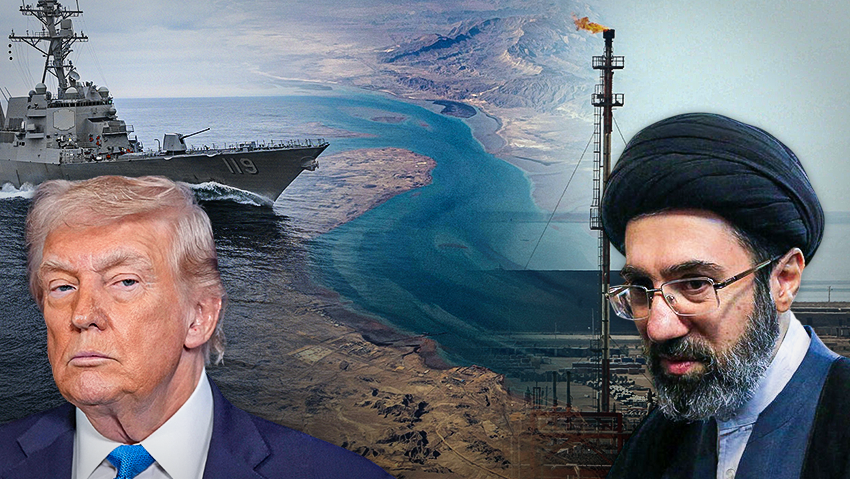
(Photo: AP/Alex Brandon, Atta KENARE/AFP, REUTERS/Stringer, Lance Davis/United States Navy/Huntington Ingalls Industries)
That matters because Western governments experience the crisis through domestic politics as much as through maritime security. When traffic increases, leaders can present lower energy pressure as evidence that diplomacy, deterrence or negotiation is producing results. When traffic collapses, opponents can portray the same government as incapable of protecting consumers or deterring Tehran. Hormuz therefore becomes raw material for competing political narratives.
A short confrontation can concentrate public attention. An open-ended cycle of disruption, partial reopening, warnings and negotiations does something else. It turns a strategic crisis into background pressure. Fuel prices, inflation and shipping costs become more visible to voters than missile ranges, nuclear enrichment or Iran’s regional military infrastructure.
The US Energy Information Administration reported that oil and petroleum liquids moving through Hormuz averaged 21.6 million barrels a day in the final quarter of 2025. By the second quarter of 2026, the figure had fallen to 4.9 million barrels a day. EIA also linked uncertainty over reopening to unusually volatile oil prices during the second quarter.
Those numbers point to a strategic paradox: physical disruption can diminish while political disruption survives. A partial reopening may relieve energy pressure without restoring confidence that the route is secure. A new attack, warning or diplomatic breakdown can revive fears within hours. Every reopening can therefore remain provisional.
For Washington and European capitals, provisional stability creates an uncomfortable calculation. They must demonstrate that pressure on Iran is producing results while avoiding the economic consequences of another disruption. Tehran can exploit that tension simply by keeping the possibility of renewed closure credible.
Saudi Arabia has expanded efforts to move exports through routes that reduce dependence on Hormuz, while other producers have sought alternative channels. Those measures cushion the economic impact, but they also reflect an adaptation: regional governments cannot assume Hormuz will remain dependable during a confrontation with Iran.
A Gulf government may strengthen security cooperation with Washington while simultaneously preserving channels to Tehran and investing in alternatives to Hormuz. This is not necessarily Iranian control. It is what states do when they believe the strategic environment could change quickly.
For Israel, that distinction is crucial. Jerusalem does not need Gulf partners to choose Iran over the West for uncertainty to matter. It is enough if regional governments become more cautious about taking positions that could expose them to economic retaliation or renewed maritime disruption.
Iran does not need to control Western media or dictate the positions of Western politicians. It can benefit from divisions that already exist. One government may view renewed pressure as necessary to contain Tehran. Another may prioritize lower energy prices. A political opposition may blame the government for economic pain regardless of which policy produced it.
The longer this cycle lasts, the easier it becomes to frame restraint as pragmatism and continued pressure as an unnecessary economic risk.
The nuclear issue is particularly vulnerable to this dynamic because its consequences are harder for voters to see than the price of gasoline or a shipping disruption. If each new Iranian crisis is absorbed into a broader debate about energy costs, Western attention can drift from the question of what Tehran is building toward the narrower question of how quickly the latest emergency can be made to disappear.
If Western governments increasingly measure success by temporary calm, Tehran can seek agreements that reduce disruption without resolving the capabilities that generated the crisis. A reopened Hormuz would then become proof of de-escalation even if Iran retained the ability to threaten it again. A diplomatic pause could be treated as stability even when the underlying military balance remained unchanged.
Israel should therefore distinguish between relief and resolution.
Lower oil prices would be welcome. Restored shipping would be welcome. A diplomatic channel would be welcome. None of those outcomes, by themselves, establishes that Iran has lost the ability or incentive to create another crisis.
The relevant question is durability:
Can commercial traffic remain secure without new political concessions? Can Iran be prevented from repeatedly turning maritime access into bargaining leverage? Can Western governments maintain pressure when the immediate economic incentive points toward accommodation?
Those questions matter more to Jerusalem than whether tomorrow’s shipping figures are higher than today’s.
Iran’s ability to impose costs intermittently creates a different challenge from a conventional blockade. Permanent closure would invite a clear response. Intermittent disruption creates arguments over proportionality, timing and escalation. It gives political actors room to demand patience precisely when the strategic problem has not disappeared.
That ambiguity can constrain Israel indirectly.
Suppose renewed Iranian pressure on Hormuz raises energy prices just as Israel faces another confrontation with Tehran. Western leaders would not necessarily abandon Israel. They could instead ask for restraint, a pause or a narrower military response in order to prevent another economic shock. None of those decisions would have to be coordinated with Tehran to produce an outcome favorable to Tehran.
The central threat is not that every Western government will suddenly reverse its Iran policy. It is that repeated economic shocks can gradually change the political price of maintaining a confrontational strategy. A policy that appears sustainable during a short crisis can become difficult to defend after months of uncertainty.
Iran has time on its side in a way democratic governments often do not. Tehran can think in terms of rebuilding, waiting and testing. Western politicians face elections, budgets, polling and consumer pressure. The asymmetry does not guarantee an Iranian victory. It gives Tehran an opportunity to exploit the different clocks.
Judge Iranian moves by what remains after the headlines fade.
If Hormuz reopens, the question should be whether the reopening is durable. If talks begin, the question should be what capabilities and leverage Iran retains. If oil prices fall, the question should be whether the underlying vulnerability has actually been reduced.
That standard would make the political consequences harder for Tehran to manipulate.
Israel also has a communications challenge. Its message to Western partners should not be that every disruption requires escalation. It should be that temporary calm cannot become the only measure of success. Otherwise, an adversary can learn that creating instability is enough to generate pressure for concessions.
 Amine Ayoub
Hormuz is therefore becoming more than a maritime chokepoint. It is becoming a test of Western political endurance.
Iran does not have to close the strait indefinitely. It does not have to defeat Western navies. It does not even have to persuade Western publics that its policies are justified.
It only has to keep the future uncertain.
If that uncertainty becomes persistent, fatigue can follow. Fatigue can create political pressure. Political pressure can encourage temporary arrangements that leave the underlying strategic problem intact.
For Israel, that is the real warning from Hormuz.
The question is no longer simply whether ships can pass through the strait today. It is whether Tehran can make Western governments change their behavior because they fear what might happen tomorrow.
If Iran can do that repeatedly, uncertainty itself becomes a weapon.
And unlike a missile, it does not need to be launched only once.
- Amine Ayoub, a fellow at the Middle East Forum, is a policy analyst and writer based in Morocco. Follow him on X: @amineayoubx