

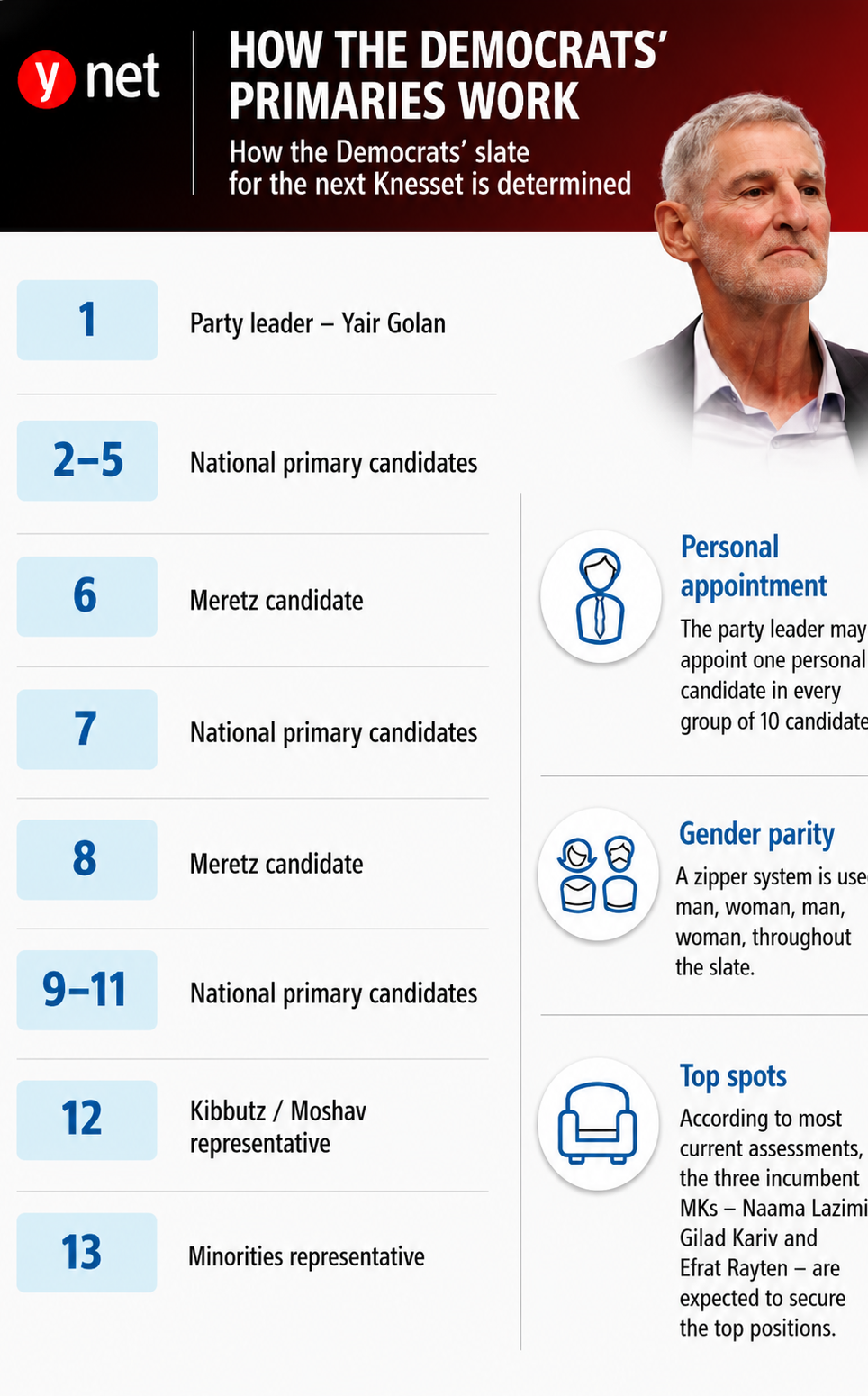
Members of Israel’s Democrats party will vote today on their slate for the next Knesset. At first glance, the choice appears straightforward. The party is polling at around 10 seats — effectively nine available places, since party chair Yair Golan does not have to compete for the top position.
The party’s three current lawmakers — MKs Efrat Rayten, Gilad Kariv and Naama Lazimi — have been among the most effective members of the opposition. Together with Golan, they have defined the party’s public identity and helped lift it into double digits in the polls. It would be a major surprise if all three were not elected near the top of the slate. Their greatest danger is the familiar one facing strong primary candidates: voters may assume their election is already guaranteed and cast their ballots elsewhere.

Assuming all three win, six places remain. Two are allocated to candidates from Meretz, which merged with Labor to form the Democrats. Golan may appoint two additional candidates to the top 10 and also has the authority to promote candidates within the slate. The final list must then comply with the party’s gender-balancing system, alternating between men and women. It is highly progressive — and exceptionally complicated.
Whether we welcome it or not, this election may mark the final chapter of Israel’s primary system. Among the Democrats, primaries survive only in a heavily restricted form. In Prime Minister Benjamin Netanyahu’s Likud party, they appear to be approaching extinction. Israeli parties increasingly fall into two camps: those in which the leader — or leaders, in the case of former prime minister Naftali Bennett and opposition leader Yair Lapid — choose the candidates, and those in which a small circle of rabbis and politicians settles the matter through private negotiations.
Only a year and a half ago, former IDF chief of staff Gadi Eisenkot caused a serious crisis in the National Unity party after its chair, Benny Gantz, refused to hold primaries for either the leadership or the parliamentary slate. Three weeks ago, Eisenkot launched Yashar, the new party he now leads. I attended the event. It was pleasant. Candidates were introduced to applause. Primaries were not mentioned, even in passing.
Should advocates of internal party democracy now sound the alarm? I am not convinced.
Selecting a parliamentary slate is meant to serve two purposes. The first is electoral: choosing candidates who can attract votes. The second is political: assembling a group capable of wielding influence in the next Knesset. The first goal favors popular, polished candidates with impressive military ranks, academic credentials and public résumés. The second favors experienced, combative politicians who understand how to turn parliamentary and government positions into power.
Former defense minister Moshe Dayan once observed that no one remembers the name of ancient Jewish rebel leader Bar Kochba’s deputy. The same is largely true of the order of Likud’s candidates below Netanyahu. Few people other than the candidates and their families will remember who ranked seventh and who ranked 17th. In the end, the party leader — not the primary voter — will decide who becomes a minister and who remains on the Knesset’s back benches.
Individual candidates can bring additional votes when a party represents clearly defined communities. In United Torah Judaism, which represents much of the Ashkenazi ultra-Orthodox public, every Hasidic court and Lithuanian faction expects representation. The same principle applies to the Sephardi ultra-Orthodox Shas party: without representation, there are no votes. It also matters in Israel’s Arab parties.
For most other parties, however, the names below the leader have limited impact on election results. Their importance becomes clear only after the votes are counted.
Likud offers a useful example. The slate it presented four years ago included, on one side, colorless opportunists who treated the current term as a waiting room before the struggle over Netanyahu’s succession. On the other were disguised Kahanists, habitual provocateurs such as Likud MK Tally Gotliv and inexperienced lawmakers who entered parliament because of the reckless expansion of the Norwegian Law, which allows ministers to resign from the Knesset and be replaced by lower-ranked members of their party slate.
Many appeared to have little understanding of their parliamentary role. They served the coalition’s political attack machine, but also damaged the reputation of the governing party. Netanyahu is now seeking to replace some of them with figures who are less inflammatory.
The Democrats’ primary voters face an equally consequential dilemma. Within Israel’s center-left, theirs is the bloc’s most militant party. Removing the current government is, for many of them, not simply an electoral objective but an existential mission. Yet they understand that winning an election would be only the beginning. Any government that includes the Democrats would receive no honeymoon period.
Such a government would be torn between the demand for sweeping change — a reversal of the current coalition’s agenda — and the need for stability and political calm. The Democrats’ representatives in the Knesset and the Cabinet would face contradictory expectations. They would need maturity, restraint and discipline, while also preserving the distinct identity that brought their voters to the party in the first place.
Consider social activist and primary candidate Naor Narkis, who is competing for one of the two places allocated to Meretz. Narkis has built a substantial social media following around a sharply anti-Haredi and secularist agenda. He recruited many new party members and speaks to the anger of voters who believe the government has been shaped by United Torah Judaism leader Moshe Gafni, former housing minister Yitzhak Goldknopf and Finance Minister Bezalel Smotrich.
But would a candidate who built his support through confrontation be able to function within a party seeking a place in government?
That is the Democrats’ central challenge. They want to represent the protesters who filled Kaplan Street without turning a future government — should one be formed and should they join it — into a permanent extension of the protest movement.
They must remain a vehicle for public anger while proving they can also govern. That is the choice behind today’s primary.