

I love going to the Western Wall. It is difficult to explain the emotional connection that many Jews, from across the spectrum, feel toward a site that symbolizes to a great extent the completion of our return to our historic home. One does not have to be religious, certainly not Orthodox, to feel that connection. Secular Israelis hold their children’s bar and bat mitzvah ceremonies there. The site draws interest from non-Jews as well. The notes tucked between the stones tell small and large personal and collective stories alike. Everyone is equal before the Wall.
Yet Judaism did not remain in one place, and today more Jews live outside Israel than in it. Jewish communities in the Diaspora have done an exceptional job of preserving their Judaism while developing additional streams beyond familiar Orthodox Judaism rooted in Jewish law. Anyone who, like me, has had the privilege of public life knows and feels the extraordinary bond Jewish communities around the world have, especially in the United States but not only there.
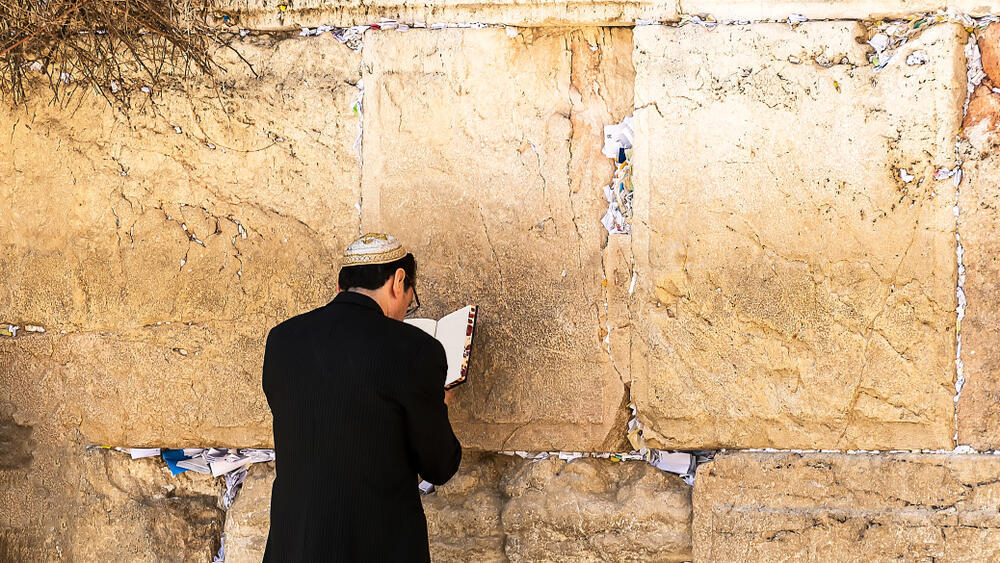
A Jewish man reads Psalms at the Western Wall
(Photo: Shutterstock)
Questions of Jewish law evolved alongside the emergence of the Conservative and Reform movements — issues such as separation between women and men, whether women may serve as rabbis and cantors, and whether women may be called to the Torah. Anyone who has visited a synagogue in a Jewish community abroad can attest that the Friday night Kabbalat Shabbat service was not necessarily familiar. It carried different melodies and nuances, even if worshippers held the very same prayer book used in an Orthodox synagogue. To preserve their Judaism, they built communities and forged paths that allowed them to hold fast to their roots.
From that world, they also came to the Western Wall — from places where equality between women and men is taken for granted, and from a search for a way for all Jewish communities to feel at home at the bedrock of our existence. After years of bitter dispute, expressed in clashes during the monthly Rosh Chodesh prayers when the group Women of the Wall entered with Torah scrolls, wrapped in prayer shawls and at times wearing tefillin, they faced shocking and sometimes violent reactions. Some have the right to raise an eyebrow and feel uncomfortable with those rituals, and others may view them as provocative. But violence is what desecrates Judaism more than anything else.
The 'Ezrat Yisrael' plaza
In 2016, Prime Minister Benjamin Netanyahu launched important staff work, led by then-Attorney General Avichai Mandelblit, to advance what became known as the Western Wall compromise. The idea was to build a plaza adjacent to the Wall — in fact, it has already been constructed — called the Ezrat Yisrael plaza, where no gender separation would be required and the various Jewish streams could conduct their ceremonies as they have developed over the years.
Unfortunately, although the plan was approved by the government, it was never implemented. On Wednesday, for the first time in years, Israel’s Supreme Court ruled that in the absence of another decision, the government must implement the plan it had adopted. In 2017, under pressure from ultra-Orthodox parties, the plan was frozen, though work on preparing the plaza continued, reflecting how essential the issue is for Jewish communities abroad. When the justice minister claimed after the ruling that it marked a “red line,” he would do well to read the government’s own response, conveyed by the Cabinet secretary, stating that the directive simply continues implementation of Government Decision 2785 regarding prayer arrangements at the Western Wall.
It is not only the Supreme Court that reached the correct decision in this case, but the government itself, in recognizing the enormous contribution of Jewish communities to the State of Israel — a commitment that has intensified a thousandfold since October 7.
 Ayelet Nahmias-Verbin
Although there are photographs documenting the Western Wall plaza before the establishment of the state, when there was no separation between women and men, I acknowledge that for me this is not the end of the world. But I fully understand and respect those for whom separation is nonnegotiable. That is why the Ezrat Yisrael plaza offers a model of creativity and common sense: The platform touches the Wall but rises above it. It creates a mixed-gender space for those who seek it and does not disturb those who require separation during prayer — a case in which one benefits and another does not lose, Judaism at its best.
As noted, since October 7 there is no dispute about the place of Jewish communities and their commitment to the Jewish people and the state. Yes, even a Jew who spends his or her life abroad deserves appreciation and a warm embrace for their involvement and care for the State of Israel. Israel would do well to embrace them, whether on the matter of prayer at the Western Wall or on the painful issue of conversion. The Diaspora is our extended family. As in any family, we are obliged to respect each member’s path. That is the secret of our strength.
Ayelet Nahmias-Verbin is a former member of the Knesset.