

Ahead of every election, Israelis begin arguing about what the vote will really be about. Will it be the cost of living? The military draft? The ultra-Orthodox? The settlers?
Yesterday, I saw someone argue that the next election would be about Jewish extremist violence in the West Bank. Then I saw someone else write that she was more frightened by areas where the ultra-Orthodox community increasingly appears to set its own rules.
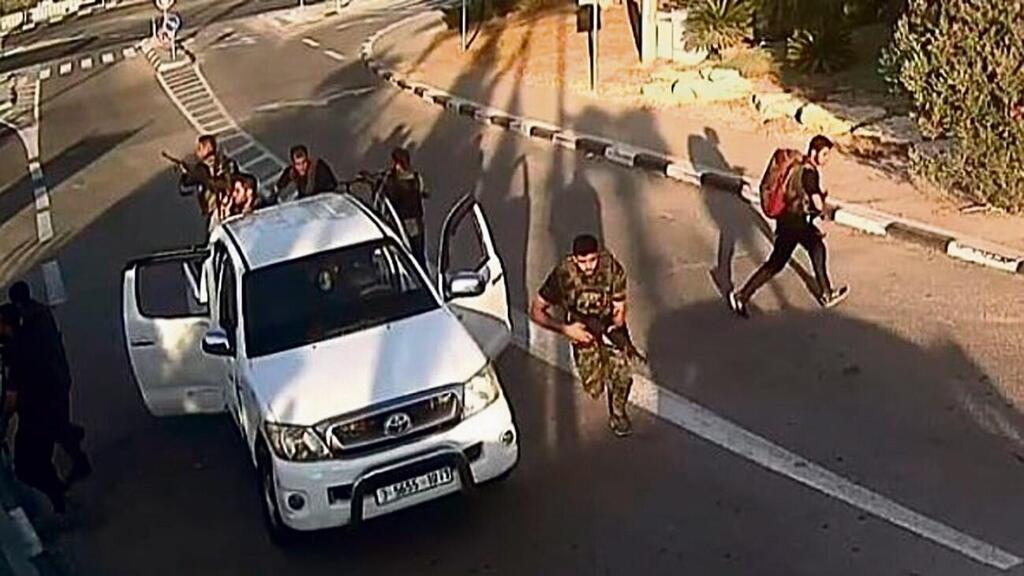
Hamas terrorists on October 7
(Photo: Screenshot)
For several hours, I genuinely wondered which answer was right.
There is certainly no shortage of material.
Over this weekend alone, an ultra-Orthodox draft evader was arrested while driving a stolen vehicle. Dozens of Haredi protesters blocked Route 443 in protest over his arrest. In Bnei Brak, shipping containers were placed in streets to block traffic on Shabbat. On Saturday night, buses were prevented from entering Jerusalem.
At the same time, images emerged from the West Bank of masked Jewish men entering a Palestinian village in white pickup trucks.
We have enough material for 10 election campaigns.
Ultra-Orthodox against secular Israelis. Settlers against Palestinians. Military service. Shabbat. Policing. Law and order.
Everyone can simply choose the issue that frightens them most and start fighting about it.
And then it occurred to me: I had fallen into the trap.
How is it possible that we are already debating what the next election will be about, while the worst event to happen here is steadily being pushed further down the list?
October 7.
There does not even need to be one enormous, sophisticated political spin campaign to make us forget it.
The opposite may be far more effective: overwhelm us with a thousand smaller stories.
Today, we fight about Haredi protesters blocking a bus. Tomorrow, about settlers entering a Palestinian village. Then it is a smashed statue, an outrageous remark by a lawmaker or the latest political storm that survives only until the next one arrives.
All of these stories are real. All of them matter. All of them deserve attention.
But while we argue, time passes.
And Israelis possess a remarkable ability to get used to almost anything.
Even this week’s images from the West Bank, of masked men riding in white pickup trucks, immediately reminded many Israelis of the white pickup trucks seen on October 7.
The association was almost impossible to avoid.
Yet somehow, we managed to spend more time discussing the resemblance between the images than the event those images brought back to mind.
And perhaps that is the biggest spin of all.
It is not about convincing us that October 7 was not horrific. No one could do that.
It is simply about convincing us that there are now other things to talk about.
But in this sense, there are no “other things.”
Almost every major argument Israel is having today runs through October 7.
The debate over military conscription is connected to it. The debate over security is connected to it. The question of responsibility is connected to it.
 Ruth ElbazPhoto: Stav Barkai
So are Israelis’ trust in the state, the military and the government, and their confidence that those institutions can protect them.
Even today’s arguments over sovereignty, groups imposing facts on the ground and a state struggling to enforce its own laws did not emerge in a vacuum.
Of course, the next election will also be about the ultra-Orthodox, the cost of living, the West Bank and another 20 issues that will undoubtedly drive us mad before Israelis eventually go to the polls.
But amid all that noise, one simple fact is worth remembering.
The next election will be Israel’s first election since October 7.
You can change the subject. You can change the headline. You can even change the thing everyone wakes up angry about each morning.
The one thing you cannot change is the date.