

Beneath a veneer of business as usual in the face of the ongoing siege and exchanges of threats with the United States, the Islamic Republic is experiencing one of the most complex crises in its history. It is a crisis that has spun out of control and has begun to manage the system itself.
The collapse in the value of the local currency to an unprecedented low of 200 million rials to the dollar, the prolonged absence of the supreme leader, a deep sense of national humiliation over the failure to avenge the death of the leader who was assassinated, the loss of trust in a leadership concerned only with lining its own pockets, the obsession with the hijab in the face of women’s resistance, the pressure and economic erosion caused by the costs of war and U.S. threats, and more — all of these are combining to completely wear away what remains of the regime’s backbone, if it can still be called that.
The economy as a guillotine: 200 million rials to the dollar
When a country’s currency loses almost all of its value to the point that one dollar is worth 200 million rials, the numbers cease to be dry economic data and become a social cry of distress. For the average Iranian citizen, the marketplace has become an arena of daily survival, and the enormous gaps between the elite close to the regime and the general public have become unbearable — some continue to post showy videos from glittering cafés while others struggle to buy an egg for dinner.
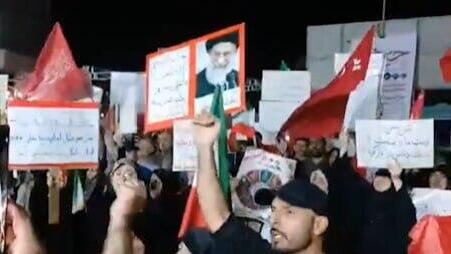
Demonstrations in Iran against Foreign Minister Abbas Araqchi and Parliament Speaker Mohammad Baqer Qalibaf
Runaway inflation is dismantling the last contract of trust that connected parts of the public to the government — the promise of stability and economic security in exchange for political obedience. And when the wallet is completely empty, fear of the security apparatus begins to fade, because what, in fact, is left for a person to lose? The clock is ticking toward the next round of protests, and those holding the regime’s reins understand this very well.
Another deep wound in the regime concerns its symbolic failure — the assassination of Ali Khamenei struck the regime’s upper echelons with shock, and since then a leadership vacuum has prevailed around the figure of the “missing leader,” while the regime tries to project business as usual. Yet the most dangerous threat to totalitarian regimes has never been only the opposition outside, but the disintegration of the “base” within.
Among broad circles of supporters in Iran — elements that in the past were staunch regime loyalists and hard-line nationalists — a deep sense of shock is growing over what is defined as complete “feebleness” in the face of the West. The expectation of a powerful response to Khamenei’s elimination has been replaced by bitter frustration over the leadership’s attempts to advance negotiations and save their own skins.
In the eyes of many Iranians who saw themselves as supporters of the Islamic Republic, the great tragedy is not only that the power of its enemies has grown, but that the regime that once threatened to destroy countries has itself become battered, weak and helpless. Nothing undermines a radical religious regime more than the realization among its supporters that their “lion” is nothing more than a cat afraid of its own shadow. This is a profound crisis of faith.
And precisely at a time when the regime’s legitimacy is at an unprecedented low, while the economy and its loyal base are collapsing beneath it, the leadership chooses to take a step that illustrates its complete detachment more than anything else: deepening its grip on society through zealous tightening of enforcement of the hijab laws. Instead of showing flexibility, the regime is investing enormous resources in a hopeless war against women in the streets.
 Dana SamehPhoto: Yakir Asido
This attempt to impose authority through force is functioning as a deadly boomerang. For a broad public, including citizens who had previously remained indifferent, the harsh enforcement has become a symbol of total governmental blindness. It turns every street into an arena of daily confrontation and further punctures the shell of legitimacy. Citizens see the government as a body that does not provide bread, does not provide security and excels only at suppressing personal freedoms.
The picture on the ground is far more complex than a simple binary struggle. The cracks now run through almost every social stratum — from the deep disappointment of members of the loyal and devout “base,” who are beginning to question the leadership’s strategic horizon, to the anger of a younger generation that no longer seeks reforms, but the fall of the regime itself.
This is a disintegration of legitimacy from which there is no return: the public has long since ceased to believe in the ability of the clerics to run a modern state. The Islamic Republic’s hourglass is running out, and the question is not whether the system will change, but with what force this volcano will erupt from within.
Dana Sameh is an independent researcher, commentator and lecturer specializing in understanding the Iranian street and processes of civil protest from the revolution to the present day