

Not long ago, I was in Madrid and met two very pleasant Lebanese women. We spoke about Lebanon and, in particular, why they had left and moved to Madrid. One of them told me she had lived in Europe for a long time and had planned to return to Lebanon. She did return. But one day, the Lebanese government effectively seized the money people had in their bank accounts, not just hers but everyone’s. In that moment, she realized she had no future in Lebanon and left for Europe.
From there, the conversation shifted to a broader question: How did Lebanon, long seen as a promising and prosperous country, become a sad, crumbling and failing state? Their answer was sharp and painful. In their view, Lebanon was a kind of social experiment, an attempt to test whether different minority groups could live together over time. Their conclusion was clear: The experiment failed.
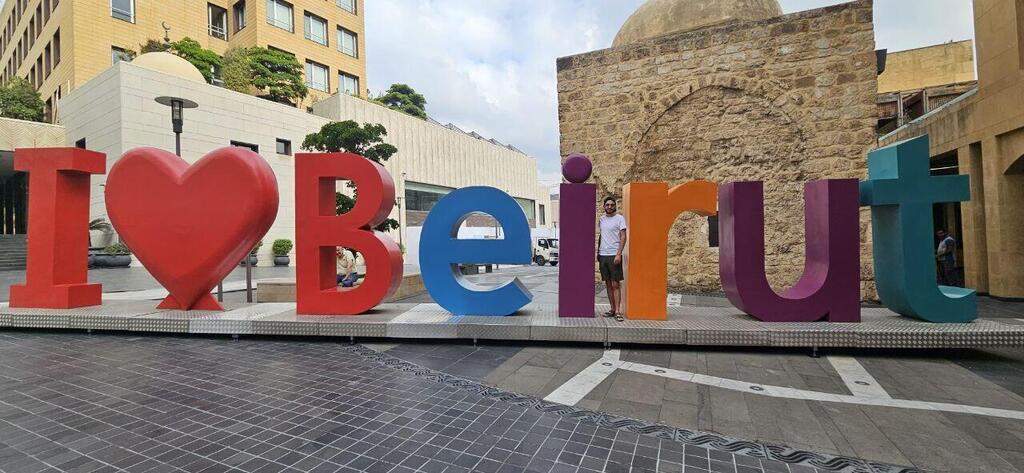
Beirut
(Photo: Berry Indig)
When different groups cannot imagine a shared future, they do not cooperate. They compete with one another and ultimately undermine the state in which they live. Their story reminded me of a simple experiment I conducted several years ago. I divided people into groups based on the color of their shirts. Blues versus reds. Within minutes, people who had never met began thinking in terms of “us” and “them.” The blues wanted the blues to win. The reds were convinced the blues were receiving preferential treatment. This is our tribal instinct, deep, automatic and alarmingly easy to trigger.
Now imagine an entire country built on that principle, not blues versus reds but Sunnis, Shiites, Druze, Greek Orthodox and others. Each carries a history of grievance, a collective memory of trauma, and leadership whose primary task is to protect its own community. That is Lebanon. It may be the most fascinating and painful social experiment unfolding in our world.
The Lebanese system sanctifies division instead of trying to blur sectarian identities. The president must be a Maronite Christian, the prime minister a Sunni Muslim, the speaker of parliament a Shiite Muslim. On the surface, this sounds fair. Everyone is represented. Everyone is included. In practice, however, it is as if the system tells people in every election and every public decision: Do not forget who you are. Do not forget who they are. This is not about right or wrong. It is about Maronite versus Sunni.
When you live in such a reality, something very basic breaks down. In research we conducted on cooperation, we found that people are willing to work together when they feel the rules are fair and the system serves the common good. But the moment they believe the system is rigged, that another group is getting more or taking advantage of them, cooperation collapses. Not out of malice, but out of clear psychological logic. Why cooperate in a game that is stacked against you?
Scientists have found that in countries with high levels of public trust, people pay taxes almost willingly. Not because they are naive, but because they feel the money comes back to them through health care, education and infrastructure. They share a common “we.”
Take taxes. Researchers have found that in countries with high public trust, people pay taxes almost willingly. Not because they are naive, but because they believe the money comes back to them through health care, education and infrastructure. They share a sense of “we.” In Lebanon, when a Maronite pays taxes, he may ask himself: Is this money reaching Maronites, or is it going to Shiites? When he does not know, or worse, when he suspects it is being “stolen” by the other side, he does not pay. That is not antisocial behavior. It is rational behavior under conditions of mistrust.
Corruption in Lebanon is not a bug. It is a feature. When there is no strong “we,” everyone works for their own group. If you are a Maronite minister, you take care of Maronites. If you are a Shiite leader, you take care of Shiites. And everyone understands the rules. In the laboratory, we can stop an experiment that spirals out of control. But Lebanon is an experiment without a stop button. The results speak for themselves: collapsing infrastructure, unreliable electricity, shuttered banks, recurring disasters, and no one truly assuming collective responsibility. Not because of a lack of talent or morality, but because the question “Who benefits?” overrides the question “Is this good?”
The problem is not minorities themselves. The problem is the absence of a civic identity strong enough to rise above them. When every group thinks only of itself, no one thinks about the state. And without someone thinking about the common good, the system collapses inward. Lebanon teaches a simple and cruel lesson: A country made up of minorities, each thinking only of itself, cannot endure. Not because its people are evil, but because they are human. Our psychology requires a sense of “we” in order to sacrifice, to cooperate and to plan for the future.
We, too, have our fears, and we, too, ask who is getting more. The question is whether we have enough of a shared “we” to hold it together.
At this point, it is worth pausing to think about Israel. We, too, are a country of minorities: Haredim, secular Jews, Arabs, national religious Jews, immigrants from the former Soviet Union and immigrants from Ethiopia. We, too, have fears. We, too, argue over who gets more. The question is whether we have enough of a shared “we” to hold it together.
 Dan ArielyPhoto: Jonathan Bloom
In my view, the answer is still yes, but the margin is narrowing. Every time we speak in terms of “them” instead of “us,” every time we assume the other side is cheating us, we take another step toward the Lebanese model. The effort to preserve a shared civic identity is not a luxury. It is a matter of survival. The question Lebanon poses is psychological before anything else: How much “we” does a country need in order to function? We need a great deal of it. And it seems clear that we need to start investing in becoming more of a “we.”