

As reports of U.S. aircraft carriers making their way to the region sound like the beating of war drums, a question arises: Is geopolitical reality truly confined to two options — a comprehensive nuclear agreement or military confrontation? Or is a “third path” now being paved under the radar: a tactical deal that would allow all sides to climb down without declaring surrender?
Today, as Trump’s envoys sit down in Geneva with Iran’s foreign minister, the roar of the U.S. Air Force will echo in the background. The question hanging in the air is whether Trump is deploying forces to launch a campaign, or to impose a new “zone of possible agreement,” known in negotiation theory as ZOPA — one in which the cost of refusing talks becomes unbearable.
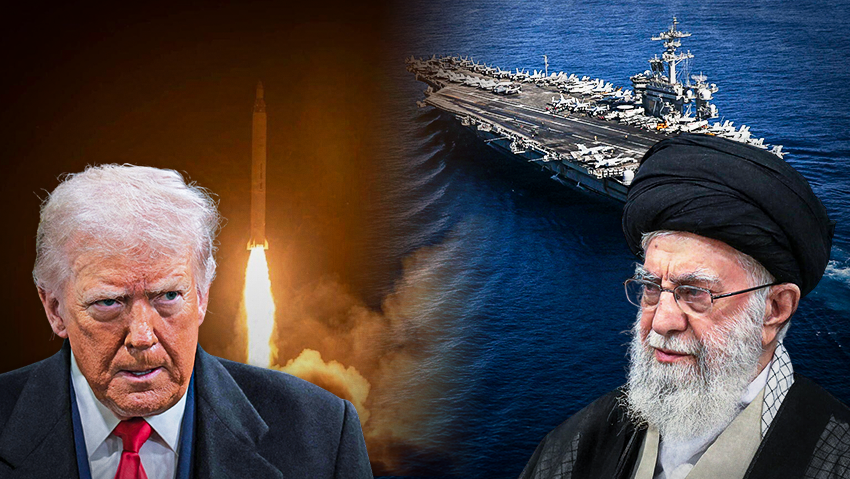
(Photo: Anna Moneymaker/AFP, KHAMENEI.IR/AFP)
The art of the ultimatum
Trump’s negotiating style has never been subtle. It is based on creating a credible and tangible threat designed to make the status quo too costly for the other side. That approach was on display in 2017 with North Korea, when his fiery rhetoric — including threats of “fire and fury” — served as a tool to break the stalemate and led to the Singapore summit. It is important to recall, however, that the ultimatum did not culminate in North Korea’s full nuclear disarmament. It achieved only a tactical shift.
In the Russia-Ukraine arena, Trump employed what could be described as a “dual ultimatum,” pressing all players. He signaled to Ukraine that aid could be halted if it did not show flexibility, and threatened Russia with advanced weaponry if it refused a ceasefire. There, too, despite heavy pressure and some degree of rapprochement, developments on the ground suggest that an ultimatum alone does not guarantee a decisive outcome.
Is the current buildup of forces opposite Iran the “stick” meant to generate similar movement? When the alternative to an agreement — known as BATNA, or best alternative to a negotiated agreement — becomes dangerous, compromises once deemed impossible can suddenly become viable.
The third path: a tactical deal
Unlike a historic strategic agreement aimed at resolving the conflict at its roots, the third path envisions a tactical arrangement — a risk-management mechanism based on “quiet in exchange for oxygen.” It is not a dream deal but a functional solution designed to manage the situation.
For Iran, that could mean relinquishing tactical assets such as a certain level of uranium enrichment or restraining its regional proxies, in exchange for much-needed economic “oxygen” in the form of oil-sale waivers and the unfreezing of assets.
For the United States, it would mean achieving a verifiable freeze and a period of relative calm, allowing Trump to fulfill his pledge to avoid costly and prolonged military entanglements.
Between Gaza and Tehran: the Israeli angle
A similar approach can be identified in the pressure Trump applied in Gaza. There, the message was comparable: the use of force not solely to achieve military victory but to impose a “deal framework” based on an exchange of assets — hostages in return for reconstruction and security guarantees.
From Israel’s perspective, the third path presents a complex dilemma. Jerusalem fears a partial agreement that would freeze an immediate threat while leaving Iran fundamentally dangerous. It reflects a familiar pattern: conflict management rather than decisive resolution.
 Dana WolfPhoto: Gabriel Baharlia
It is important to acknowledge that, as in discussions surrounding Gaza, Israel’s influence over the final outcome of negotiations between world powers is very limited. For Israelis, the meaning would be the continuation of a fragile reality in which calm rests only on a temporary balance.
The ultimate test
Is this a bluff, genuine preparation for a strike, or the most aggressive negotiating tactic seen in the region in an effort to open that third path? The meeting in Geneva will provide initial answers.
For Trump, the goal is likely to “close a deal.” For the Iranians, the question is whether they see the aircraft carriers as an opportunity to climb down with dignity — or as a reason to dig in.
Dr. Dana Wolf is an expert in international law and negotiation at Reichman University.