

Two weeks after protests erupted in Iran, and about a month before the Islamic Republic marks the 47th anniversary of the 1979 revolution, it appears—cautiously—that the current wave of unrest may pose the most serious challenge to the regime’s stability since its founding.
At the official anniversary ceremonies held in February 2012, organizers used an enlarged photograph of the revolution’s founder, Ayatollah Ruhollah Khomeini, pasted onto a piece of cardboard. Images from the event, later published in Iranian media, sparked ridicule on social media. Many Iranians saw the cardboard cutout as a fitting metaphor for the Islamic Revolution's deteriorating state: a hollow regime, reduced to a cracked and fragile symbol of its former self.
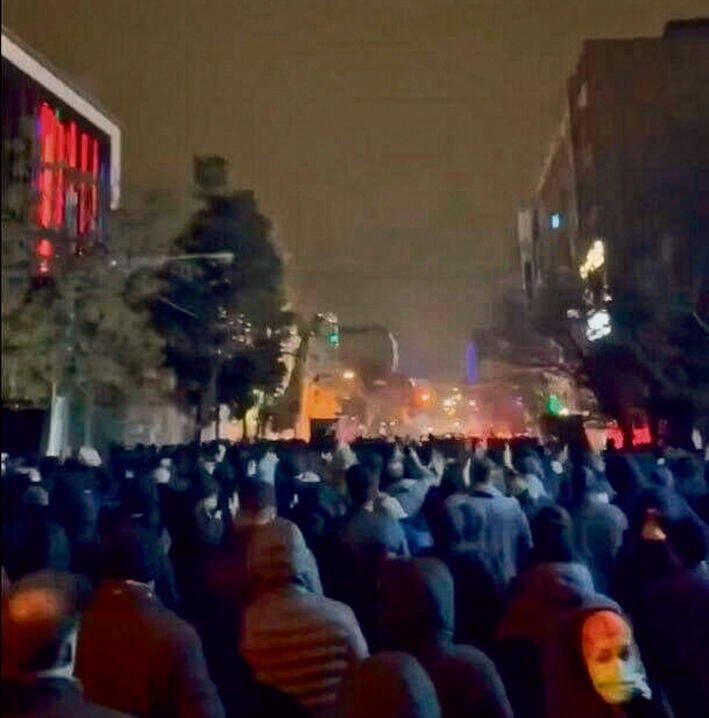
Protests in Iran
(Photo: Iran International English)
Fourteen years later, Iran is expected to mark the anniversary against a dramatically different backdrop—images of young Iranians setting fire to portraits of Supreme Leader Ali Khamenei.
This does not necessarily mean that political change in Iran is imminent. Even after days of widespread and violent protests, it is still premature to speak of a true “protest movement” in the sense of a cross-sector, organized coalition. So far, there are no signs of participation from key economic sectors, such as oil industry workers, whose ability to shut down vital parts of the economy played a crucial role in the downfall of the Shah’s regime
Moreover, the protests lack a clear leadership structure—though at this stage, that may be a strategic advantage, making it harder for the regime to suppress the movement by targeting individual leaders. Still, the absence of leadership and coordination could hinder the formation of a viable alternative government in later phases.
Another critical condition for regime collapse has yet to emerge: fractures within the ruling elite, particularly within the enforcement and security apparatus—the Islamic Revolutionary Guard Corps (IRGC), the Basij militia and the internal security forces. For now, the political leadership appears unified and determined, at least outwardly, with no signs of defections, operational breakdowns or refusals by security forces to carry out orders.
As things stand, the regime seems unable to halt the protests, but it is equally unclear whether the protesters have the capacity to bring down the regime’s foundations.
Against this backdrop, Iran appears to be slipping into a protracted revolutionary state—one that could last for an extended period and develop along several main trajectories.
The first is sustained and effective repression by the regime, which may succeed in containing the unrest, at least temporarily. From the regime’s perspective, this remains the preferred option. However, its continued reliance on force only deepens public frustration and anger over time, while increasing the risk that the United States might act on threats to intervene. Even if the government manages to suppress the current wave of protests, further acts of civil resistance are likely, culminating eventually in another wave of unrest, as the regime shows little ability to address the public’s core demands.
A second possible trajectory is the continued spread and intensification of the protests, coupled with a breakdown in the regime’s ability to control them, potentially posing a serious threat to its stability, and even leading to its collapse. While such a revolutionary outcome may align with the hopes of some desperate citizens, others within Iran fear it could plunge the country into political chaos. Those concerns stem from the possibility that radical forces—either domestic or foreign—could exploit the instability to impose a new political order misaligned with the public’s will, possibly resulting in the fragmentation of Iran and the erosion of its territorial integrity.
A third scenario would involve recognition by the Iranian leadership—or at least segments of it—that it can no longer contain the crisis. That realization could lead to two very different outcomes. One is a dramatic policy reversal, such as agreeing to U.S. demands on the nuclear issue in exchange for sanctions relief and economic improvement. As of now, this appears highly unlikely. Supreme Leader Khamenei remains entrenched in his position, repeatedly affirming that Iran will not retreat “even a single centimeter” from its principles.
The other possibility is a power grab by elements within the political-military elite. In an extreme scenario, factions within the Islamic Revolutionary Guard Corps—far from a monolithic body—could force the removal of the supreme leader, with or without his consent, and establish a temporary or permanent military regime to safeguard both the state and their institutional interests. While such a move would not guarantee stability, nor signal a transition to a democratic or pro-Western government, it could mark a shift in power from the “turban-wearers” (the clergy) to the “boot-wearers” (the military), ushering in a fundamentally different model of governance.