


The headline of this day did not come from any leader’s mouth — not even from the most powerful man in the world, in his extraordinary speech to the Knesset. It came instead from the few tearful words repeated over and over by Einav Zangauker to her son Matan: “My life, you are my life. Champion, hero. I’d give my life for you.”
People say this is a victory image — and today we saw 20 of them. But the word “victory” isn’t quite right. This is an image of healing, or perhaps the beginning of healing, for an entire nation. The shiver that passed through Israelis as they watched one clip after another was the tremor of an ending — the end of an era. Not a complete one: the bodies of fallen soldiers are still in Gaza, and their families endured a difficult day. Nor an “absolute” one, since Hamas still holds power in the Strip, armed and dangerous, and the future remains uncertain.
Gallery
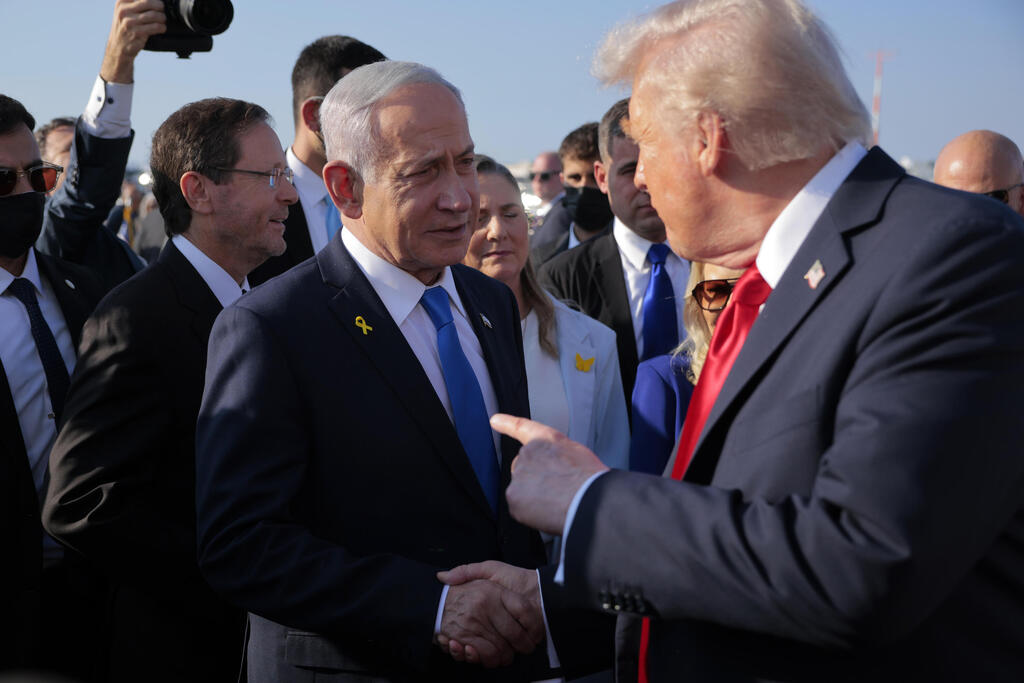
Donald Trump and Benjamin Netanyahu at Ben Gurion Airport
(Photo: Chip Somodevilla/Getty Images)
But between siblings Gali and Ziv Berman, wearing their Maccabi Tel Aviv jerseys; Eitan Mor, embracing his parents and saying he bragged in Gaza about the values they taught him; and Alon Ohel, aboard a helicopter with the words of Shalom Hanoch — “My strength, laughter and tears, the end of my suffering” — hope outweighed despair today.
Another moment came when it emerged that the U.S. president Donald Trump, using his signature dramatic negotiating style, managed — almost casually and from his presidential car en route to Jerusalem — to arrange a phone call between Prime Minister Benjamin Netanyahu and Egyptian President Abdel Fattah el-Sissi, their first conversation in two years.
El-Sissi invited Netanyahu to a summit in Egypt, to be attended by Arab and Muslim leaders, Palestinian Authority President Mahmoud Abbas, and European and other world leaders. Soon after, however, Netanyahu’s political allies on his favored TV channel began arguing against his participation. It was unclear whether they were delivering a message from the prime minister — or to him. Before long, Netanyahu’s office announced that due to the approaching holiday, he would not attend.
Ultra-Orthodox parties were quick to clarify they had not threatened to support early elections (more accurately, they hadn’t had time to). Shrewdly, the American president secured agreement from Arab states to attend the summit before inviting Netanyahu — a tactical coup. But, as journalist Danny Zaken reported, Turkish President Recep Tayyip Erdoğan refused to land in Sharm el-Sheikh and threatened to turn his plane around if Netanyahu arrived, creating general embarrassment. Israeli officials also believed Netanyahu feared an awkward handshake with Abbas. The regional peace conference will have to wait — for another day, or another era.
The highlight of the day was the U.S. president’s address to the Knesset — classic Trump. When speaking before an admiring audience, Trump is generous with praise and headlines. And outside of a MAGA rally, there will never be an audience more receptive than the Israeli parliament, across both coalition and opposition benches.
Israelis could learn from the president’s willingness to lavish credit on others — he devoted much of his speech to it. His description of businessman Steve Witkoff as “a Kissinger who doesn’t leak” is bound for the quote books, as were his anecdotes about the chairman of the Joint Chiefs, General Kane; about how much money Miriam Adelson keeps in the bank; and about his favorable personal impression of opposition leader Yair Lapid.
“Who cares about cigars and champagne?” the president said, in what became the political headline of the day. His direct appeal to President Isaac Herzog from the podium was a dramatic moment. Judging by Netanyahu’s radiant face, it may have been his happiest moment of the entire war — perhaps the ultimate victory he sought.
Politically, Trump’s public call for a pardon for Netanyahu was the most significant part of the speech. Together with other glowing compliments — “You’re a very popular man because you know how to win” — it gave Netanyahu enough material for his next election campaign. Those who suspected Trump of harboring a secret plan to punish Netanyahu after the war were proven wrong.
Substantively, Trump’s speech contained several key messages: unwavering support for Israel, coupled with a clear declaration that the war in Gaza is over. Israel, he said, must now channel its energy into development and peace.
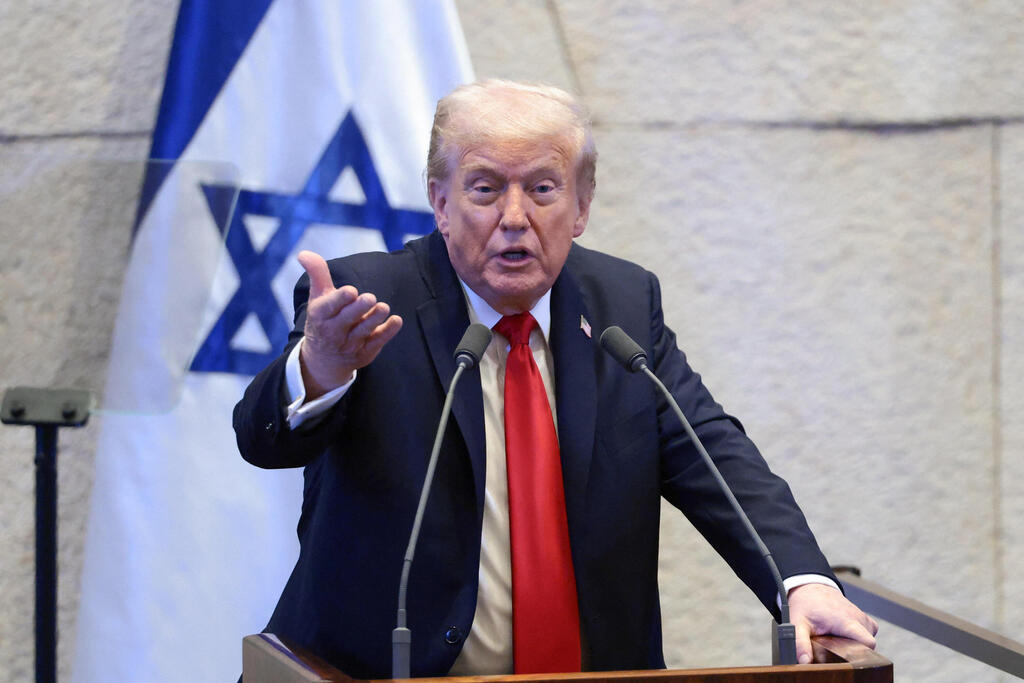
Trump speaks in the Knesset
(Photo: REUTERS/Evelyn Hockstein/Pool)
“Israel has achieved all it can through military force. Now is the time to translate those achievements against terrorists on the battlefield into the ultimate prize of peace and prosperity across the Middle East,” Trump said.
He spoke about Israel’s standing in the world, saying it had “gone bad” and that Netanyahu understood “this is the moment.” He declared that Gaza would be demilitarized and Hamas disarmed, though he did not specify how. He was clear, however, about his intent to expand the Abraham Accords. His call for Iran to reach a deal came both from his prepared text and his off-script remarks.
The president did not mention a Palestinian state, but highlighted the contribution and economic strength of the Arab nations — particularly the Gulf states and Saudi Arabia — and stressed the need for regional cooperation. There were no threats of military action, in Gaza or anywhere else, and no pledges of military backing. Trump’s message was unequivocal: Israel should turn the page.
He told Netanyahu, Foreign Minister Israel Katz and the defense establishment to “get used to achieving strategic goals without military force.” That, he noted, would be a tough challenge regarding Gaza, given that Israel’s leadership had neglected planning for the “day after” for two years. For now, Hamas remains in control of the Strip, eliminating its rivals.
The Knesset’s organization of the event lacked pomp and dignity — to put it mildly — not only because of the controversial guest list, which included party activists but excluded the attorney general and the president of the Supreme Court. Yet on a day like this, even the murky puddle of Israeli politics could not cloud the joy.
That joy belongs to the hostages who returned home after unimaginable suffering, and to their families who never gave up hope. Alongside it stands deep sorrow for those who gave their lives so selflessly to make this moment possible — sorrow that will linger in Israel’s collective life for a long time.
Our postwar lives will not be defined only by joy and recovery, but also by grief and a powerful longing for change. The phrase “to be worthy” has become a cliché — but there is no truer aspiration.