

Last Friday, immediately after noon prayers, Iranian security forces surrounded dozens of mosques in 15 cities across the country. In a swift operation, they pulled large groups of worshippers outside and directed them into pro-regime demonstrations in the streets.
The move caught the worshippers by surprise. They were unable to resist as security forces and guards sealed off exits to ensure no one slipped away.
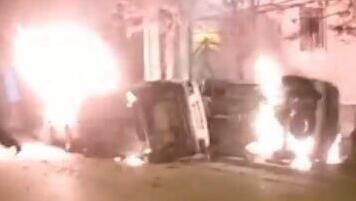
Iran protests against the regime: vehicles burn in Azna near a police station
At the same time, armed members of the Basij, the volunteer force operating alongside Iran’s Revolutionary Guard, infiltrated anti-regime protests. The Basij, whose name means “mobilization,” are tasked with the regime’s dirtiest work. They usually wear black uniforms, but when blending into civilian protests they dress in jeans and sweaters to avoid suspicion.
At a chosen moment, they suddenly seize a young man or woman from the crowd and rush the “meat,” the code word, into a police vehicle. The detainees do not return. Neither do the Basij members who carried out the arrest. Others take their place.
Unlike previous protest waves, including the massive demonstrations three years ago under the banner “Woman, Life, Freedom” following the death of Mahsa Amini, communication with and within Iran is now almost entirely cut off. Social media platforms and mobile networks have been heavily jammed. Only sporadically do Iranian exiles manage to reach family members inside the country.
Hundreds of thousands have taken to the streets in 21 of Iran’s 33 provinces. Even the religious stronghold of Qom has seen significant opposition turnout. Still, no one can say whether this will end in a revolution.
Iran protests


On one hand, protesters continue to fill the streets despite harsh weather. On the other, these are hundreds of thousands, not the 90 million citizens of the Islamic Republic.
This round of protests began in Tehran’s bazaars, where hundreds of merchants demonstrated against water shortages, rolling power outages and the dramatic collapse of the national currency. Shops closed as ordinary Iranians found themselves unable to afford basic goods whose prices soared almost overnight.
Soon after, protesters burned images of Qassem Soleimani, the legendary commander of the Quds Force killed by the United States in Iraq. By the weekend, even in Tehran, crowds dared to tear down and set fire to portraits of Supreme Leader Ali Khamenei.
The chants were unmistakable. “Death to the dictator,” protesters shouted, alongside “Neither Gaza nor Lebanon. We want a free Iran.”
President Donald Trump has approached the unrest cautiously, warning without naming names that the United States would intervene if the regime began killing its citizens. Some protesters have called for American and Israeli intervention.
Trump is weighing every word. Prime Minister Benjamin Netanyahu is silent. He has instructed ministers not to speak publicly about Iran, even as Israeli intelligence agencies closely monitor developments.
Senior advisers to Khamenei have already accused “the Zionists” and the Trump administration of orchestrating the protests.
In conversations over the weekend with senior officials in Arab states, several said they were convinced Israel would send aircraft toward Iran on the night the Netanyahus marked the New Year at Mar-a-Lago. One senior security official insisted that Israel canceled or postponed such a move at the last minute.
I tried, unsuccessfully, to persuade him that Israeli intervention at this stage would likely strengthen the Iranian regime by uniting the public around claims of an existential threat from the “Zionist entity.”
Iran’s foreign minister, Abbas Araghchi, said Tehran had declared a state of alert following what he called threats by Trump, and that Iran had filed a complaint with U.N. institutions against the United States.
 Smadar PerryPhoto: Yariv Katz
Ali Shamkhani, a senior adviser to Khamenei, warned Trump not to embark on “adventures with unknown consequences,” saying his statements crossed a red line and that Iran would “cut off the hands” of anyone who interfered in its internal affairs.
Over the weekend, Iran’s national security secretary Ali Larijani accused Israel and the United States of initiating the protests. Trump, he said, had dragged Israel into an adventure that would lead to attacks on American soldiers across the Middle East.
And perhaps it is Israel’s silence that is most confusing for Tehran.
As in Jerusalem, so too in Tehran, officials have chosen quiet. There are almost no speeches naming Netanyahu, no Israel-focused rhetoric, no burning of flags.
Khamenei himself has disappeared from public view since the unrest began. His advisers are factoring in the possibility of Israeli action.
For now, only Mohsen Rezaei, the outgoing commander of the Revolutionary Guard, has issued a direct threat, warning that Iran would destroy Israel if it attacked. According to reports, he was later asked to delete the post from X, on the grounds that it was unwise to provoke Netanyahu, who “knows a thing or two about Iran.”