

For some time, there has been a sense that strange things are happening within Israel’s system of government. Recently, the fog has begun to lift, and it has become clear that the change in leadership many Israelis have longed for has in fact taken place, albeit not through the accepted legal process. Yet it has happened. Donald Trump has become Israel’s prime minister — not through elections as prescribed by law, but by other, unusual means (though the prevailing assumption is that if Trump were to run in Israeli elections, he would win an overwhelming majority).
The development that confirmed Israel has a new prime minister occurred when Trump announced that Israel had agreed to a temporary ceasefire in Lebanon. Under normal circumstances, the security Cabinet would have been convened, at least to create the appearance that it had made the decision. But the masks have fallen, and it is now clear that such a performance is unnecessary.
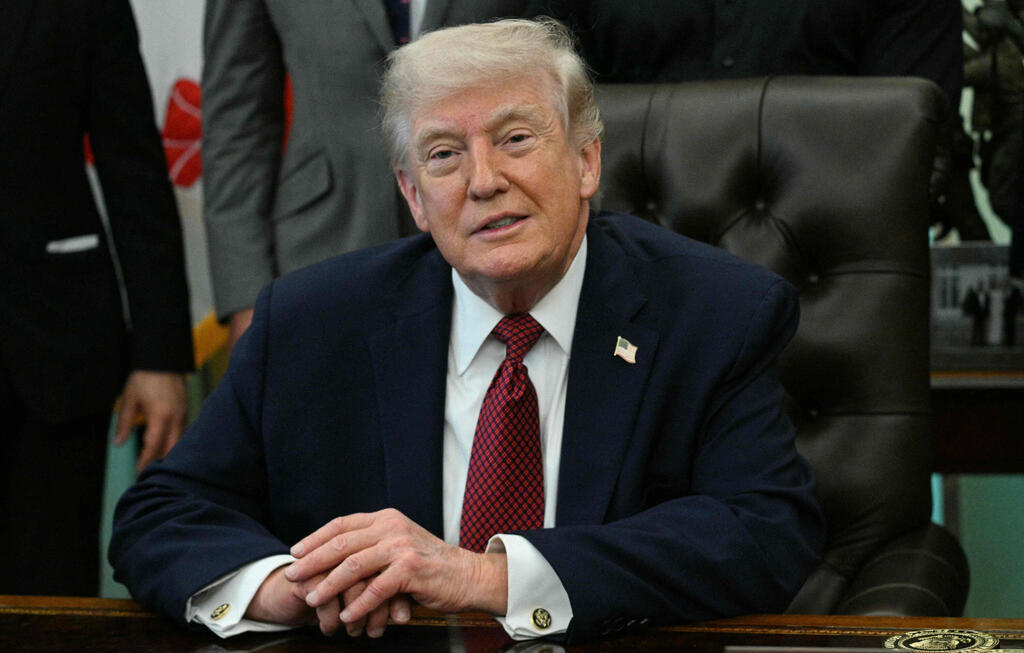
(Photo: Jim WATSON / AFP)
It is true that the ceasefire decision contradicts statements made by Prime Minister Benjamin Netanyahu about the conditions under which such a move could occur, including the disarmament of Hezbollah. But Israelis have grown accustomed to the lack of connection between such declarations and reality. As commentator Ben-Dror Yemini has noted, residents of northern Israel were misled by statements from Netanyahu and Defense Minister Israel Katz into believing that Israel is capable of disarming Hezbollah and would do so.
Israel’s autonomy, under Netanyahu’s failed leadership, has not succeeded over two and a half years of war in toppling Hamas rule in Gaza or disarming it. If so, how could it achieve that in Lebanon, where Hezbollah enjoys far more favorable conditions than Hamas does in Gaza?
Trump’s announcement of a pause in Lebanon has made clear that Netanyahu is now effectively the prime minister of the autonomy that remains in Israel, and that authority over the country’s foreign and security policy has shifted to a new prime minister seated in the White House in Washington.
It is true that Israel has long depended on the American president. But there were times when Israel could contend with decisions made in Washington that it found unfavorable. It could turn to the opposition party in the United States, seek assistance from the Jewish lobby or even expect support from European countries. All of these options have eroded during Netanyahu’s tenure, as Israel’s international standing has collapsed.
Netanyahu has burned Israel’s relationship with the Democratic Party, while support for Israel among the American public has declined sharply. Large segments of American Jewry no longer believe in Israeli policy or in those who lead it. The endless war in Gaza and the destruction there have also damaged Israel’s relations with a number of European countries.
Israel’s dependence on Trump is now absolute, and the government is not even attempting to consider what will happen when his term ends in about two and a half years. Meanwhile, Netanyahu’s coalition continues to undermine Israel’s standing. Jewish terrorism in the West Bank — known in Hebrew as Judea and Samaria — continues to flourish. The chairman of the Knesset National Security Committee, a lawmaker from the far-right Otzma Yehudit party, showed considerable force and little judgment when he declared that Trump had “come out a duck,” later apologizing.
The finance minister, also known for his rhetoric, harshly attacked German Chancellor Friedrich Merz, one of Israel’s few remaining allies. Bezalel Smotrich told him he must “apologize a thousand times on behalf of Germany,” adding, “You will not force us into ghettos again.” In my view, the one who should apologize before lecturing others is the finance minister himself — for his responsibility as a member of the government for the disaster of Oct. 7, and for having told Israelis that “Hamas is an asset.”
The fact that Israel has lost its independence and become an autonomy does carry short-term advantages that cannot be ignored. Trump is managing Israel’s security policy far more effectively than Netanyahu’s failed government. Thanks to Trump, Israel has secured, albeit belatedly, a pause in Gaza. It has also gained a reprieve from Iranian missile fire, and northern Israel has received a break from Hezbollah rocket attacks.
Still, it is somewhat sad that after more than a century of Zionism, Israel has lost its independence and been left with autonomy. It is no less troubling that Netanyahu’s government is using even that autonomy to advance a draft exemption law and channel funds to ultra-Orthodox communities that do not serve in the military.
The question of how authority will be divided between Trump’s central rule and the autonomy left to Israelis also remains unresolved. For example, Trump appears to believe that the issue of pardons now falls under his authority. There are those in Israel bold enough to think otherwise. The matter will be clarified in time.
 Daniel FriedmannPhoto: Tal Shahar
One issue also remains: Hamas in Gaza and Hezbollah in Lebanon, which, regrettably, remain — after two and a half years of fighting — alive, kicking and dangerous. Seizing territory in Syria and Lebanon will not solve the problem. It would be wise to consider diplomatic measures, including addressing Hezbollah through appropriate agreements with Syria, with Saudi Arabia and the Gulf states, with the Lebanese government, and with the United States and France. Any diplomatic agreement will, by necessity, involve concessions on Israel’s part. We will wait and see what our prime minister, Donald Trump, decides.
Prof. Daniel Friedmann served as Israel’s justice minister.