

By any strategic logic, this should have been the week that pushed us into the arms of necessity. The results of the U.S. midterm elections and the gathering clouds of war with Iran should have made it clear to any sensible leadership that we cannot afford to wage an existential war while divided into entrenched political camps. Israel faces enormous challenges in the coming years, in its foreign policy, in confronting antisemitism and in fighting sophisticated enemies on multiple fronts. We must face these challenges together, shoulder to shoulder.
But instead of rising to the occasion, Likud is exploiting it. It is exploiting the fragility, the fear and the democratic elections themselves to wage a campaign to delegitimize the rules of the game. If last week's central question was which parties could legitimately form a government together, the question now is whether the election results themselves are even legitimate.
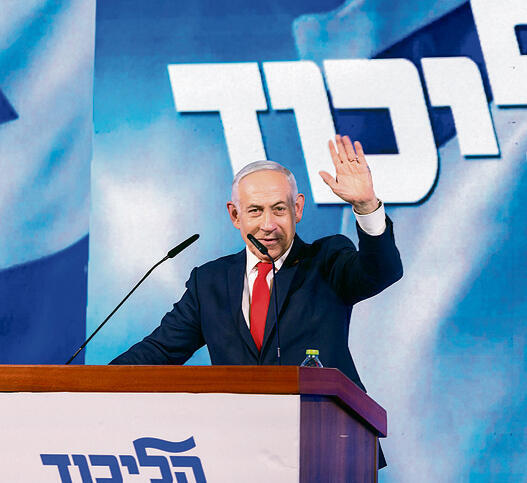
Benjamin Netanyahu
(Photo: Alex Kolomoisky)
For six years, I have argued in favor of Zionist unity, with all its many flaws, out of a conviction that there was no alternative. We have been through so much during those years, yet the rift within the Zionist majority remains. There was no electoral constituency for that sentiment, for many reasons, some of them entirely understandable. But the results have left us with nothing but bad options. In the first days after the election, calls for unity grew louder, and cracks began to appear in the change bloc. The various parties had to navigate the countless promises they had made in every direction, desperately struggling to find a way out of their predicament as they came to understand just how complicated the political deadlock had become. Meanwhile, significant voices in both camps began pointing to unity as a last resort, almost a necessity, despite the crisis of trust, not to mention the hatred, between the two sides. Just last week, this supplement published four separate opinion pieces calling for that possibility to be put back on the table. Political unity does not mean erasing disagreements, nor is it an exercise in naivety. It is simply a practical tool, sometimes necessary to prevent further deterioration.
Yet while large parts of the public were searching for a bridge at almost any cost, the ruling party was dismantling the foundations on which such a bridge could be built. It began with the complete delegitimization of the Arab parties and quickly escalated into an increasingly vocal "stolen election" campaign, launched long before a single ballot had even been cast. The campaign was sustained through entire days of programming on Channel 14 and echoed by the prime minister and Knesset members ahead of the submission of the election results to the president. We saw this playbook in action during the 2022 election. On election night, before television exit polls had even indicated a majority, Likud's lawyers rushed to circulate dramatic statements alleging systematic fraud, bribery and violence in Arab society, while accusing the Central Elections Committee of a cover-up. The moment it became clear that Netanyahu's bloc had secured 64 seats, those allegations vanished as though they had never existed. This time, given the results, the plan has simply moved to the next level.
The Shin Bet, Israel's domestic security agency, was also dragged into this minefield this week. It is difficult to explain the conduct of its director, David Zini, though one can only hope he is an inexperienced newcomer acting recklessly rather than a political operative. What began with assurances that Election Day was proceeding smoothly was followed by a series of leaks about an investigation into suspected widespread election fraud, suggestions that Knesset members should be questioned without evidence being presented, and anonymous briefings from people close to Zini that poured fuel on the conspiracy fire. The seeds of trouble had already been planted, regardless of subsequent efforts by the president, the chairman of the Central Elections Committee and even Zini himself to affirm the legitimacy of the results.
Netanyahu and his associates have lit a fire and believe they can control the flames. But once public trust in state institutions is dismantled, the damage will never stop where it is convenient for those responsible. Now even the most committed advocates of unity are left at a loss in the face of what is clearly an assault on democracy.
The chaos and lack of trust have placed the leaders of the change bloc in an almost impossible position. A political partnership can only take shape where at least a minimum level of trust exists. Netanyahu has never excelled at building that trust, but his latest moves have produced an understandable reaction in the opposite direction: closing every door to unity and moving quickly to form an emergency government. The change camp's renewed consolidation around its promise to replace Netanyahu amounts to a tourniquet for an already fragile democracy.
Yet that retreat serves Netanyahu just as well. Once the change camp entrenches itself in its refusal, the burden of proof is reversed. The man who undermined the legitimacy of the election becomes the one calling for a broad government, on his own terms, while those seeking to defend the integrity of state institutions are portrayed as refusing to recognize the urgent security and diplomatic needs of the moment. For Netanyahu the politician, this is simply preparation for his next election campaign. He assumes that any government relying on the support of ultra-Orthodox or Arab parties will quickly collapse, allowing him to win again by arguing that the Arab vote is illegitimate and that the change bloc broke its promises by relying on supporters of terrorism or betraying the "alliance of those who serve."
We have grown accustomed to Netanyahu the politician's utter cynicism. The question now is whether Netanyahu the strategist can emerge from beneath his overwhelming desire to crush his opponents. Can Likud and Netanyahu grasp just how complicated and dire the situation has become and extend a genuine hand of partnership after the storm they themselves unleashed? Not out of manipulation, or even affection, but solely because of the magnitude of the challenges ahead. The fear is that even if such a realization comes, it may be too little, too late.
Where do we go from here? Probably toward a minority government that is likely to be short-lived and face numerous vocal opponents. A government born of necessity. But before taking that step, perhaps one more attempt is worth making, both as a matter of fairness and to demonstrate to voters the sincerity of the intentions behind it. This week, Gadi Eisenkot welcomed into his office a man who had stood outside his home shouting that Eisenkot had murdered his own son. A horrifying accusation by any measure. Eisenkot agreed to meet the protester, accepted his apology and even ended the encounter with a hug. It was an extraordinary gesture. With precisely that same spirit, Eisenkot could stand before the cameras and set out simple, statesmanlike preconditions: full and unequivocal recognition of the election results, protection of the independence of democratic watchdog institutions, and a focus on urgent security and social priorities. One-on-one negotiations with Netanyahu could be limited to a single week to prevent endless delays.
The chances of unity may be close to zero, but many other positive outcomes could emerge from such a move. Taking such a principled stand would return the initiative to the change camp and dismantle the trap that has cast Eisenkot and his colleagues as unwilling obstructionists. This time, they would be the ones defining the boundaries of responsible statecraft, leaving Netanyahu to explain to the public why, once again, he chose division over unity.