

For roughly three decades, a comforting idea has circulated through boardrooms and policy circles: the internet compressed distance, globalization diluted borders and geography began to matter less. In the digital age, the argument goes, power belongs to code and data rather than ports and straits.
Yet the evidence of recent years points in the opposite direction. Geography did not fade; it returned in a more expensive, more sensitive form. The digital economy did not liberate us from the map. It deepened our dependence on it, turning every physical chokepoint into an immediate economic chokepoint.

To see why, it helps to revisit the places where empires have repeatedly focused their attention. Suez, Hormuz, the Dardanelles, Gibraltar. Anyone who reads the history of trade and empires encounters these names again and again, not by coincidence, but because they mark the gravitational centers of global movement.
In the nineteenth century, the competition revolved around ships and colonies. In the twentieth it revolved around oil and alliances. In the twenty-first century, it revolves around something that looks more abstract, but still travels through the same bottlenecks. Only now, alongside tankers, data moves too. And in many cases, data is no less strategic than oil.
The digital world is built on a sensation of air. We upload a file to the cloud, send a message, join a video call and it feels as if it happens outside of space. In reality, that sensation rests on dense physical infrastructure: cables, landing stations, data centers, power grids and the facilities that keep services running in real time.
The cloud is not the sky. It is a network of buildings connected by subsea cables and terrestrial lines. Like any physical network, it has chokepoints. Understanding that means understanding why, even in an age of AI, infrastructure corridors remain strategic decisions.
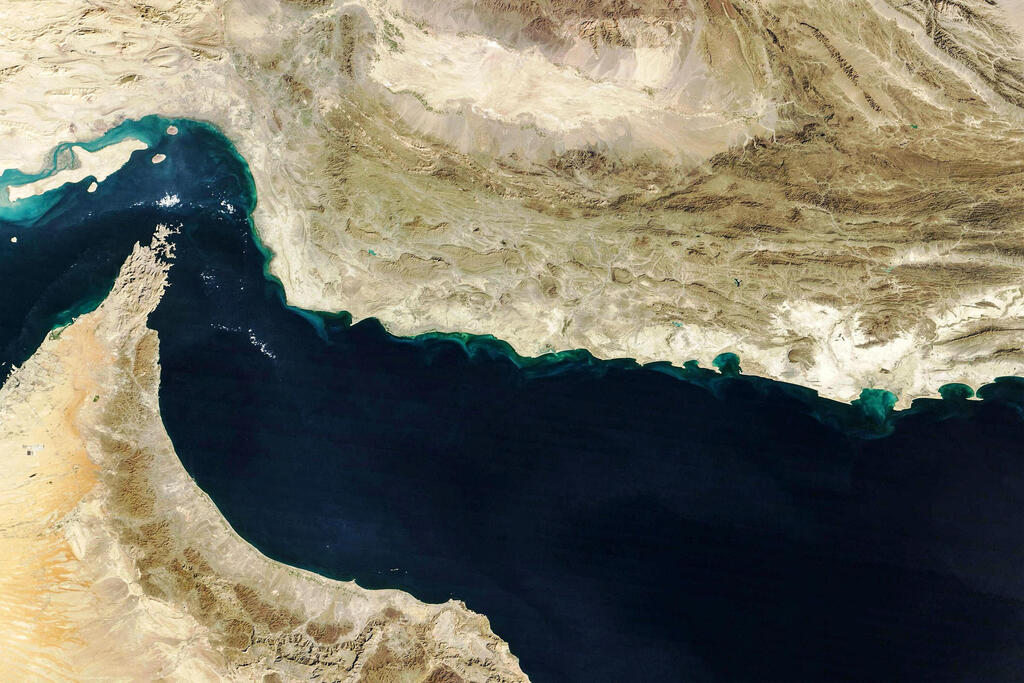
The Strait of Hormuz
(Photo: AFP PHOTO / NASA)
This creates the defining paradox of our era. The more digital the economy becomes, the more dependent it is on the continuity of physical space. In the past, if a port stalled, goods were delayed and costs rose over time. Today, if a major cable landing point is damaged, the impact is not limited to a slower internet connection. Payment systems, operational technologies, financial markets, insurance, logistics and essential public services can be disrupted, sometimes rapidly.
Geography has become the operating layer of the digital economy. Whoever controls critical junctions and infrastructure corridors controls whether the digital world can appear seamless.
This is where the Middle East returns to the center of the global story, not only because of energy but also because of its location. Between Europe and Asia. Between India and the Mediterranean. Between major production centers and major consumer markets. The region carries shipping lanes, as well as fiber routes. It lends itself to ports and logistics hubs, but also to data centers, cable landing stations and cloud infrastructure. It is a conduit for energy, and increasingly a conduit for information.
In a world where geography again commands a premium, location is not merely a fact. It is an asset that can be developed, insured, and converted into growth.

(Illustration: Shutterstock)
That is why the current conversation about new trade corridors, rail links connecting the Gulf to the Mediterranean, expanded aviation access and cross-border digital infrastructure is not simply about development. It is about power and the price of risk. A corridor is not only a shortcut. It is a backup system. It allows an economy to keep functioning when a single chokepoint closes or becomes prohibitively expensive. And as global systems grow more sensitive to disruption, the value of alternatives rises.
What once looked like a competitive advantage increasingly functions as insurance, calming markets and lowering risk premia.
A new language of policy follows. States were once judged primarily by their control of territory and force. Now they are increasingly judged by operational continuity. Do they have sufficient port capacity? Do they have diversified routes? Do they have a communications infrastructure that is not dependent on a single axis? Can they protect critical junctions?
And an additional question now matters as much as any of these: who finances these systems, and who sets the standards. Because whoever finances infrastructure often defines the protocols, technical norms and access conditions.
 Dr. Bella Barda Bareket Photo: Lia Yaffe
This is why the digital age did not free us from geography. It converted geography into pricing. Distance did not vanish; it became a risk component that shows up immediately in the cost of insurance, capital and delivery. And the cost of failure is no longer measured only in delayed containers, but in disrupted systems.
If empires once competed over canals and straits to control the movement of ships, today the contest is broader. It is about the movement of ships and bits, barrels and data. Those who grasp this early will also understand why certain regions will be disproportionately advantaged in the next decade, not because they discovered a new resource, but because they sit at the junctions without which the world struggles to move.
The real question is not whether the digital world erases the map. It forces us to read it differently. In an era where each disruption quickly translates into a risk premium, the conclusion is increasingly clear: we can speak of a world beyond geography, but we cannot run a modern economy without it.
- Dr. Bella Barda-Bareket is an entrepreneur and a macroeconomic and geopolitical analyst.