


The threat posed by the Islamic Republic of Iran has just crossed a definitive, irreversible threshold. While the world remains distracted by proxy wars and diplomatic posturing, intelligence reports confirm that Tehran has been secretly advancing its nuclear weapons program with direct, covert assistance from the Russian state.
This is not a theoretical problem for an undefined future. It is a technological leap that fundamentally alters the security landscape of the entire Middle East. This strategic cooperation—which exploits a critical, cutting-edge technology—proves two terrifying realities: Iran is actively pursuing a weapon, and Russia is acting as its chief geopolitical accomplice, helping Tehran circumvent international monitoring and rapidly close the gap to a nuclear capability.
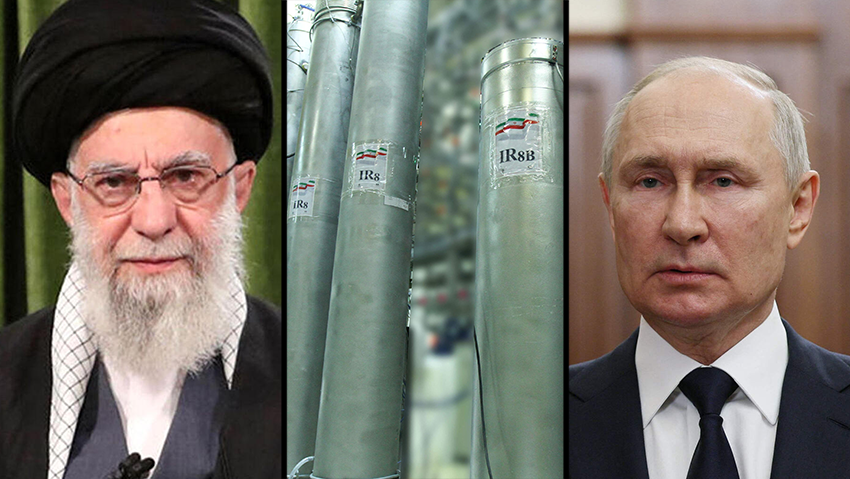
Ali Khamenei and Vladimir Putin
(Photo: AFP)
The Russian blueprint for weaponization
The core of this crisis lies in a covert mission: an Iranian Defense Ministry-affiliated delegation secretly traveled to Russia to seek "laser technology and expertise" specifically designed to help Iran "validate a nuclear weapon design without conducting a nuclear explosive test."
This is the sound of a red line snapping. For years, Iran sought to maintain a "breakout capacity"—the technical ability to quickly build a bomb, stopping just short of a final design. Now, Tehran is aggressively pursuing the final technical hurdle through sophisticated, non-visible means.
The mission was organized by DamavandTec, a front company for the Iranian Organization of Defensive Innovation and Research (SPND)—the very entity that led Iran's nuclear weapons research program before 2003. This is not a civilian research trip; it is the resurrection of the military nuclear file. The Iranian specialists visited a U.S.-sanctioned Russian military technology company, confirming Moscow’s role as an active and knowing enabler, helping a non-proliferation regime outlier bypass international scrutiny.
The goal is clear: by leveraging advanced computer modeling and laser technology, Iran can achieve weapons design validation covertly. It can neutralize the international monitoring mechanisms—the seismic and satellite surveillance that once policed its physical development—and drastically shorten the timeline to a weapon, all while maintaining the convenient, transparent lie that it remains committed to diplomacy.
The existential veto on 'Palestine'
This escalating nuclear threat provides the ultimate, irrefutable justification for Israel’s uncompromising stance on security.
Those in the international community who demand that Israel accept an unsecured "Palestinian state" based on pre-1967 borders are engaged in suicidal folly. This demand ignores the singular, terrifying reality of the new Iranian axis. A fully sovereign, demilitarized "Palestinian state"—one without Israeli security control—is projected by military analysts to be immediately infiltrated and militarized. It would instantly become a forward operating base for Iran’s most aggressive proxies, including Hezbollah and Hamas.
This nuclear-enabled Axis, with its newly acquired high-tech knowledge, would not hesitate to flood unsecured territories with advanced artillery, drones, and long-range weaponry. It would result in a bloodbath—a scenario chillingly described as "Gaza times ten." This reality is why Israeli leadership consistently maintains that security control over all territory west of the Jordan River is a non-negotiable imperative.
Granting political recognition to an entity that would be used by a nuclear-ambitious Iran to institutionalize terror is not a path to peace; it is a mechanism for institutionalizing existential war.
The true anchor of stability
Ultimately, the covert nuclear assistance from Russian forces in the world to the reality of the Middle East's geopolitical architecture.
Iran is consistently identified by Israeli officials as pursuing a "secret program" to develop nuclear weapons, possessing thousands of ballistic missiles, and distributing arms to proxies in five Arab countries. Against this backdrop, the argument that Israel is the greater threat to regional stability is an inversion of reality.
 Amine Ayoub
The moderate Sunni Arab states know this truth, which is why they quietly rely on Israel as a "partner in survival" against Tehran. As one regional expert noted, "You don't intercept missiles heading toward a threat to regional stability—you intercept missiles from one."
The revelation of Russia’s active assistance in nuclear weapon design proves that Israel’s security concerns are not maximalist political demands—they are necessary, minimalist requirements for survival. The world must recognize that without Israel’s unyielding security posture, the entire region is left defenseless against an Iranian axis that is determined to use nuclear escalation to achieve regional hegemony.
- Amine Ayoub, a Middle East Forum fellow, is a policy analyst and writer based in Morocco.