


As Iranian missiles and drones rain down on the Gulf, the region confronts a coordinated campaign of aggression orchestrated by Tehran and its proxies. Saudi air defenses have intercepted ballistic missiles over Riyadh, while Kuwait International Airport sustained significant radar damage from drone strikes. In the United Arab Emirates, falling debris from intercepted missiles ignited fires in Abu Dhabi’s Khalifa Economic Zone (KEZAD), injuring civilians.
Omani authorities reported drone attacks on the port of Salalah that damaged infrastructure and wounded a worker. Bahrain has battled fires at industrial facilities amid waves of Iranian strikes. These are not isolated incidents but elements of Tehran’s retaliatory escalation in the ongoing U.S.-Israeli war against Iran.
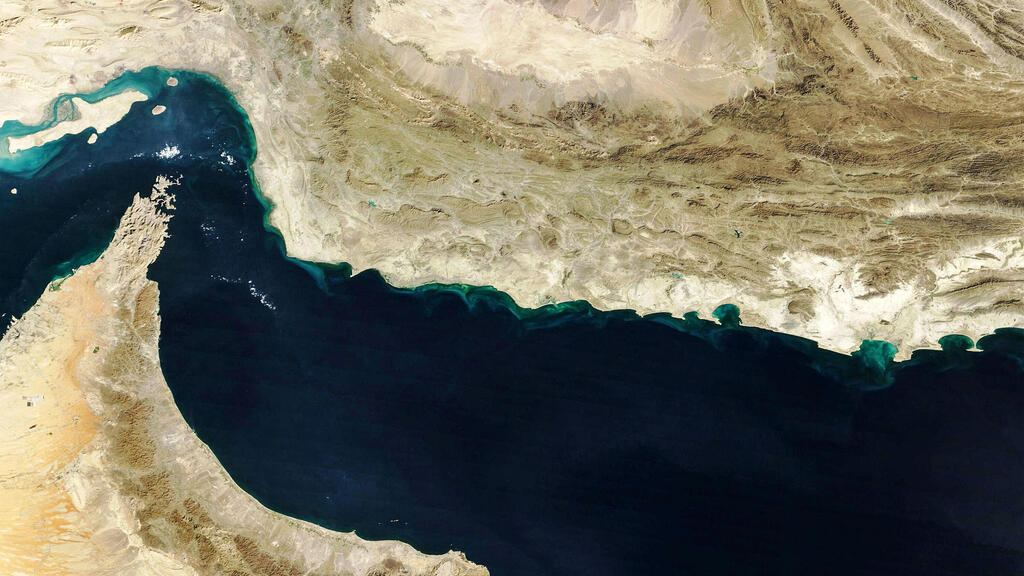
Strait of Hormuz
(Photo: AFP PHOTO / NASA)
In the midst of this violence, Pakistan is hosting a quadrilateral summit in Islamabad on March 29 to 30, 2026, bringing together the foreign ministers of Saudi Arabia, Egypt, and Turkey. At the invitation of Pakistani Deputy Prime Minister and Foreign Minister Ishaq Dar, the delegations, including Saudi Foreign Minister Prince Faisal bin Farhan, Egyptian Foreign Minister Badr Abdelatty, and Turkish Foreign Minister Hakan Fidan, will discuss “regional de-escalation.” Pakistan presents itself as a neutral facilitator. Yet the timing and context reveal a calculated strategy that prioritizes protecting Tehran over genuine peacemaking.
The most revealing indicator of this alignment emerged just before the summit. Iran granted passage through the Strait of Hormuz to 20 additional Pakistani-flagged vessels, at a rate of two ships per day. Foreign Minister Dar publicly hailed the concession as “great news” and a “meaningful step toward peace.” In reality, this arrangement exposes the transactional nature of the Islamabad-Tehran relations.
While Iranian forces and proxies have paralyzed much of the strait, targeting shipping and disrupting global energy flows, Pakistan receives preferential treatment. Tehran does not extend such strategic exemptions to adversaries. The exemption functions as a protection racket: Islamabad secures economic lifelines for its merchant fleet while Iranian aggression continues unchecked against Arab Gulf infrastructure.
This is consistent with Pakistan’s long-standing playbook. For decades, elements of the Pakistani military and intelligence services have balanced sponsorship of militant networks with the extraction of Western aid. They cultivated the Taliban even as they hosted U.S. bases and drone operations. Today, the same dual track approach serves the “Axis of Resistance.”
By convening Sunni Arab and Turkish diplomats in Islamabad, Pakistan seeks to frame the conflict as a manageable “regional misunderstanding” requiring Islamic solidarity. The goal is transparent: delay unified Gulf retaliation, fragment any emerging anti-Iran coalition, and buy Tehran critical time.
The summit’s timing underscores Pakistan’s priorities. Hours before the meetings began, Iran’s Islamic Revolutionary Guard Corps (IRGC) issued an explicit threat to target U.S. and Israeli universities across the Middle East. The warning followed reported U.S.-Israeli strikes on Iranian academic institutions, including the University of Science and Technology in Tehran.
 Amine Ayoub
Demanding Western condemnation as the price for sparing Gulf campuses, the IRGC demonstrated Tehran’s willingness to internationalize the conflict further. Pakistan’s diplomatic initiative provides the perfect pressure release valve, offering Tehran a forum to project reasonableness while its proxies and forces press the attack.
Pakistan’s maneuvering is driven by institutional self-preservation. Washington has discarded strategic patience in favor of decisive hard power. The United States is reinforcing its regional posture with thousands of additional troops, including approximately 2,500 Marines aboard the amphibious assault ship USS Tripoli and indications that the nuclear-powered aircraft carrier USS George H.W. Bush will bolster operations.
This buildup, layered atop existing forces exceeding signals Washington’s intent to confront the Iranian threat directly. Islamabad recognizes that a sustained campaign against radical Islamism will eventually scrutinize Pakistan’s own role as an exporter of ideology and a sanctuary for militants across South Asia and the broader Middle East.
By inserting itself as an indispensable mediator, Pakistan hopes to forestall the economic sanctions and diplomatic isolation that its policies have long invited. Yet this posture is inherently compromised. Pakistan’s foundational ideological sympathies, rooted in its support for Islamist causes, align more closely with Tehran’s revolutionary project than with the security interests of the Gulf states it now courts. The maritime exemption is not an isolated favor; it is structural collusion.
Any diplomatic process routed through Islamabad risks legitimizing the very networks sustaining Iranian aggression. Gulf states, already absorbing the human and economic costs of Tehran’s campaign, cannot afford talks that serve as a shield for the Revolutionary Guard. Western policymakers, likewise, must reject the illusion of Pakistani neutrality. Treating Islamabad as an honest broker only perpetuates the cycle of proxy warfare, extortion, and ideological subversion.
- Amine Ayoub, a fellow at the Middle East Forum, is a policy analyst and writer based in Morocco.