


Security cooperation between Israel, Greece and Cyprus, including joint air, land and naval exercises, has been ongoing for several years. While Israeli officials have denied a Greek news report claiming the three countries intend to form a “joint intervention force,” ynet has learned that the political echelon has already informed the IDF of such a plan and even issued instructions to begin preliminary planning.
However, no concrete steps have been taken, and military planners in Tel Aviv are awaiting further directives from Prime Minister Benjamin Netanyahu and Defense Minister Israel Katz. For now, the government has instructed the IDF not to move beyond the initial planning stage.
Gallery
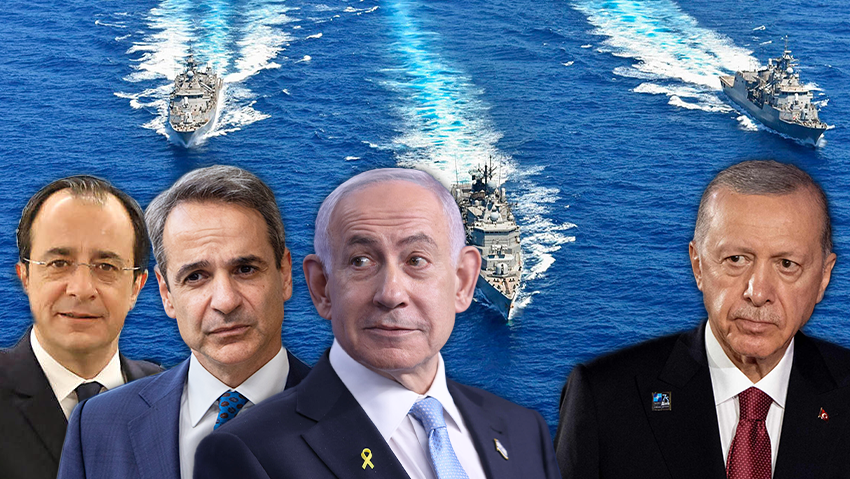
Cypriot President Nikos Christodoulides, Greek Prime Minister Kyriakos Mitsotakis, Prime Minister Benjamin Netanyahu, Turkish President Recep Tayyip Erdoğan
(Photo: Andrew Harnik/GETTY IMAGES NORTH AMERICA/AFP, Alex Kolomoisky, AFP PHOTO / HO / PIO)
The caution is understandable. If established, the main mission of a Greek-Israeli-Cypriot intervention force would likely be to counter Turkish activity in the eastern Mediterranean basin.
The envisioned force would protect the economic and strategic interests of Israel, Greece, Cyprus and potentially Egypt in the region. This includes defending offshore natural gas and oil production zones and fishing rights in areas claimed by Turkey and the Turkish Republic of Northern Cyprus, a self-declared entity created following Turkey’s 1974 invasion of the island.
It would also involve safeguarding Israel’s proposed gas pipeline to Europe, which Turkey opposes, and could extend to territorial disputes between Greece and Turkey over sovereignty claims to several Aegean islands.
Although both Greece and Turkey are NATO members, their decades-long hostility, centered in large part on the Cyprus dispute, remains unresolved and could ignite at any moment. Turkey’s military, particularly its navy and ground forces, is larger, stronger and more modern than Greece’s. Ankara also holds a clear edge in defense manufacturing, thanks to Turkey’s rapidly developing military industry.
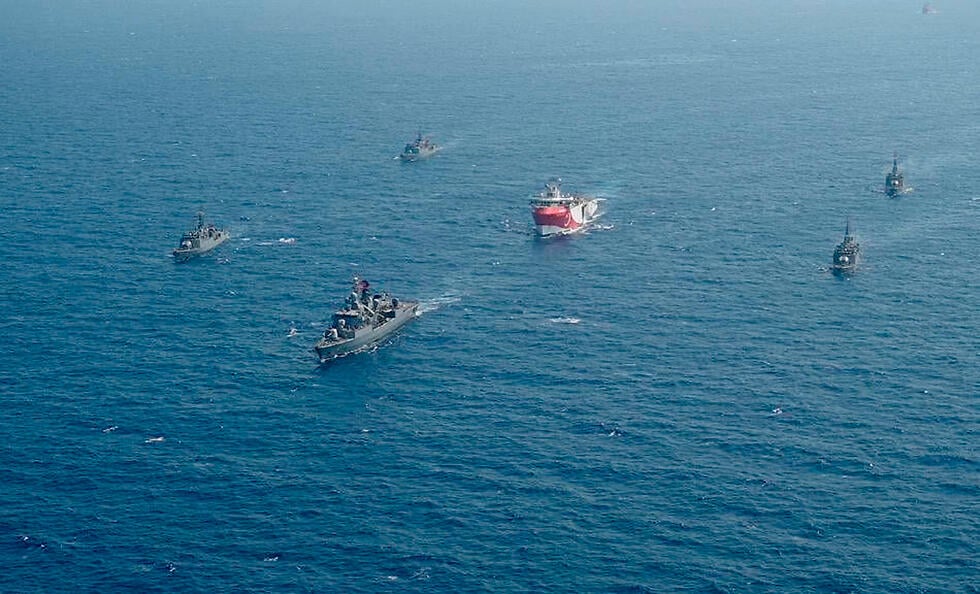
Turkish survey ship escorted by warships
(Photo: AP)
However, Turkey’s air force is relatively weak. Israeli security officials believe that if Israel joins forces with Greece and Greek Cyprus, contributing the IDF’s aerial and intelligence capabilities, it could significantly shift the balance of power in the eastern Mediterranean, potentially deterring President Recep Tayyip Erdoğan from escalating tensions with Athens under such conditions.
Still, Israel’s primary strategic objective in pursuing this alliance is not to confront Turkey directly, but rather to create a flanking deterrent. The aim is to contain Erdoğan’s growing military presence along Israel’s northern and southern borders.
Since the collapse of Bashar Assad’s regime in Syria, Turkey has worked aggressively to expand its military and political foothold in the country. This includes deploying early-warning radar systems and air defense batteries that could dramatically restrict Israel’s aerial freedom of operation over Syria, Iraq and even Iran, narrowing the IDF’s strategic options and its ability to pose a credible threat to Turkey itself in the event of a future conflict, fueled by Erdoğan’s increasingly hostile posture toward Israel.
The possible inclusion of Turkish troops in the proposed International Stabilization Force (ISF) for Gaza, as outlined in U.S. President Donald Trump’s 20-point peace plan, is viewed in Jerusalem as a direct threat. Israel strongly opposes Turkey’s participation in the ISF, arguing it would limit the IDF’s operational freedom to prevent Hamas from rebuilding its military infrastructure in the Gaza Strip. Erdoğan’s open support for Hamas has further deepened Israeli concerns.
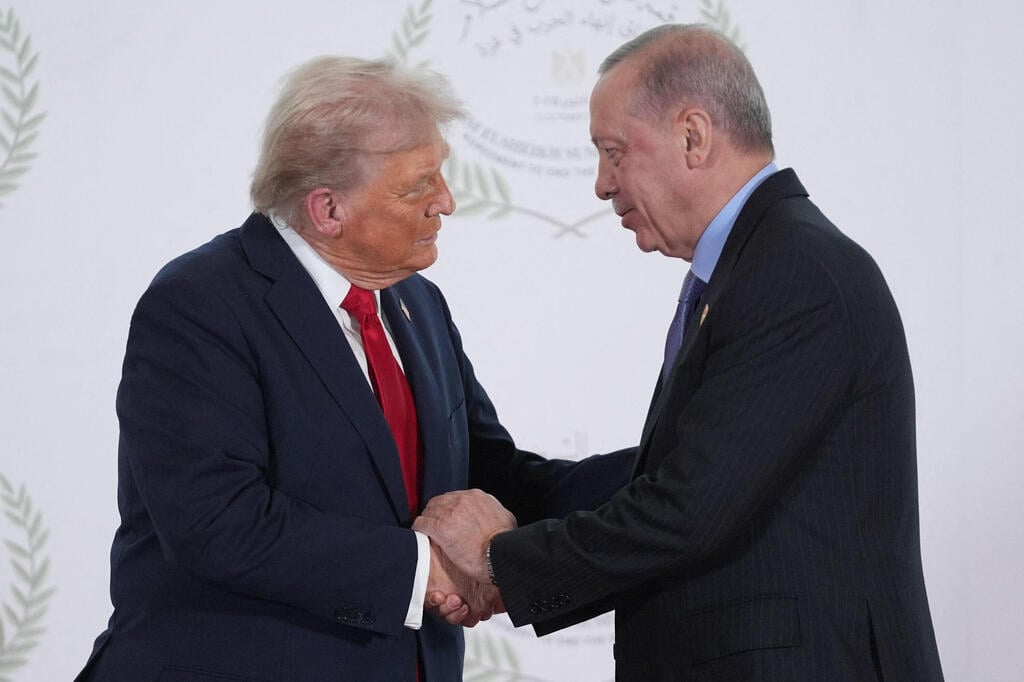
US President Donald Trump and Erdoğan
(Photo: Evan Vucci / POOL / AFP)
If Turkey were permitted to contribute forces to the ISF, expected to be a brigade-sized deployment of 1,000 or more personnel, Israeli officials warn it could facilitate weapons smuggling into Gaza or aid in rearming Hamas through the transfer of dual-use materials.
This may be one of the reasons Erdoğan is lobbying Trump to allow Turkish involvement, despite Israel’s firm objections. In response, Israel appears to be signaling its own potential counter-move: advancing the idea of a joint intervention force with Greece and Cyprus. Such an alliance would present a political and military counterweight to the threats and hostility Israel perceives from Turkey on both its northern and southern fronts.
Israel has no desire for direct military conflict with Turkey. However, given Erdoğan’s policies and his close ties to Trump, Israeli officials see a need to send a clear warning, strategic and symbolic, by aligning with Turkey’s historical (and predominantly Christian) rivals in the region.
However, the proposed joint intervention force remains at the conceptual stage. While preliminary planning is underway at IDF headquarters, no concrete steps have been taken. So far, the idea exists mainly through regional media reports, particularly in Greece, intended, it seems, to signal to Ankara that the option is on the table and to pressure Erdoğan and his foreign minister, Hakan Fidan, to reconsider their approach.