


On November 3, 2026, a decades-old pillar of American foreign policy was shaken on live television. President Donald Trump said Washington would stop paying Israel roughly $4 billion annually after this year, a figure broadly matching the $3.8 billion military package under the existing memorandum of understanding. Trump said he and Prime Minister Benjamin Netanyahu had agreed months earlier to end the payments. Netanyahu had separately proposed phasing out American military aid over a decade, not immediately. The memorandum runs through September 2028, and Trump offered no details on how funding would stop early.
Trump said Washington would continue selling military equipment to Israel, shifting the question to who will finance purchases already planned. A State Department document reviewed by The Wall Street Journal indicated that Israel would need approximately $10 billion after 2028 to cover American weapons orders outstanding as of April 1, 2026. The figure may have changed since April. Ending annual grants would not immediately sever the financial and industrial commitments linking the two countries.
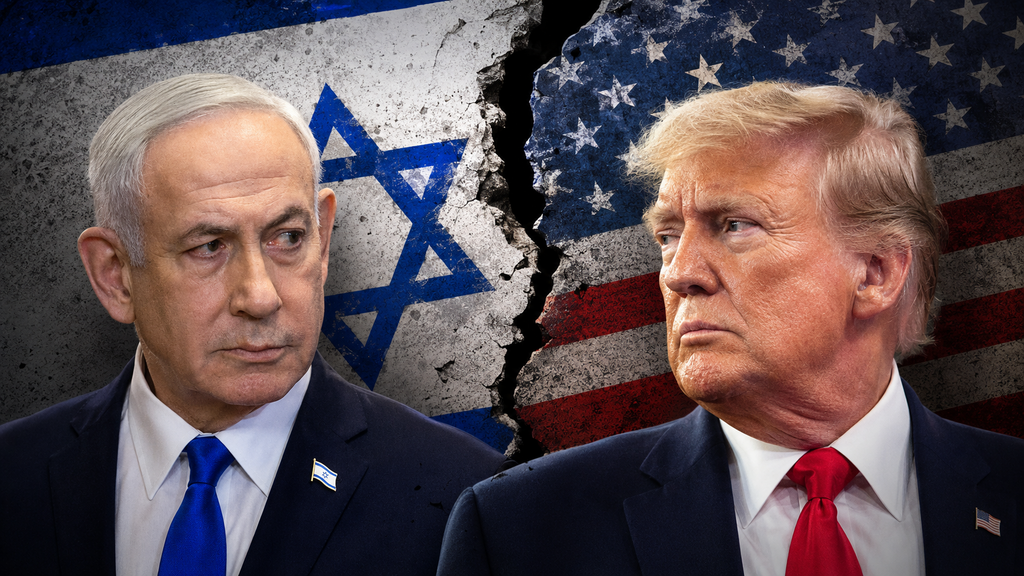
Benjamin Netanyahu and Donald Trump
The current memorandum provides $3.3 billion annually in Foreign Military Financing and $500 million for cooperative missile-defense programs. Most FMF finances purchases from American defense contractors. A declining offshore procurement allowance for Israeli-origin equipment is due to reach zero in FY2028. The arrangement supports American manufacturers and gives Washington influence over procurement and supply chains.
The 1978 Camp David Accords and the 1979 Egyptian-Israeli peace treaty established the foundations of a US-backed regional security order. The 1994 Israel-Jordan peace treaty added another strategic dimension to Washington's relationship with Israel's eastern neighbor. The partnerships have separate legal and budgetary frameworks but remain interlocking parts of Washington's regional strategy.
The regional security architecture on Israel's borders
The three assistance relationships are legally separate. Ending Israeli military aid would not automatically terminate funding for Cairo or Amman, but the relationships are politically connected. The Congressional Research Service has noted that US assistance to the three countries has facilitated military cooperation, and that Arab governments at peace with Israel could find it harder to defend continued American grants if Washington phases out aid to Israel. The consequence would not be an automatic financial domino, but a weaker political case for treating the commitments as one regional strategy.
Israel receives $3.3 billion in annual FMF and $500 million for missile defense under the current memorandum. Egypt receives $1.375 billion in FMF under the FY2026 appropriations framework. The legislation withholds $320 million unless the secretary of state makes specified human-rights-related determinations, although a national-security waiver is available. The US-Jordan memorandum commits Washington to seek $1.45 billion in annual economic and military assistance for FY2023 through FY2029, subject to congressional appropriations. Congress can appropriate more or less.
Congressional support for Jordan remains strong, but it is not automatic. The FY2026 appropriations law provided a record $2.1 billion in bilateral aid to the kingdom, 44 percent above the memorandum's annual benchmark. In July 2026, the House rejected by 421 votes to 6 an amendment that would have eliminated the proposed $2.1 billion in FY2027 assistance. The vote shows bipartisan support, but future budget fights remain uncertain.
The fragile buffers on Israel's longest borders
Israel has greater economic capacity to absorb a change in American financing than Egypt or Jordan. Its 2025 nominal GDP reached approximately $610.8 billion, making the $3.8 billion annual package 0.6 percent of economic output. That comparison understates the operational importance of the grants, concentrated in military procurement and missile-defense cooperation. Replacing them would require difficult choices involving procurement, readiness, domestic production, and other national priorities. Wartime spending has also narrowed Israel's fiscal room.
Jordan's fiscal room is narrower. The United States appropriated $2.1 billion in bilateral assistance to Jordan in FY2026. Direct budget support of $845.1 million annually helped finance the kingdom's national budget and represented nearly 6 percent of government revenue in 2025, according to the Congressional Research Service. Jordan also relies on American training, equipment, and border-security cooperation. A substantial reduction could intensify pressure from debt, unemployment, water scarcity, and regional instability.
For Israel, the concern is not an immediate end to Jordanian security cooperation. A financially weaker kingdom could have fewer resources for border protection, intelligence coordination, and efforts to disrupt weapons-smuggling networks. Iran-linked networks have sought routes through Jordan toward the West Bank. Any deterioration in Jordan's capacity to police its territory could create an additional security problem along Israel's long eastern frontier.
Egypt faces different pressures. Its population is approximately 110 million, and the International Monetary Fund projects general-government gross debt at 84 percent of GDP in 2026. Washington has traditionally justified military assistance to Cairo as an investment in regional stability, cooperation with the Egyptian military, and preservation of the 1979 peace treaty with Israel. The aid also directs Egyptian military procurement toward American weapons and services, supporting US defense companies.
A weaker American commitment could encourage Cairo to diversify suppliers and financing partners. China and Russia could seek openings where American conditions, congressional delays, or delivery schedules frustrate Egyptian procurement. But replacing decades of American equipment, maintenance, training, and interoperability would take years. The immediate risk is not an Egyptian break with Washington, but a gradual loss of leverage for Cairo's principal military supplier.
The 2025 Rescissions Act showed how foreign aid can become part of Washington's domestic battles. The original White House proposal sought to rescind $9.4 billion in unobligated funding, but the enacted law protected unobligated Economic Support Fund balances for Egypt and Jordan.
Shaking the Gulf and redefining American leverage
For Saudi Arabia, the UAE, and Bahrain, Trump's announcement raises questions about American commitments when domestic politics change. Gulf governments have long diversified defense procurement. In December 2021, the UAE signed a contract for 80 French Rafale fighters to replace its Mirage fleet. Eleven days later, it suspended F-35 discussions, citing technical requirements, sovereign operating restrictions, and cost-benefit concerns. Emirati officials stressed that the Rafale complemented, rather than replaced, the F-35 discussions.
 Amine Ayoub
Inside Israel, ending grants would accelerate the shift to nationally financed procurement. Separately, the current memorandum phases out the offshore procurement allowance, which lets Israel spend part of its FMF on Israeli-origin equipment, by FY2028. But financing more purchases nationally would not make Israel independent of American technology. Its military remains reliant on US-made aircraft, components, maintenance, and advanced systems, including the F-35. Washington would retain leverage through sales approvals, export controls, spare parts, and the supply chains needed to keep American platforms operational.
The Biden administration's May 2024 pause on one shipment of 1,800 2,000-pound bombs and 1,700 500-pound bombs over Rafah concerns illustrated another form of leverage. It was not a suspension of military aid. Even if Israel pays for more equipment itself, arms sales and technology transfers remain subject to American law and policy.
The cost of walking away
Washington may calculate that ending military assistance saves taxpayers billions while asking a wealthy ally to assume more responsibility for its own defense. That calculation captures the budgetary saving, but not the full strategic cost. Aid has supported defense-industrial ties, technology cooperation, interoperability, and political influence while binding Israeli procurement to American suppliers.
Israel can finance more of its defense needs, but the transition will take years and compete with other priorities. Egypt and Jordan will not automatically lose their aid or abandon their American partnerships. The danger is more gradual: as the political logic connecting these relationships weakens, Washington may find it harder to sustain the regional architecture that has helped secure two of Israel's borders.
The $3.8 billion is the visible figure. The less visible cost could be the erosion of American influence built through decades of security cooperation. Ending the assistance may prove easier than rebuilding the strategic relationships that came with it.
- Amine Ayoub, a fellow at the Middle East Forum, is a policy analyst and writer based in Morocco. Follow him on X: @amineayoubx