

It is very hard for me to write this piece. The truth is, the moment I was asked to write a column that would be a “lighthouse,” I felt the ground fall away beneath my feet. How can I be a lighthouse? How can I light the way for others when I myself, so often, am deep inside the darkness?
There is a lump in my throat, and the inner struggle I have been living with for more than two years has once again become painfully real.
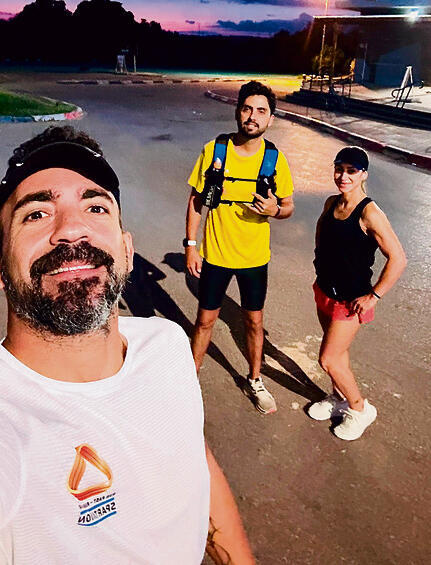
From left to right: Ram Hayon, Kobi Pariente and Naomi Sheetrit Azulay on October 7, moments before getting ambushed by Hamas terrorists
My struggle with post-trauma and depression is an endless journey of learning. Sometimes there is an idea that the path is like a “sharp upward curve,” as if there is a moment when you “recover” and move on.
But in reality, it is not a curve. It is circles and waves. This is a state that joins me for life, and in order to continue, I must learn how to live with it in a certain way.
The improvement, the progress, is not in the disappearance of depression or trauma, but in learning how to live alongside them.
And even when I understand this deeply, it is still very hard to live it. I stopped standing with a stopwatch, asking when it will end. This understanding gives legitimacy to the fact that difficulty can also appear during happy or calmer periods.
If there is one thing that is harder for me than anything else, it is transparency. How much energy is poured every day into projecting “business as usual”?
The struggle is double. Facing the inner storm, and facing the deep need not to be seen as needy or as someone asking for help.
There is a fear that the terrible inflation of trauma and disaster has created a devaluation of personal suffering.
This feeling is accompanied by a profound self-blame: When you know there are hostages who returned from captivity, families who lost loved ones, how dare I suffer?
This guilt is a destructive mechanism whose purpose is to convince me that I am not entitled to recognition of my pain, and that anyone who did not experience this exact kind of darkness will never truly understand the loneliness.
And yet, even within this constant battle, there are insights. One of them is the understanding that suicidality is not necessarily an active thought of harming yourself, but rather a wide spectrum of feelings that damage your functioning and affect those around you.
The very recognition of how broad this spectrum is can be a kind of release. And now I return to the question: how am I a lighthouse? Maybe a lighthouse is not something that never goes out, but something that experiences the night deeply from within, and continues to shine.
If you are reading this, and you are in a similar place, know this: You are not alone. You must not face this alone. Reaching out is not a sign of weakness, it is the greatest form of courage.
And a final word to the people around us, to families and friends. You, our loved ones, are what holds us. Your light is our lighthouse. But part of our great difficulty is our fear for you. The fear that you will lose hope, that you will grow tired of the journey. That fear becomes another burden we carry.
We understand very well the difficulty and the worry you carry, and so I beg you: Please, please, please do not give up on us. So that we can continue to lean on you, you must protect your own strength. Hold on to whatever you need. Talk. Seek support. Only if you take care of yourselves will you be able to continue being our light.
The journey is long, winding and constantly being learned. But we are together. And for that, it is worth continuing to fight.
We Came to Embrace the Darkness is an annual project of the MOSHE Movement – Words that Make a Difference, whose purpose is to raise awareness for suicide prevention through the community.