


In early July 2026, an investigating judge from Iraq’s Central Anti-Corruption Criminal Court monitored an asset recovery operation in Tikrit that exposed the financial plumbing of regional instability. Security forces extracted bundles of mud-stained canvas bags from a local storm drain, uncovering ten point seven million dollars in physical American currency. This discovery followed a raid that uncovered twenty million dollars packed into plastic water bottles alongside five kilograms of gold jewelry. Iraqi state television has broadcast these striking images of confiscated currency, small arms, and provincial property deeds, transforming a judicial investigation into a highly publicized political event. State prosecutors have tied these assets directly to Adnan al-Jumaili, a former deputy oil minister arrested for receiving illicit kickbacks from state contracts.
While Baghdad frames these moves as an independent crusade for internal accountability, the situation reflects a complicated intersection of domestic political survival, regional national security, and international financial pressure applied by Washington to disrupt the funding pipelines of Tehran's regional proxies across the Middle East region today explicitly.
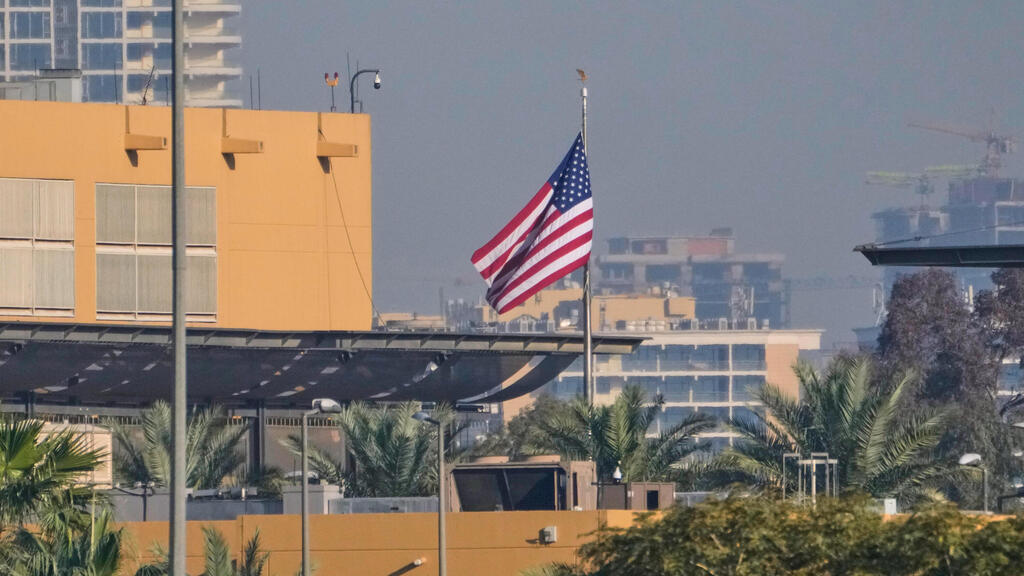
US Embassy in Baghdad, Iraq
(Photo: AP Photo/Hadi Mizban)
The Green Zone domino effect
The investigation centered on Jumaili quickly transformed into a broader institutional purge that rippled through the upper echelons of the Iraqi bureaucracy. Security forces executed a series of synchronized raids across Baghdad’s fortified Green Zone and adjacent commercial districts, arresting dozens of senior bureaucrats, municipal lawmakers, and prominent private contractors. Among those currently held in custody is Ali Maarij, another deputy oil minister whose administrative control over Iraq’s vital hydrocarbon infrastructure was previously considered insulated from political interference. The Supreme Judicial Council recently announced that total asset recoveries from this specific network have surpassed one hundred and twenty million dollars in physical cash, alongside significant quantities of gold bullion, small arms, and approximately forty separate luxury properties distributed across prime real estate sectors in Baghdad, Salah al-Din, and Erbil. While the government has touted these seizures as a historic breakthrough, independent analysts note the importance of contextualizing the scale of this operation within Iraq's broader history of endemic graft. While a one hundred and twenty-million-dollar cash recovery is substantial for a single enforcement action, it represents a modest fraction of the billions in capital flight the country has suffered over the past two decades from systemic political theft by entrenched elites operating across multiple successive governing administrations in the capital city of Baghdad.
Domestic cleavages and political skepticism
Skeptics point out that this purge pales in comparison to massive systemic scandals such as the infamous corruption case widely known as the Heist of the Century, where an estimated two point five billion dollars was siphoned directly from the General Commission for Taxes through fraudulent check schemes. Consequently, the current campaign is viewed by some critics not as an absolute dismantling of corruption, but as a targeted strike against a specific economic network closely tied to non-state actors. At the center of this dangerous political maneuvering is Prime Minister Ali al-Zaidi. Taking office as an independent compromise candidate, the forty-one-year-old businessman entered the premiership with a critical political asset, specifically that he lacks direct, historic ties to the established paramilitary factions that restricted the policy options of his predecessors. Zaidi has sought to capitalize on this independence by introducing a comprehensive whistleblower reward system and granting broader operational latitude to anti-graft investigators. However, this aggressive approach has drawn sharp criticism from Iranian-aligned political blocks within the Coordination Framework. These factions argue that the Prime Minister's anti-corruption campaign is not an objective defense of state resources, but rather a weaponized, politically motivated purge designed to marginalize specific groups and weaken their economic influence ahead of future electoral contests. They claim the judiciary is being selectively deployed to fulfill external mandates rather than serving domestic judicial equity, maintaining that Zaidi’s administration is bending to Western demands at the expense of Iraqi national cohesion today explicitly.
The mechanics of the dollar freeze
To understand the sudden velocity of the current campaign, the domestic momentum in Baghdad must be linked to financial decisions enacted thousands of miles away in Washington and New York. The enforcement drive intensified significantly following a sharp uptick in regional security friction earlier this year. After the major escalation involving Israel, the United States, and Iran, certain local militias in Iraq launched a series of rocket and drone strikes targeting Western installations and regional transit corridors, threatening to draw Iraq directly into a broader multi-front conflict. In response, the United States chose to leverage Iraq’s unique financial dependencies rather than relying solely on conventional military deterrence. Under a bilateral regulatory framework established after the 2003 invasion, Iraq’s international oil revenues are deposited into a secure account held at the Federal Reserve Bank of New York. The Central Bank of Iraq regularly draws down these reserves by requesting physical shipments of hundred-dollar bills, flying millions in cash to Baghdad to maintain liquidity within its cash-reliant domestic marketplace. Citing intelligence that these physical funds were leaking into the hands of sanctioned Iranian entities and hostile regional armed groups, Washington enacted a four-month suspension of approximately five hundred million dollars in scheduled currency deliveries. This financial intervention created immediate structural anxieties within the political elite, as the sudden dollar shortage threatened to depress the value of the dinar and widen the parallel exchange market spread. American policymakers conditioned resumption on rigorous, transparent central bank financial audits.
Paramilitary patronage and institutional durability
The physical currency shipments were restored shortly after Baghdad executed its high-profile arrests and offered comprehensive transparency guarantees to international monitoring agencies. Washington’s restrictions acted as an irresistible accelerant, forcing the Iraqi judiciary to target systemic graft that historically functioned as the primary economic engine for non-state armed groups linked directly to Iran’s Islamic Revolutionary Guard Corps. Factional banking entities routinely used the Central Bank's foreign currency sale window, submitting highly fraudulent import documents to purchase heavily discounted government dollars, which were then smuggled across regional borders to fund militant activities. While Western policymakers view the disruption of this pipeline as a crucial victory for regional stability, pro-Iran political entities contest this narrative, labeling the audits as imperial overreach designed to force Baghdad into alignment with a pro-Western geopolitical agenda that suppresses the axis of resistance. Prime Minister Zaidi has actively attempted to leverage this momentum by issuing a strict disarmament ultimatum to irregular militias, establishing a strict late September cut-off date that aligns with the planned scale-back of international military personnel. The ultimate test will occur when acute temporary currency crises fade and these institutional systems must operate independently. Achieving sustainable success will require moving permanently beyond selective enforcement toward objective oversight, ensuring that transparent institutional governance can shield the domestic economy from parallel administrative networks and withstand shifting regional realignments over this decade as Iraq seeks independence.
- Amine Ayoub, a fellow at the Middle East Forum, is a policy analyst and writer based in Morocco. Follow him on X: @amineayoubx