


The catastrophic failure of October 7, 2023, delivered a final verdict on the strategic doctrine that guided Israeli national security for two decades. The strategy known as mowing the grass rested on a comfortable illusion. It assumed that hostile armed groups along the borders, principally Hamas in Gaza and Hezbollah in Lebanon, could be indefinitely contained through periodic air campaigns, high-tech border barriers, and economic incentives.
Policymakers convinced themselves that complete victory was unnecessary and that managed quiet could be bought in installments. October 7 shattered that belief forever. It proved that containment against deeply ideological armies is a dangerous fantasy, and that allowing hostile forces to build war infrastructure on a nation's doorstep guarantees that the next disaster will strike at a time and place of the enemy's choosing.
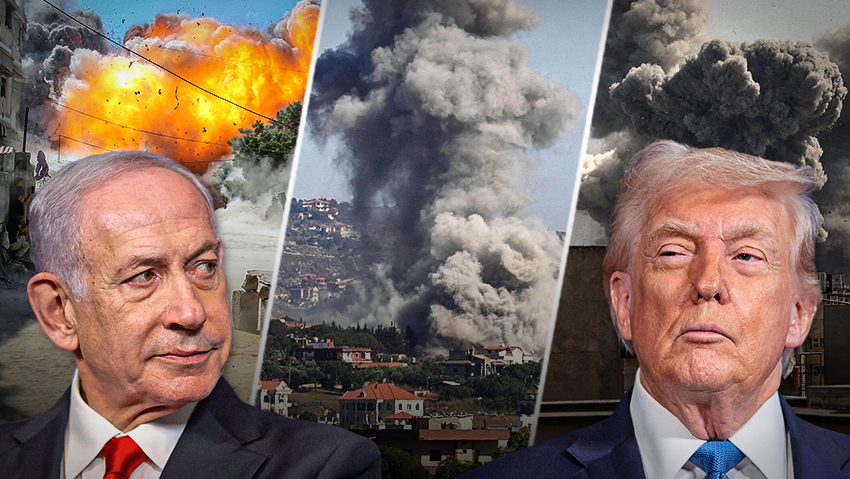
(Photo: Ahmad Hasaballah/REUTERS, Stringer/Getty Images, Majid Asgaripour/WANA via REUTERS, JOE RAEDLE/AFP, REUTERS/Jonathan Ernst)
Moving beyond this failed approach requires a clear, realistic definition of victory. Skeptics often argue that total victory is impossible because no army can destroy an ideology with bullets. That argument confuses a political mindset with an organized war machine. Military force cannot erase an abstract belief from human minds, and it does not need to. The true goal of military action is much more practical: stripping an enemy of its physical capability to wage war. Decisive victory means systematically destroying organized battalion-level formations, flattening weapons factories, eliminating command centers, and cutting off supply corridors. Crucially, it requires establishing permanent security buffer zones and maintaining total freedom of military action to strike whenever an enemy tries to rebuild. It is not about converting minds; it is about permanently taking away the weapons.
Achieving this military finality is not just an operational necessity, but a race against time. Israel currently operates within a favorable political window under the administration of President Donald Trump. This alignment provides vital advantages in Washington, including robust military resupply, diplomatic protection at the United Nations, and significant room to maneuver on the battlefield.
However, treating American support as an endless blank check ignores the realities of alliance politics. Even under a friendly White House, real frictions regularly emerge. Washington operates on a global chessboard with its own competing priorities, from preventing wider regional conflict to keeping shipping lanes open and energy markets stable. These competing interests produce constant pressure over operational timelines, humanitarian aid corridors, and diplomatic compromises. Current American backing is a powerful tool, but it is neither frictionless nor guaranteed to last forever.
The more significant strategic challenge lies in the deep political shifts taking place across the broader American political landscape. Over the past decade, progressive movements have reshaped internal debates within the Democratic Party. Key progressive platforms explicitly endorse the Boycott, Divestment, and Sanctions movement, advocate for ending military aid, and openly challenge the legitimacy of the Jewish state.
This political shift does not mean American support will vanish overnight. Deep institutional ties, persistent bipartisan support among senior national security officials, and a long-standing commitment to Israel's Qualitative Military Edge remain strong stabilizing forces. Furthermore, the realities of governing a country often temper the radical rhetoric heard during primary campaigns. Yet the direction of travel is unmistakable. Primary election results, shifting youth demographics, and rising political figures point toward a plausible future where an American administration or Congress could condition weapons resupply, restrict intelligence sharing, or demand immediate halts during active operations. Leaving dangerous threats intact on the borders now risks a future where Israel must face those same threats with its hands tied by Washington.
Critics frequently argue that continuing high-intensity operations will permanently destroy the Abraham Accords and freeze broader regional integration. This argument misunderstands why those historical peace agreements happened in the first place. Sovereign Arab capitals did not sign the Abraham Accords out of sentimentality or affection. They signed them based on cold, calculated self-interest: a shared fear of Iranian aggression, access to high-technology sectors, and respect for Israeli military power.
While heavy fighting creates genuine public outrage across the Arab world and forces governments to pause visible diplomatic ceremonies, leaving radical proxy networks intact poses a far greater long-term danger to those same Arab regimes. Governments in regional capitals view radical non-state movements as direct threats to their own internal stability. If Iranian-backed proxies survive and claim victory, it sends a clear message that Israel cannot serve as a reliable security anchor. Conversely, an Israel that decisively neutralizes these groups proves its hard power, ultimately reinforcing the core rationale for long-term regional cooperation and opening the door to future normalization with key partners like Saudi Arabia.
A convincing case for decisive victory must also confront its strongest objections directly rather than brushing them aside.
The first major concern is the heavy strain on domestic cohesion and the national economy. Prolonged mobilization places a painful burden on citizens, reserve forces, and commercial life. Yet the alternative policy of endless conflict management offers no real economic or social relief. It guarantees permanent volatility, sudden security crises, and repeated call-ups every few years when the next escalation inevitably arrives. A concentrated, finite exertion to eliminate a threat once and for all brings far greater long-term stability than living in perpetual insecurity.
The second objection is the fear that enemies will simply reconstitute the moment primary fighting stops. In reality, armed groups rebuild when military forces pull out completely and relinquish operational control. Sustaining active security buffers, maintaining constant intelligence coverage, and reserving the right to act immediately whenever threat signals appear prevents small insurgent remnants from ever growing back into organized, battalion-level strike forces.
The third challenge involves international isolation and legal pressure in global tribunals. Diplomatic friction and international criticism carry real costs that cannot be ignored. However, international standing ultimately rests on physical survival and demonstrated strength. The temporary political heat of a decisive military campaign is far more manageable than the permanent nightmare of living alongside intact rocket arsenals and elite cross-border invasion units.
Finally, there is the question of strategic focus and resources. Investing massive national energy into conventional warfare leaves fewer resources for diplomacy or technological development. Yet high-tech tools and diplomatic channels are useless if physical borders can be overrun by enemy forces. Basic physical security is the mandatory foundation upon which all other national capabilities depend.
These uncertainties do not weaken the argument for decisive action; they make it urgent. Israel has a clear, time-bound opportunity to establish a firm operational standard for success: the full deconstruction of hostile organized formations on its borders, the creation of enforceable security perimeters, and the locking in of permanent active intervention rights.
Failing to complete this task while the current strategic window remains open leaves a dangerous legacy. It means leaving capable, hostile armies on the doorstep at a future moment when diplomatic cover in Washington may be far harder to secure and operational freedom is strictly curtailed. Strategic wisdom demands finishing the job on the battlefield before the political clock runs out in Washington.
Amine Ayoub, a fellow at the Middle East Forum, is a policy analyst and writer based in Morocco. Follow him on X: @amineayoubx