


The Supreme Court is set to hear petitions seeking the removal of National Security Minister Itamar Ben-Gvir, after court President Isaac Amit ordered that the case be heard by an expanded panel of the court’s most senior justices — a move widely interpreted as signaling that the judiciary intends to address the matter in depth.
The court said the five-justice panel will include Amit, Deputy President Noam Sohlberg and Justices Dafna Barak-Erez, Yael Willner and Ofer Grosskopf. The hearing is scheduled for March 24.
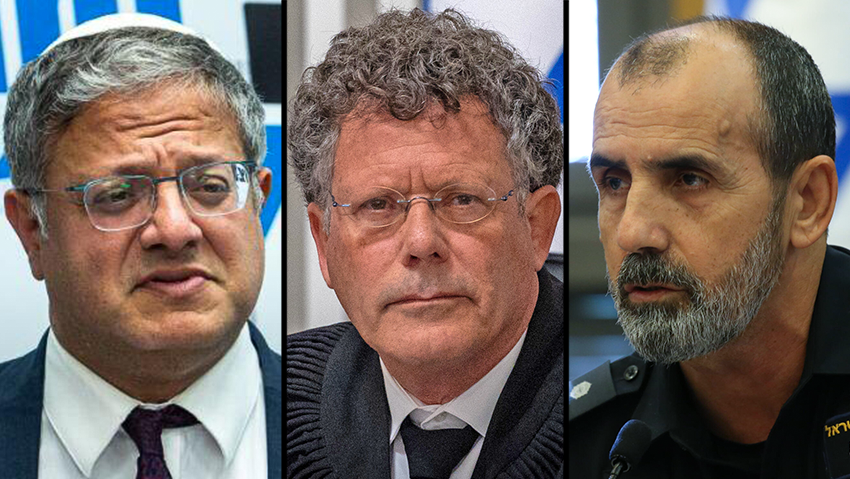
(Photo: Shalev Shalom, Oren Ben Hakoon, Amit Shabi)
The petitions ask the High Court of Justice to order Ben-Gvir’s removal from his post, citing allegations that he has improperly intervened in police operations and undermined the independence of law enforcement since taking office. Ben-Gvir, a far-right politician, has denied any wrongdoing.
Legal observers say the decision to convene a senior and expanded panel reflects the court’s view that the case raises issues of exceptional public importance, with potential implications for the relationship between elected officials and professional law enforcement bodies.
Allegations of political interference
According to the petitions, Ben-Gvir has exercised excessive influence over police decision-making, effectively acting above the police commissioner and intervening in operational matters, including the handling of demonstrations and internal personnel decisions. Critics argue that such conduct risks politicizing the police and weakening their ability to enforce the law impartially.
The court has not ruled on the substance of the claims. However, the composition of the panel is seen as an indication that the justices view the case as having broader consequences beyond the question of one minister’s conduct.
Ben-Gvir has previously pledged to refrain from interfering in police operations, assurances he provided to the prime minister, the attorney general and the court. Petitioners argue those commitments have not been upheld.
Tensions within the police
The case comes amid growing concern over internal strains within the police force. While the investigations division has remained formally independent, critics say the advancement of several senior officers has been delayed or blocked. Among those referenced in recent court proceedings was a senior officer who previously participated in investigations involving the prime minister.
Earlier this week, testimony by a senior police officer in a Jerusalem court describing threats and pressure directed at law enforcement officials drew public attention and renewed scrutiny of the relationship between political leaders and police commanders.
Police Commissioner Danny Levy has approved some promotions but has largely avoided public confrontation with the minister, a dynamic that critics say reflects a broader leadership vacuum at the top of the force.
Broader implications
Legal analysts say the court’s deliberations are expected to go beyond the personal conduct of Ben-Gvir and address whether political intervention in policing could set a precedent for other ministers overseeing law enforcement and regulatory agencies.
The justices are also expected to consider the limits of judicial authority. Under established precedent, ministers are typically removed only after criminal indictments. Petitioners argue that the current case is exceptional because of the alleged ongoing damage to democratic norms and the rule of law.
The expanded panel’s move is also seen as placing pressure on the prime minister, who has the authority to reassign ministerial portfolios. While the government has argued that the court lacks the power to dismiss a minister in the absence of an indictment, petitioners are asking the court to consider ordering Ben-Gvir’s removal from the national security portfolio rather than from the government entirely.
Timing and public interest
The case unfolds amid heightened political tensions and with future elections on the horizon, a period during which police neutrality during campaigning and on election day is viewed as critical. The Supreme Court has repeatedly emphasized the importance of a professional, independent police force that enforces the law without regard to political affiliation.
Government supporters have accused the judiciary of overreach, while backers of the petitions argue the court is fulfilling its role in protecting the public interest and safeguarding democratic institutions.
The court has not indicated when it will issue a ruling following the March hearing.